Indonesian rupiah falls to record low against US dollar
The unit broke the psychological 18,000 barrier against the greenback.
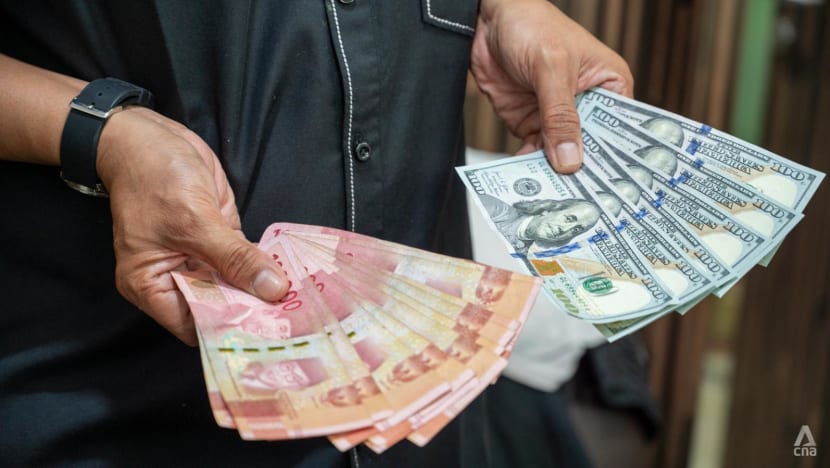
An officer displays US dollars and Indonesian rupiah banknotes at a foreign currency exchange outlet in Jakarta. (Photo: CNA/Ridhwan Siregar)
JAKARTA: Indonesia's rupiah hit more than 18,000 per dollar for the first time Thursday (Jun 4) as the country is stung by surging energy costs, while lawmakers passed a Bill expanding oversight of the central bank that raised concerns over its independence.
Bank Indonesia has moved to bolster the currency, which has been hammered amid mounting concerns about the state of Southeast Asia's biggest economy.
But on Thursday, the unit broke the psychological 18,000 barrier against the greenback. The country's stock market sank nearly 4 per cent and has lost a third of its value in 2026.
Parliament, meanwhile, gave the green light to a legislative amendment expanding the central bank's mandate to include responsibility for economic growth.





It also allows lawmakers to evaluate Bank Indonesia's performance.
The new parliamentary oversight will also apply to the Indonesia Deposit Insurance Corporation (LPS), tasked with guaranteeing bank deposits and ensuring banking system stability, and the Financial Services Authority (OJK) financial regulator.
Finance Minister Purbaya Yudhi Sadewa said Wednesday the legislative amendment was aimed at boosting economic growth and enhancing global competitiveness as Indonesia's economy grapples with a spike in global oil prices.
"It's not just about exchange rate stability, or just about inflation. It's also about paying attention to economic growth and creating jobs," he said.
Economist Yose Rizal Damuri, of the Centre for Strategic and International Studies (CSIS), said the move raised the "question of independence", especially if parliamentary intervention becomes "routine".
"If independence is perceived to be weakening, the risk could trigger an increase in risk premiums and put pressure on financial markets," added Central Bank Asia chief economist David Sumual.
Members of the public viewed the rupiah weakening with alarm.
"It will create inequality, a visible gap between those earning dollars and those earning rupiah," pensioner Diana Murdiana, 60, told AFP in the capital.

For government employee Ryandi Febri Nurcahyo, 35, government assurances were wearing thin.
"Our officials keep saying that our economic fundamentals are strong ... Are they really that strong? This rise in the dollar affects people from the lower-income level to the middle class. Maybe it does not have much impact on those at the top," he said.
"COSTLY POPULIST PROGRAMMES"
The rupiah has tumbled more than 7 per cent this year and has been Asia's worst-performing currency, according to Bloomberg News, as the US-Israel war on Iran sent global oil prices surging.
Permata Bank chief economist Josua Pardede said an exchange rate of 18,000 was a "psychological threshold" for market investors.
The weakening, he told AFP, was fuelled by high dollar demand caused by the surge in oil prices and a narrowing trade surplus.
Indonesia is a net oil importer and has been battered by high crude costs, yet the government has insisted on leaving heavily subsidised fuel prices unchanged.
The country's trade surplus narrowed to just US$89 million in April, from US$3.3 billion a month before, further reducing dollar supply, Josua said.
At the same time, "dollar needs for energy imports, raw materials, dividends, foreign debt payments and seasonality needs remain significant", he told AFP Wednesday.
The central bank hiked its lending rate by 0.5 basis points to 5.25 per cent last month - the first increase in two years - as it looked to stabilise the rupiah and keep inflation in check.
It has also tightened rules for dollar purchases, but has been unable to halt the exchange rate rout.
Teuku Riefky, a University of Indonesia economist, said the rupiah was reacting not only to the economic fallout of the Middle East war, but also "various costly populist programmes" including the government's multi-billion dollar school feeding scheme.
There was also flagging confidence among investors in Jakarta's ability to repay its debts.
"If this continues, the impact will be sustained inflation due to rising production and raw material costs," Teuku told AFP.
Further fuelling investor concerns, President Prabowo Subianto last month announced commodity export controls that set markets aflutter amid concerns over "resource nationalism" in the world's largest palm oil producer.