Middle East conflict forces Southeast Asia’s pivot to travellers from the region, but gaps remain
Countries like Malaysia, Indonesia and Thailand are recalibrating their tourism strategies, while tour operators have ramped up intra-Asia offerings as airspace restrictions and rising costs weaken long-haul demand.
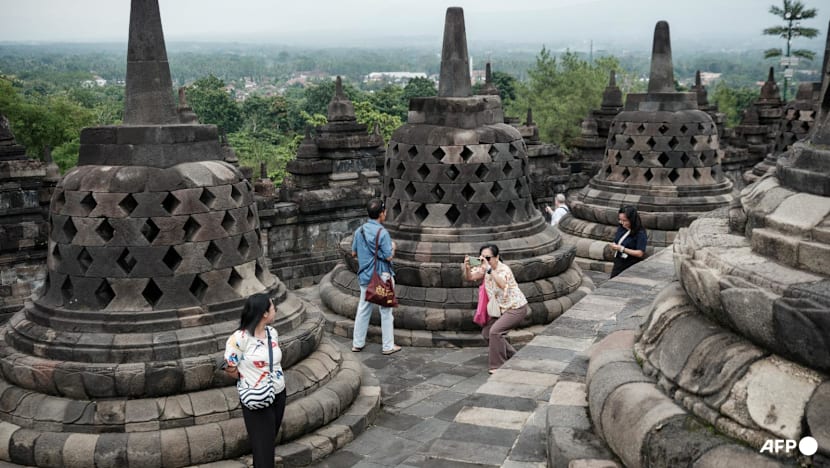
Tourists at the Borobudur Temple in Central Java on Jan 31, 2025. The Middle East conflict has changed how people travel, experts say. (File Photo: AFP/Yasuyoshi Chiba)

This audio is generated by an AI tool.




SINGAPORE: When bookings for trips to the Middle East began to drop sharply in March – following the United States and Israel’s strikes on Iran from Feb 28 – Malaysian tour operator IBC Tours & Travel quickly rolled out 32 new packages focused on Southeast Asia and destinations closer to home.
“About 80 per cent of our business was affected in early March … we now offer travel alternatives that do not involve transiting through the Middle East,” said its managing director Mohammad Rizal.
He is among the tourism players in Southeast Asia that have scrambled to adapt as tens of thousands of flights globally were cancelled or rerouted.
Airspace closures and restrictions, as well as fuel shortages, have disrupted popular routes that traditionally transit through major aviation hubs like Dubai and Doha. This has reshaped how people travel.
Countries like Malaysia, Indonesia and Thailand are recalibrating their tourism strategies to make up for the loss of longer-haul inbound travellers from regions like Europe and the Middle East, while outbound tour operators in the region are ramping up intra-Asia offerings.
These recalibrations will not be seamless due to some Southeast Asian countries’ longstanding focus on Western tourists, and the different travel patterns of shorter-haul travellers, observers say.
While it remains to be seen if the recalibration will continue when Middle East tensions dial down, the good news is that appetite for travel appears robust.





GOVERNMENTS, INDUSTRY PIVOT TO SHORT-HAUL TRAVELLERS
Since the Middle East conflict started, Asian countries have seen visitor arrivals from longer-haul markets decline.
Short-haul markets generally refer to those that are up to a three-hour flight away, while long-haul markets are over a six-hour flight away, with the medium-haul segment falling in between.
“Bookings (from the Middle East) are totally zero, and they postpone their trip until the end of the year. But … we still don't know when they will come back, because the problem now is the war is very uncertain,” said Mint Leong, president of the Malaysia Inbound Tourism Association. This is despite overall arrivals in March still being “very positive”.
In Thailand, Pullman Phuket Panwa Beach Resort marketing and communication director Pimpisa Sukapasert said Middle East travellers have declined by 30 to 50 per cent since the start of the war, while data from early March shows “sharp declines” from Germany, Russia, the United Kingdom, France and Israel.
Long-haul travel has become less predictable due to airspace disruptions, higher fuel costs and traveller caution linked to the conflict, said Siamak Seyfi, an associate professor in tourism geography at Finland’s University of Oulu.
“Longer travel times and the increased likelihood of delays have made long-haul journeys less attractive,” Seyfi said.
“Regional markets such as Singapore, India, and China remain more stable (as destinations), and price-sensitive travellers are more willing to take short trips,” he said, adding that this was the case during the COVID-19 pandemic, when countries reliant on long-haul markets struggled to recover.
In addition to the disruption to Gulf hub connectivity, airfares on some European routes have risen by close to 100 per cent, prompting a “very understandable” shift towards shorter, more predictable journeys, said tourism consultant Nisha Abu Bakar, founder of World Women Tourism.
“Those three forces are pointing demand toward intra-Asian travel and destinations are responding accordingly,” she said.
Although overall arrival numbers are holding up, some tourism authorities in the region have signalled a rough few months ahead.
At Singapore’s Tourism Industry Conference 2026 on May 8, Singapore Tourism Board (STB) chief executive Melissa Ow cautioned that travel demand is expected to be muted in the coming months due to the conflict.
"Our tourism businesses are under strain from the crisis and the global uncertainty that persists," Ow said.
Regional travel to Singapore has remained stable, with international arrivals rising 10 per cent year-on-year in March, driven by strong growth from Asian markets including Indonesia, China and Malaysia, with increases of 23 per cent, 12 per cent and 27 per cent respectively, STB assistant chief executive Oliver Chong told CNA.
“We are thus working closely with our tourism partners to adapt to evolving market conditions and roll out campaigns at the appropriate timings across all source markets,” Chong said.


Government agency Tourism Malaysia said arrivals from West Asia have fallen by 27.2 per cent since the war, while arrivals from Africa fell 8.4 per cent.
On Mar 31, Malaysia’s Ministry of Tourism, Arts and Culture (MOTAC) announced it would prioritise “high-performing” and “stable” tourism markets in Asia, including China, Indonesia, Thailand, Japan, South Korea, India, Bangladesh and Vietnam, amid geopolitical developments.
It announced expanded routes set to begin in October, including AirAsia flights from Phuket to Penang, Batik Air flights from Banda Aceh to Kuala Lumpur, and Chongqing Airlines flights from Chongqing to Kota Kinabalu.
Asked about the October timeline for these flights, Tourism Malaysia told CNA the schedule is preliminary and intended to guide preparations.
Malaysia has recorded “encouraging progress” in tourism performance since its pivot, Tourism Malaysia told CNA.
Visitors from Southeast Asia remained Malaysia’s primary market and accounted for about 70 per cent of arrivals between January and March this year. Malaysia is targeting 47 million international visitor arrivals in 2026.
“By prioritising the broader Asia-Pacific region, including second- and third-tier cities, we are stable in growth as Malaysia recorded 3.43 million visitors in March 2026 in comparison to 3.37 million the previous year,” it said.
“This reflects the inherent strength of short-haul travel, which tends to recover faster due to accessibility and traveller confidence,” it added.
MOTAC minister Tiong King Sing on Mar 31 also said the ministry is monitoring airfare trends, flight frequencies and overall air connectivity, with Tourism Malaysia instructed to provide daily reports on international arrivals and market movements.
Indonesia has made a similar push, prioritising Southeast Asian markets such as Malaysia and Singapore, alongside East Asia and Oceania markets for China, South Korea, Australia and New Zealand.
"These markets are closer (to Indonesia), do not require transit through the Middle East and are relatively unaffected by significant ticket price increases," said the tourism ministry’s marketing deputy Ni Made Ayu Marthini on Apr 24.
Indonesia’s foreign tourist arrivals from January to March this year reached 3.44 million, which marked the “highest achievement since 2020”. Malaysia remained its largest source of visitors.
But March tourist arrivals from the Middle East fell 9.51 per cent year-on-year, while European visitors fell 8.5 per cent, according to Indonesia's tourism ministry data, as reported by The Jakarta Post on May 11.

In Thailand, authorities previously told CNA the country is targeting shorter-haul markets such as China, Malaysia and India.
Its Chinese arrivals rose 38 per cent year-on-year in March 2026. In April, Thailand recorded the strongest on-year growth from the Chinese market at about 32 per cent, reported local news outlet Bangkok Post.
In contrast, overall foreign arrivals to Thailand fell 3.45 per cent in the first four months of 2026 compared to the same period in 2025, with three of its top five markets, including Malaysia and the UK, declining 11 to 23 per cent in April due to the war, said its Tourism and Sports Ministry.
Tourism authority governor Thapanee Kiatphaibool said the tourism industry is likely to face a prolonged impact from the conflict, as higher airfares and limited seat capacity affect short-term travel plans, reported Bangkok Post.
Recent recovery of global tourism and Thailand’s pivot to regional markets has helped rebound visitor numbers, the Tourism Authority of Thailand (TAT) told CNA.
Between Jan 1 and May 5, Indian visitors to Thailand saw a near 10 per cent increase compared to the same period last year, while visitors from Myanmar and the Philippines increased about 25 per cent and 3.8 per cent, respectively.
Vietnam and the Philippines have not announced a tourism push for Asian markets, but regional industry players told CNA they are also likely to focus more on short-haul travellers from the region.


REVENUE GAP, COMPETING FOR THE SAME MARKETS
The pivot towards shorter-haul travellers is unlikely to be seamless or instantaneous, experts said.
The shift also reveals some structural vulnerabilities in Southeast Asia’s tourism model, they said.
“A European tourist might stay two weeks and spend on higher-end hotels, tours and shopping (in Southeast Asia) but a regional traveller from Singapore might come for a long weekend and spend less overall,” said Seyfi.
“So countries may report strong recovery in visitor numbers while still facing gaps in total income.”
Long-haul markets now account for only about one-third of Phuket’s tourist numbers but generate nearly half of the tourism revenue due to higher spending, said Pullman Phuket Panwa Beach Resort’s Sukapasert, who is also marketing director of the Phuket Tourism Association.
“Up to 600,000 visitors and 40 billion baht (US$1.23 billion) in revenue could be lost in Phuket if the conflict persists for (more than) eight weeks,” said Sukapasert.
In focusing on nearby markets, Phuket’s tourism operators are adjusting prices and offerings to attract more “mid-tier” travellers, added Sukapasert.

While intra-ASEAN and East Asian source markets have long featured in tourism authorities’ strategic plans, the industry remained overdependent on distant markets, said tourism consultant Nisha.
“What was absent was the urgency to restructure product design, pricing architecture and visitor experience around those markets (as) long-haul arrivals were simply too comfortable and too lucrative to displace,” she told CNA.
The Middle East conflict has removed the comfort, raising questions about whether the disruption will drive genuine structural investment or simply a reallocation of marketing budgets until European arrivals recover, she said.
The shift to regional markets “fundamentally changes revenue forecasting model, yield management approach and product development priorities”, she said.
Another challenge is the growing competition for the same pie, with countries like Malaysia, Thailand, Indonesia and Vietnam targeting similar groups, especially Chinese and Indian travellers.
“If multiple countries promote similar beach, shopping, and cultural experiences to the same markets, price competition becomes inevitable,” said Seyfi.
“When every national tourism organisation is simultaneously activating messaging that amounts to ‘we are safe, we are welcoming, we are affordable’, directed at the same Chinese, Indian and Korean consumers, there is a commoditisation problem,” Nisha agreed.
She also noted that visitor experiences - from signage, payment systems, guided content and service language - remain largely aimed at the Western long-haul visitors.
“Pivoting to Chinese, Indian, Indonesian or Korean travellers is not simply a matter of translating your brochure. It requires rethinking the entire visitor journey”, which will require time, investment and genuine cultural understanding, she said.
“It cannot be outsourced to a marketing agency.”


DESIRE TO TRAVEL REMAINS
Countries in the region are beginning to adopt differentiation strategies, experts noted.
Seyfi shared how Thailand has positioned itself strongly in wellness and medical tourism, while Malaysia has focused on Muslim-friendly travel.
Thailand is seeking to diversify its ASEAN tourism markets rather than rely on a single source market, through campaigns such as “Trusted Thailand” and “Value with Volume” aimed at attracting high-quality, repeat travellers, the TAT said.
Indian visitors will be targeted through “Wedding, Luxury and Celebration” segments to increase spending, while Myanmar visitors, known for their relatively long stay and familiarity with Thailand, will be targeted through “Health and Wellness” segments.
“Our strategy is not simply about replacing long-haul markets with regional arrivals. It is about achieving a more balanced, diversified, and higher-quality tourism ecosystem,” TAT added.
Malaysia recorded 9.7 million Muslim visitors out of a total 42.2 million arrivals in 2025, with the top three markets being Indonesia, Singapore and Brunei, reported local media.
Indonesia, meanwhile, has reaffirmed its commitment to diversify beyond Bali by promoting 10 other destinations, including Labuan Bajo, according to its Tourism Minister Widiyanti Putri Wardhana.
“These strategies help, but they require consistent quality and clear messaging. Without that, destinations fall back into competing mainly on price, which is not sustainable,” said Seyfi.
Nisha called for greater collaboration across Southeast Asia, describing the region as an “underutilised collective tourism brand”.
“Rather than 10 countries competing with near-identical propositions for the same traveller, there is a compelling case for collaborative destination marketing that positions Southeast Asia as a multi-country journey,” she said.
Looking ahead, experts say the shift towards regional markets is unlikely to replace long-haul travel, which “remains important for revenue generation”.
“What is more likely is a more balanced tourism strategy, as countries actively manage both segments instead of prioritising one over the other,” said Seyfi.
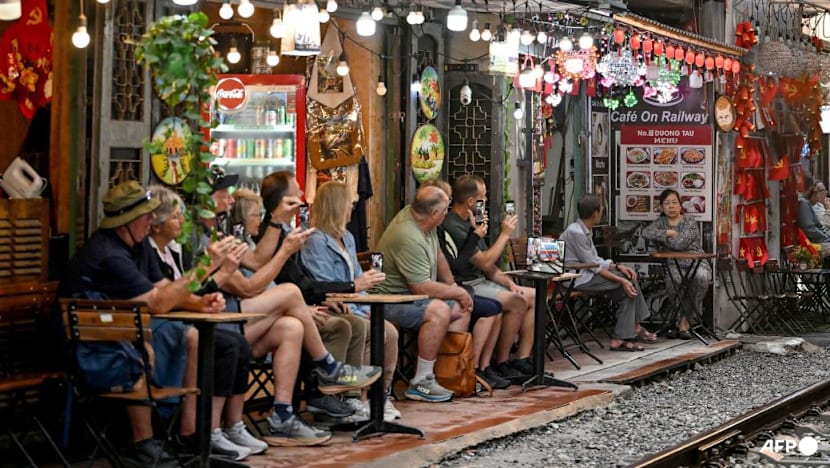
A bright spot is that the Middle East conflict has not appeared to dampen enthusiasm for travel.
“In most cases, they (the customers) are redirecting their plans towards destinations within Asia or other regions they perceive as more stable and safe,” said Mohamed Nafis Abdul Rahman, director of Singapore-based travel agency TravelConnect.sg.
Southeast Asian destinations, including Sabah, Penang, Ho Chi Minh City, Phu Quoc, Sapa, Hanoi, Lombok and Labuan Bajo, are among the agency’s more popular alternatives currently.
A Singaporean who only wanted to be known as Chan was planning to travel to Portugal over the summer, but is now looking at Indonesia or Japan instead.
“As of now, considering the price of flights as well as my other commitments, I would still like to travel, but most likely to countries within East or Southeast Asia for cost and peace of mind, " said the 42-year-old freelance lecturer.
Other travellers are forging ahead with longer-haul plans.
Monica Lawrence, 31, a research associate in Singapore, has decided to go ahead with a trip to Poland on May 24 despite the war.
“My partner's family lives in Poland (and) I was going to visit them for the summer, hence the decision to go ahead and not change destinations,” she explained. This was after considering having him fly to Singapore instead, or changing destinations to somewhere nearby, she added.
The only concession Lawrence made was switching airlines from Emirates to Turkish Airlines to avoid flying through the Gulf, which cost her an additional S$300 after getting an early refund.