analysis Asia
'Unrealistic' for Southeast Asia to meet Hegseth's defence spending demand amid Sino-US rivalry
Washington’s call for Asian allies to spend 3.5 per cent of GDP on defence is untenable given competing needs in infrastructure, healthcare and education, analysts say.
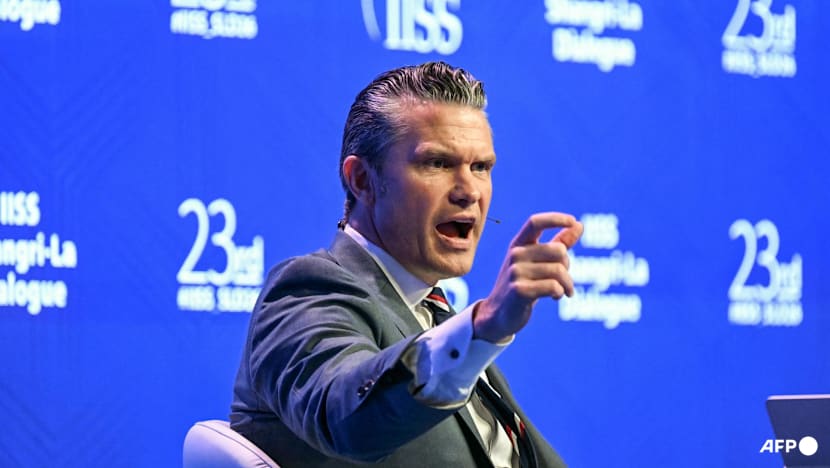
US Secretary of Defense Pete Hegseth speaks during a plenary session of the 23rd Shangri-La Dialogue summit in Singapore on May 30, 2026. (Photo: AFP/Jam Sta Rosa)

This audio is generated by an AI tool.


KUALA LUMPUR: It is "completely unrealistic" for Southeast Asian countries to heed the United States' call of boosting defence spending to counter China's growing power, analysts say, as the region prioritises domestic development while balancing ties with the two superpowers.
Economic pressures from the Iran war have tightened governments’ purse strings, the experts say, adding that Southeast Asian states could instead improve defence cooperation with middle powers and use multilateral platforms like the Association of Southeast Asian Nations (ASEAN) to navigate great power competition in the region.
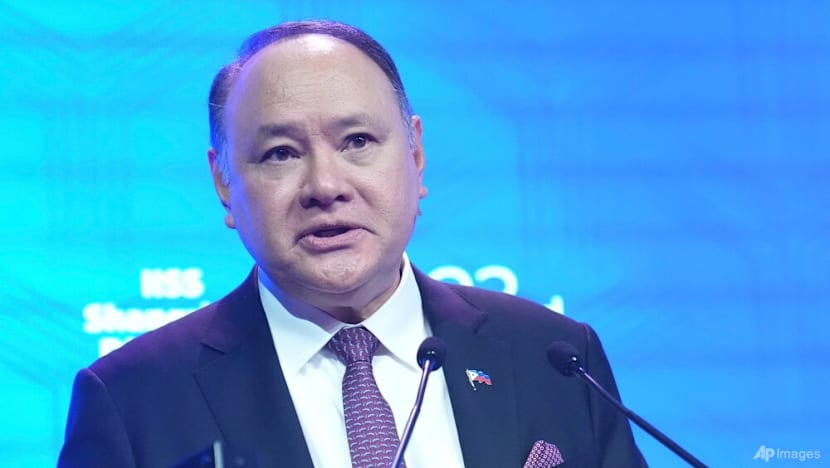
Last Saturday (May 30), US Secretary of Defense Pete Hegseth urged Asian allies to ramp up military spending to prevent China’s dominance in the region, warning of "rightful alarm" over its rapid military build-up.
The US expects its Asian allies and partners to increase defence spending to 3.5 per cent of gross domestic product (GDP), Hegseth said at the Shangri-La Dialogue in Singapore, known as Asia's premier forum for defence leaders, militaries and diplomats.





"Less Shangri-La, more ships, more subs," Hegseth said, stressing that the region needed greater defence capability than conferences.


Analysts told CNA that while the US could punish allies that fail to commit to higher defence spending by downgrading defence cooperation or complicating trade negotiations, Washington is unlikely to abandon the region given its need for critical minerals and military access.
Consistent US demands on defence spending could also produce an unintended effect of pushing some Southeast Asian states closer to China at a time when US presence in the region is already perceived as waning, the observers warned.
But they also said other ASEAN members will be wary of tilting towards Beijing given the latter's military build-up in the South China Sea.
China claims most of the strategic South China Sea, overlapping with claims by other ASEAN states including Brunei, Malaysia, the Philippines and Vietnam.
Joshua Kurlantzick, senior fellow for Southeast Asia and South Asia at Council on Foreign Relations - a US think tank - said US President Donald Trump's administration has "turned burden-sharing into the defining test of any alliance worth keeping".
"Delivering the same demand at the region's most important annual security forum was Washington's way of saying it isn't blinking - Asia is now facing the same issue that the White House is asking of Europe," he told CNA.
Trump has a long-standing demand that allies shoulder more defence costs and burden, singling out European and North Atlantic Treaty Organization (NATO) partners as needing to reduce their reliance on Washington.
But while some Asian states have increased defence spending, this is due to their "own desire" to improve defence capabilities in an increasingly contested region, said Kurlantzick, "not because the US is demanding it".
WHY 3.5 PER CENT IS UNREALISTIC
Among the 11 ASEAN members, Myanmar and Brunei have the largest defence spending proportions of GDP, at 6.6 per cent and 3.65 per cent respectively as of 2024, according to the Stockholm International Peace Research Institute.
Singapore’s defence expenditure was 3.05 per cent of its GDP in 2025.
Indonesia, which spent 1.04 per cent of its GDP on defence in 2025, has a long-term target of hitting 1.5 per cent, still far short of what the US is asking.
The Philippines has consistently increased defence spending since 2023, reaching 1.3 per cent of GDP in 2025, but has admitted it would be difficult to comply with the US demand.
Kurlantzick stressed that across much of Southeast Asia, defence spending competes directly with infrastructure, healthcare, education and poverty reduction.
“From those baselines, the distance to 3.5 per cent isn't just large - for most countries it represents a generational shift in national priorities,” he said.
“In countries like Indonesia, Cambodia and Laos, where per-capita incomes remain modest and development needs are still acute, a dramatic jump in military budgets is genuinely difficult to sell to the public.”
Abdul Rahman Yaacob, a senior fellow at Verve Research, an independent think tank covering Southeast Asian foreign policy and security affairs, said Trump’s threat of fresh tariffs and the Iran war will impact how countries spend.
“The current economic uncertainty will likely affect how regional governments allocate budget to defence,” he told CNA.
It is “completely unrealistic” for Southeast Asian countries to meet the US’ 3.5 per cent target, said Hunter Marston, director of the Southeast Asia Program at the Lowy Institute, an Australian think tank.
He argued that Washington has not been consistent in this policy across the region, pointing to how although the Philippines - a US treaty ally that is very concerned about China’s increasing assertiveness in the region - spends among the lowest on defence in ASEAN, Washington has not exactly put pressure on Manila.
“While Southeast Asian countries are anxious about US-China rivalry and China’s growing military power, what they spend on defence is reflective of their current perceptions of external threats as well as their own priorities at home,” Marston said.
THE CHINA FACTOR
And when it comes to China, not all Southeast Asian states might believe Beijing is a force that needs to be contained, said Muhammad Faizal Abdul Rahman, a research fellow at Singapore’s S Rajaratnam School of International Studies (RSIS).
“There is also the question of whether Asian countries fully share the US worldview, in which military spending primarily serves to counter China and maintain a balance of power advantageous to the US,” he told CNA.
“This also relates to the predictability of the US as an ally, China’s intentions, and how Asian countries that are neutral seek to maintain their neutrality.”
At the Shangri-La Dialogue, Hegseth insisted that the US military was not "turning our backs" on Asia while handling "global obligations" such as the Iran war.
"We can do two things at one time," he said, adding the US was working with allies on a "substantive, serious approach" to the Pacific while ensuring that “Iran doesn't get a nuclear weapon".
Hegseth said the US understood that its allies in Asia "do not seek constant escalation" and instead wanted a balance of power "in which no state, including China, can impose its hegemony".
Kurlantzick from the Council of Foreign Relations said that different ASEAN countries see China differently and their relations are “not in a straightforward way”.
Beijing's actions in the South China Sea have “genuinely alarmed the Philippines and Vietnam, giving those governments domestic cover for higher defence spending”, he said.
“But for most of ASEAN, China is not simply a threat to deter - it is the region's largest trading partner, a major source of investment, and a neighbour that will still be there long after any given US administration has come and gone.”
HOW US MIGHT FORCE ASEAN’S HAND
Still, Kurlantzick pointed out that Washington was clear in how it could deal with allies who were seen as defence "freeloaders", as alluded to by Hegseth, whose designation in the US is known as secretary of war.
“Allies who refuse to step up and carry their own weight for our collective defence will face a clear shift in how we do business,” Hegseth said.
Kurlantzick said Washington could downgrade defence cooperation, slow arms transfers, reduce intelligence sharing, or make trade talks harder for governments that do not show sufficient commitment to military spending.
Added Rahman from Verve research: “I would see the US pressing some countries on the diplomatic front to spend more on defence. But likely there will be pushback.”
For instance, Kurlantzick said it would be “counterproductive” for the US to punish the Philippines or Thailand - two countries navigating “genuine Chinese pressure” - for spending too little on defence.
“At precisely the moment Washington is asking Asian partners to invest more in collective defence, its trade and economic policy is steadily eroding the trust and goodwill that make those partnerships worth having in the first place,” he said.
“Beijing has wasted no time exploiting the opening, with Chinese leadership actively courting ASEAN nations and offering deeper economic integration as the stable, predictable alternative to an increasingly volatile Washington.”
Aisha Kusumasomantri, a defence researcher at the Jakarta-based Indo Pacific Strategic Intelligence think tank, said the US should try to “sway” Southeast Asian allies into supporting its burden-sharing policy instead of “antagonising” them.
“I think it is important for the US to think of the Asia-Pacific and Southeast Asia as a battleground for influence,” she told CNA, urging Washington not to impose increasingly punitive measures as Beijing steps up “excellent” public diplomacy in the region.
Lowy Institute’s Marston does not see the US walking away from the region anytime soon, pointing to Washington’s alliance with Manila as being “far too important” for US force projection in Asia.
“I think Southeast Asian countries have other assets that they bring to the table to preclude punishment by the US, including critical minerals and access for the US military in the case of Indonesia for example,” he said.
“I expect we’ll see more states seek to leverage comparative advantages in one sector to avoid US coercion or punishment in others.”
HOW SOUTHEAST ASIA COULD RESPOND
Despite China’s rise, the US remains a “consequential power” in the region, said RSIS’ Faizal.
“Countries that cannot meet US expectations on defence spending might seek to reassure the Americans by deepening bilateral cooperation in other aspects of defence or other non-military areas,” he said.
And as China watches ASEAN states navigate US demands, Faizal feels these countries would try to manage US-China pressures by deepening relations with middle powers such as Türkiye, India, Japan and Australia.
“The main goal of this is to manage the risk of being pressured by either the US or China,” he added.
With that said, Kurlantzick warned of a “real risk” that the US pressure produces an unintended effect: Driving smaller nations closer to the very country the US is trying to push them away from.
“Already, China's favourables in the region now top those of the US, and the Iran war has hurt US public opinion much more,” he said.

An annual survey by the ISEAS-Yusof Ishak Institute think tank, released in April, found that a slim majority of respondents across Southeast Asia would align with China over the US if forced to choose sides.
The results suggest that China continues to be seen as an “indispensable partner” whose influence is expected to “remain constructive or at least manageable”, the survey report said.
Yet the data also reveals “clear divergences” within ASEAN, it noted, citing the Philippines as a “notable outlier” with a majority of the country’s respondents foreseeing relations “worsening or worsening significantly” amid ongoing frictions in the South China Sea.
Rahman from Verve Research said he does not see ASEAN countries moving closer to China as a result of the US demands.
“This is because some have overlapping maritime claims with China,” he said.
Aisha from Indo Pacific Strategic Intelligence said China’s grey zone tactics in the South China Sea - used to describe coercive actions that fall below the threshold of conventional warfare - would have been “alarming” for ASEAN states.
“So, I don't think those countries will actually shift and lean towards China because the US is retracting. I think what is happening is that those countries will find another mechanism in order to actually navigate the situation,” she added.
“I do believe that organisations like ASEAN play a pivotal role in keeping the balance between these great powers in the region.”