'Not wise' to have two AI ecosystems, US and China can cooperate and compete: Nvidia CEO Jensen Huang
In a wide-ranging interview with CNA's Victoria Jen, Mr Huang also talked about partnerships in Taiwan and competition between the US and China.
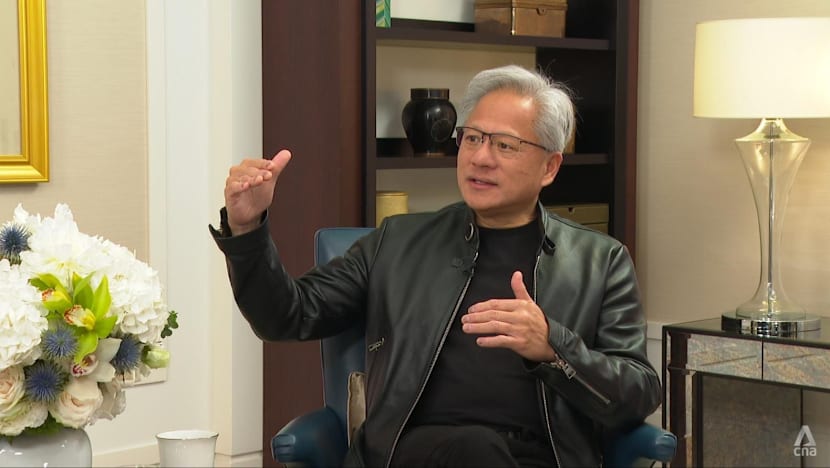
NVIDIA CEO Jensen Huang speaking to CNA in Taiwan on May 25, 2026.

This audio is generated by an AI tool.




It would not be wise to have two distinct artificial intelligence ecosystems created by the US and China, said Nvidia CEO Jensen Huang on Monday (May 25).
In a wide-ranging interview with CNA's Victoria Jen, Mr Huang said that China and the United States should cooperate rather than compete in AI, and that it is possible to do both.
He pointed out that AI has an "incredible potential for good", but can also be used in ways that could bring harm.
"The more that all the leaders work together, cooperate together to advance this technology in harmony and for good, the better it will be for the future," Mr Huang said.





"I work with so many competitors today. They're competitors of mine, but also compete with them on the one hand, and we cooperate greatly on the other hand.
"Because we want what's in the best interest of the industry, we want what's in the best interest of the market and want what's in the best interest of our society, and so therefore, cooperating ensures that harmonious advance."
PARTNERSHIPS IN TAIWAN
Mr Huang was born in Taiwan before migrating to the United States when he was nine.
He co-founded California-based Nvidia in 1993. Last year, it became the first company to breach US$5 trillion in market value, continuing a meteoric rise that has firmly positioned it at the heart of the global AI revolution.
Mr Huang said that no region is better prepared for the continued growth of AI than Taiwan.
"Taiwan has the letters AI in it, and so AI is at the centre of Taiwan. The companies on this island are incredible, as you know. The companies are at the epicentre of the possibility of AI, and the growth of AI, the advancement of AI," he said.
In the interview with CNA, Mr Huang also spoke highly of Mr Morris Chang, the founder of Taiwan Semiconductor Manufacturing Company, which is the world's largest contract chipmaker.
"Without TSMC and Morris, Nvidia wouldn't be here today. And it was the support and the friendship and the risk that they had taken back in the old days when we were quite small," Mr Huang said.
"All of our journey and all of our history are highly intertwined."
Earlier this year, it was reported in Taiwanese media that Nvidia had signed an agreement with the Taipei City authorities to build the company's Taiwan headquarters in the Beitou-Shilin Technology Park.
"The partnerships that we have here in Taiwan, how they've helped me grow and support our growth is incredible. But the most important thing is the investment in people. We have a very large site here, and we're going to have a much, much larger site here soon," said Mr Huang.
He is expected to give more details on the plans at an event this Wednesday as Nvidia deepens its investments in Taiwan.
"Nvidia spends at this point hundreds of billions of dollars in AI infrastructure, and most of our spend is in Taiwan," said Mr Huang.
"We, of course, also invest in companies here. We support them with prepayments, we support them with investment in their capital, we support them with commitments in our purchase.
"And then, my favourite form of investment is still ultimately, people. Hiring a lot of engineers here and having a lot of great employees here in Taiwan."

NVIDIA NOT STEPPING BACK FROM CHINA
A Reuters report earlier this month said that the US has cleared about 10 Chinese firms to buy Nvidia's second-most powerful AI chip, the H200, but not a single delivery has been made so far.
According to sources who spoke on condition of anonymity due to the sensitivity of the matter, the US Commerce Department has approved about 10 Chinese companies, including Alibaba, Tencent, ByteDance and JD.com, to purchase Nvidia's H200 chips.
A handful of distributors, including Lenovo and Foxconn, have also been approved, they said.
Asked if China could eventually become Nvidia's greatest rival, Mr Huang said that China is going to be "everybody's greatest rival".
"They have such an extraordinary, local market that is completely uniform," said Mr Huang, who was part of a group of executives who joined US President Donald Trump on a visit to China earlier this month.
"Just like the United States - every single state speaks English. China, every province speaks Chinese. And that's a substantial advantage versus Europe, where every single country speaks a different language or countries, where everybody speaks the same language, but the market's not very big.
"And so these two countries, the United States and China, have a substantial advantage because of that reason."
He added that China's pace of innovation and natural resources, including its people and culture, will "almost certainly guarantee" it will compete with every industry.
Mr Huang said that Nvidia is not stepping back from China.
"When we were banned from going to China through export controls, it left a vacuum that the Chinese companies were able to fill. And as a result, Huawei and many of the start-up companies in China had record years," he said.
"Even though Nvidia's technology is better, in our absence, available technology is the best you can get, and it's plenty good."
It is understandable that the Chinese authorities encourage and want to have conditions for their local companies to thrive, but Mr Huang added that Nvidia could add an "enormous amount of value" to the Chinese market.
Comparing AI's industrial structure to a "five-layer cake" that needs energy, chips, infrastructure, models and application, he said that when it comes to China, Nvidia's technology competes with one layer.
"Don't forget AI is a five-layer cake. And so, when Nvidia is participating in China and serving the Chinese market as we have in the past, it supports the expansion of the other five layers," he said.
"When you look at it in a holistic way, Nvidia could be of great service to that industry and we could add a lot of value to the China market as well."
In the almost hour-long interview, Mr Huang also touched on various topics, including what the future could hold for him and what type of leader he feels should succeed him.
"Leadership is about creating the conditions for other people to be empowered. Nvidia is giant and yet we're a small company. We are the world's smallest large company," he said.
When asked what drives him, Mr Huang said it is a combination of things.
"On the one hand, it's as basic as I don't want to fail and I don't want Nvidia to fail, and I don't want Nvidia to fail because we have too many people who are counting on me," he said.
"It's employees, it's our partners, it's our ecosystem partners, it's all of my friends here in Taiwan, I want everybody to succeed ... There's a burden on leaders that want everybody to flourish and to realise their dreams and to hopefully succeed with us."
At the same time, Mr Huang said he hopes to build something that leaves an impact.
"There's a dreamer part of me that wants to create that future and hope to see it in my lifetime. And so I'm in a hurry to have it come true."
Watch excerpts of CNA's interview with Jensen Huang on May 25 at 8pm on Asia Tonight. A 30-minute special CNA Correspondent: A Conversation with Jensen Huang will be aired on May 29 at 7.30pm. The full interview will subsequently be available on YouTube.