Commentary: China’s geopolitical weight on display, but will Xi help Trump and Putin end their wars?
Back-to-back visits by US President Donald Trump and Russian leader Vladimir Putin put a spotlight on Chinese power, but whether China will use it in the Ukraine and Iran wars remains to be seen, says war studies lecturer Samir Puri.

This audio is generated by an AI tool.


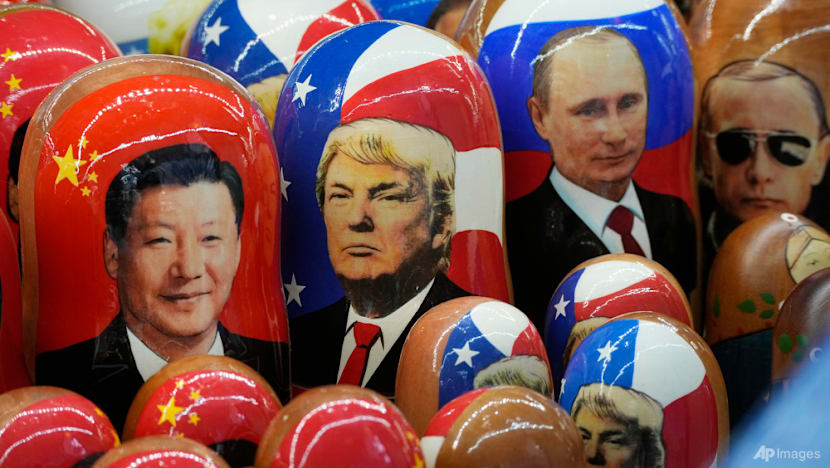
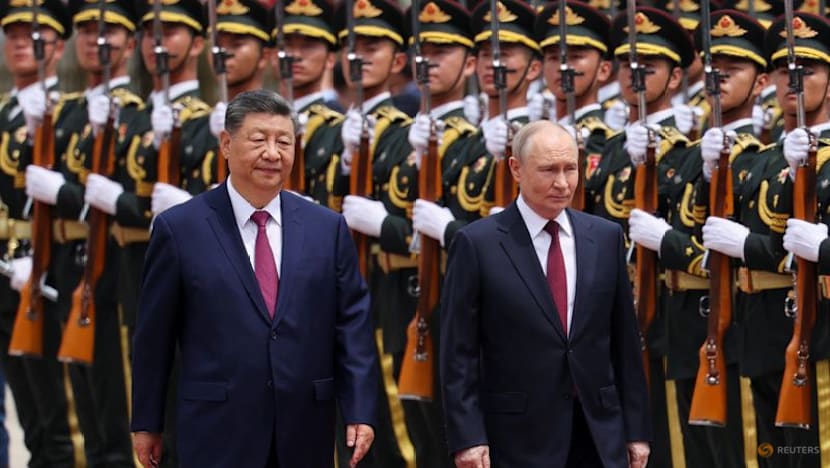
SINGAPORE: Chinese President Xi Jinping will be revelling in the perception that all roads lead to Beijing. He welcomed Russian President Vladimir Putin in Beijing on Wednesday (May 20), just days after hosting United States President Donald Trump for a hotly anticipated summit.
These back-to-back visits clearly show China’s geopolitical weight. But what is striking is how cautiously Mr Xi is using this growing influence.
Both visits come at a time when Mr Trump and Mr Putin are grappling with wars of their own making, wars that they have not yet found a way out of.
Russia has become far more dependent on China since it attacked Ukraine in February 2022. Faced with sweeping sanctions and economic isolation, Moscow relies on trade with Beijing as one of its greatest lifelines.
On the other hand, Mr Trump is confronting the limits of his coercive strategy in Iran. The Iranian regime has not collapsed as swiftly as he anticipated and instead, continues to control what transits through the Strait of Hormuz, one of the world’s vital shipping lanes.
For China, this is a uniquely advantageous moment: Russia and the US are experiencing self-inflicted difficulties while the rest of the world is forced to bear the consequences of their wars.
China, by contrast, can present itself as a stable power – and one with the leverage to shape these crises. But Beijing has shown remarkably little appetite to do so.
PRESERVING LEVERAGE OVER RUSSIA
China’s preferred lever of international influence is its economic power.
Mr Putin seeks maximum benefit from this, with Russia and China signing 22 agreements during his visit covering technology and trade cooperation. China currently accounts for about a third of Russia’s trade.
But China is still preserving its leverage over Russia. It is yet to greenlight the Power of Siberia 2 gas pipeline that would bring it Russian gas previously supplied to Europe. Russia has pushed the pipeline project for years, but it has stalled over disagreements.
Could China theoretically make its agreement for this pipeline conditional on Russia ending its war in Ukraine? Would China ever weaponise Russia’s trade dependency to help bring about a peace settlement?
Theoretically, yes. But in practice, this is unlikely. China and Russia’s partnership is still merely about deepening their trade relationship while banding together in their criticisms of US foreign policy.
In a joint statement published on the Kremlin website, Russia and China criticised “interference by external forces in the ... countries of Latin America”; they agreed that “US and Israeli military strikes against Iran violate international law”; and they singled out the US "Golden Dome” global missile defence system as a threat to “strategic stability”.
BACKING PAKISTAN’S MEDIATION
Similarly, the greater imperative of the US-China summit was to stave off an escalation in their trade war, which threatened to spiral out of control last year.
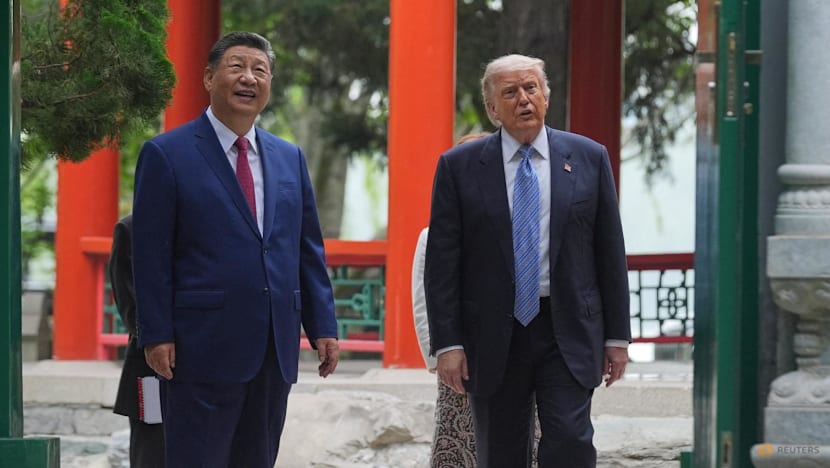
The Iran war was expected to be a key issue of discussion. But besides a broad agreement that Iran must open the Strait of Hormuz, the summit failed to yield any breakthrough.
There is no sign China will pressure Iran into concessions that would allow the US to claim victory, even if Mr Trump was correct when he said that China also wanted trade to resume through the strait.
Instead, China has preferred to involve itself by backing Pakistan’s mediation efforts. China’s Foreign Minister Wang Yi has been in regular contact with his Pakistani counterpart Ishaq Dar, including drafting a “Five-Point Initiative of China and Pakistan” in March to restore stability in the Middle East.
China’s economy has been affected by the instability in the Middle East. It purchases around 80 per cent of Iran’s oil exports, and this has been disrupted by the closure of the Strait of Hormuz and by the US naval blockade of Iran’s ports.
But for now, China can weather this disruption, thanks to its stockpiles and because so much of its oil is imported overland from Russia.

ENERGY SECURITY ABOVE ALL
Energy security above other calculations guides China’s strategic outlook. China needs both Russian and Iranian crude oil, which go for discounted prices below global benchmarks. Russia supplies a far bigger percentage of China’s demand at around 20 per cent compared to Iran’s 14 per cent.
But if China ever stopped buying Russian or Iranian oil, its competitors such as India may start snapping it up at reduced prices. So the trade-off for using its leverage in oil imports would not make sense.
So long as China’s economic relations with Russia prosper – and so long as China can extract favourable terms of trade from Russia without humiliating Mr Putin – Beijing has little incentive to pressure Russia into ending its war in Ukraine.
The war in the Middle East however is a bigger irritant for Beijing. As well as buying Iranian oil, it also imports crude from Saudi Arabia, all of which is being disrupted by the closure of seaborne routes. If the US wants China to become more engaged in the peace process, Washington will need to make progress through Pakistani mediation.
The underlying story of China’s growing role in international affairs remains one of latent power. Having manoeuvred itself into such a central global position by dint of its stature and its relative restraint, China seems content to sit back and watch as its friends and its rivals commit geopolitical blunders.
But how long before this latent influence starts to translate into more direct action? As the economic and strategic costs of global instability mount, Beijing could eventually find itself under pressure to wield its influence more directly.
Dr Samir Puri is Visiting Lecturer in War Studies at King’s College London. His books include The Great Imperial Hangover and Westlessness.