Commentary: By blocking Manus sale, China sends a warning to tech companies
China’s move to undo Meta’s acquisition of Manus was not surprising, but the lack of public criticism was, says Chong Ja Ian from the National University of Singapore.

This audio is generated by an AI tool.


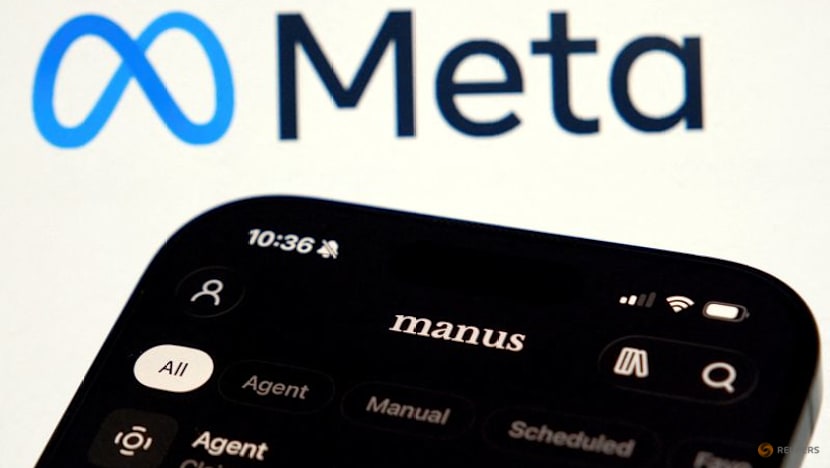
SINGAPORE: It was supposed to be a done deal: Last December, US tech giant Meta shelled out US$2 billion to buy Chinese-founded, Singapore-based artificial intelligence developer Manus. Yet, China’s move to unravel it four months later, on national security grounds, should not have surprised anyone.
What is more surprising is the expectation that business, especially in technology, can operate separately from geopolitics in today’s world. In particular, efforts to distance a company from China and present alternative origins are no longer adequate to escape sharper scrutiny – from either the US or China.
Manus rapidly gained prominence in tech circles in March 2025, positioning itself as the world’s first general purpose AI agent that could autonomously carry out tasks rather than answer questions like other AI chatbots.
By July 2025, Manus laid off staff and relocated its headquarters from China to Singapore. A fresh identity could help it gain access to global capital and high-end US chips. Months later, news of the sale to Meta made global headlines.





If Beijing looked past Manus’ initial moves, the sale to an American company made a response harder to avoid.
THE WARNING SIGNS WERE CLEAR
Beijing quickly made known its reservations about the Manus-Meta deal. Following publicity around the acquisition, the Chinese commerce ministry began investigating whether the agreement violated China’s export control, technology transfer and foreign investment laws.
On Mar 1, its Ministry of Industry and Information Technology introduced new rules on technology contracts, that give authorities greater oversight and control over such deals. The Financial Times reported in late March that Beijing barred Manus’s chief executive and chief scientist from leaving the country.
Then the State Council issued a decree strengthening control over industrial and supply chains, including technology, in early April.
Even if one overlooks recent developments, Beijing’s growing restrictions on technology and industrial chains are hardly new.
Over 2020 and 2021, Beijing targeted major homegrown technology firms, among them Alibaba, Didi, and Meituan, officially about antitrust and security rules, but in practice also served to rein in their power. The probes resulted in hefty fines, with Alibaba also forced to restructure and Didi having to delist from the New York Stock Exchange.
Limits on the export of key technologies, use of foreign technology, and social media are also being more widely applied to political ends.


BEIJING IS NOT ALONE
Beijing is not alone in trying to constrain technology transfers and investments.
US curbs on both, specifically to and from China, have grown across presidential administrations. This was emphatically seen in debates leading up to the forced sale of TikTok by its Chinese parent ByteDance to a US-controlled joint venture in January.
Washington has for some time been seeking to prevent the sale of the most advanced semiconductors and other technologies to China, moving against firms as well as individuals who tried to circumvent these controls.
There is no reason why Manus and Meta – or any other firm – are exceptions and exempt from this more restrictive environment.
In fact, the Manus-Meta transaction itself is an anomaly.
Silicon Valley and US venture capital interest in China cooled considerably over the past decade. The New York Times reported a 73 per cent drop in US-China cross-border technology deals between 2021 and 2024.
Beijing is expanding oversight on US investment in Chinese technology despite an overall desire to attract foreign investment, while the US Federal Communications Commission is rolling back the testing of US telecommunications technology in China.
Both Beijing and Washington have become much readier to use denial of technological access as a tool of economic statecraft.


BREAKDOWN OF “ORIGIN-WASHING”
Despite these constraints, Manus was effectively betting that it had found a viable workaround. The collapse of the deal with Meta suggests that it will only get harder to engage in “origin-washing” tactics.
It cuts both ways: Just as China sees Manus as strategically Chinese despite its foreign domicile, the US looked past TikTok’s Singapore headquarters and Singaporean CEO to focus on the app’s Chinese origins.
But more companies may be coming to terms with growing state intervention in business and technology.
This could explain the relative absence of public criticism to the now-thwarted Manus-Meta sale. This parallels the silence surrounding the second Trump administration’s enforcement of prohibitions on technology transfers to China. These are in sharp contrast to reactions to the “small yard, high fence” approach toward US technology controls under the Biden administration and initial US efforts at controlling TikTok.
Blocking Manus might not necessarily have the effect China intended.
Some companies may accept that state intervention is inevitable and choose to keep to a local scale. Others may design more elaborate origin-washing efforts but face diminishing gains. Some may decide to bring their ideas overseas from the very start – and that will be a bigger problem for China.
Chong Ja Ian is Associate Professor of Political Science at the National University of Singapore and a non-resident scholar at Carnegie China.