Commentary: Singapore-New Zealand 'world-first' trade pact is a bold commitment in times of crisis
Amid growing worries about energy and food supplies, the agreement is more than a reaction to the ongoing war in the Middle East, says Hinrich Foundation’s Deborah Elms.
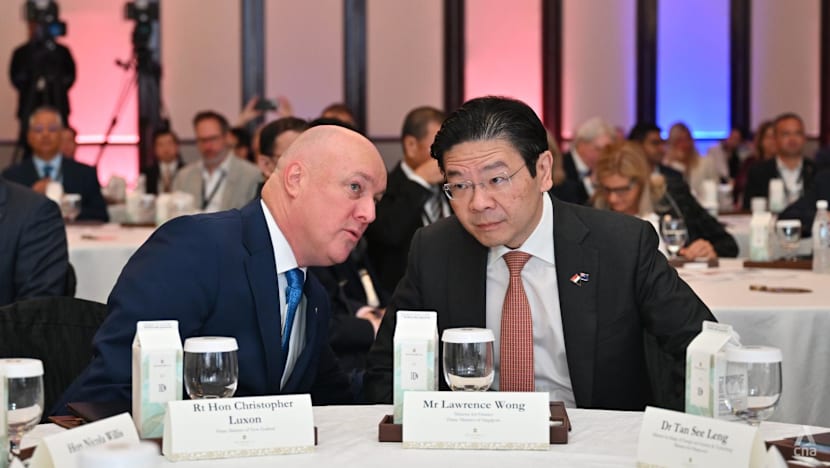
New Zealand's Prime Minister Christopher Luxon and Singapore's Prime Minister Lawrence Wong during the Singapore-New Zealand Leadership Forum at Shangri-La Hotel on May 4, 2026. (Photo: CNA/Jeremy Long)


SINGAPORE: Two small countries have just made each other a promise that no other governments have before. On May 4, Singapore and New Zealand signed the world’s first legally binding bilateral agreement to ensure that essential supplies will continue to flow smoothly, even in times of crisis.
This commitment comes at a moment when energy supplies and fertiliser stocks have been disrupted by an ongoing war in the Middle East and there are growing worries about how it will affect food supplies and prices in the coming months.
Singapore’s list included agricultural goods and important food products. About 14 per cent of its food imports comes from New Zealand. For New Zealand, the goal was to secure supplies of fuels and petrochemicals. The country has no refineries and about a third of its fuel is refined in Singapore.
As well-timed as this agreement may appear, it is not a reaction to current disruptions. Negotiations for the Agreement on Trade in Essential Supplies (AOTES) concluded last October.





It is the latest step in a long-standing partnership of two trade-dependent states that are fully aware of the risk of global shocks. What happens if trade gets disrupted and the rules of access to bigger global markets change?
SMALL STATES PROTECTING THEMSELVES IN A CRISIS
Singapore and New Zealand have decided that deeper cooperation is a critically important survival mechanism.
The AOTES has been designed as an addition to the existing bilateral free trade agreement, or Closer Economic Partnership, in place since 2001. It therefore relies on more than two decades of economic integration and a range of broader commitments.
Trade agreements often provide for some temporary exemptions in times of critical shortages. So, the AOTES is significant because both countries have agreed to forgo this for some essential goods.
This latest agreement builds on their experiences keeping bilateral trade open for medicines and critical health products during the COVID-19 pandemic, a period when many countries resorted to export restrictions to secure supplies for themselves.


This arrangement also provides an interesting model for other governments looking for similar commitments, which both Singapore and New Zealand prime ministers said they would welcome. More members and a larger pool of available resources would lower the risks for all participants of getting caught without essential supplies in the wake of a serious trade disruption.
Singapore and New Zealand have already had success in crafting trade rules on new topics that are later adopted and expanded with others. Both were early partners in the creation of what is now the Comprehensive and Progressive Trans-Pacific Partnership (CPTPP) trade agreement, which is about to welcome its 13th member.
Both were key to the creation of the Digital Economy Partnership Agreement (DEPA) in 2020. The increasing replication and expansion of digital trade rules, particularly by Singapore, shows the importance of these early efforts to create consistency and alignment on new areas of trade.
Both are also founders of the latest coalition of smaller economies, the Future of Trade and Investment (FIT) Partnership, which launched late last year.
THE REAL TEST
There are, however, reasons for scepticism about whether AOTES will follow predecessor models and attract more participants.
The first is scope. While Singapore and New Zealand are vulnerable to economic disruptions, both have different economic resources and areas of concern. These differences are clearly apparent in AOTES which basically trades energy for food.
But not every economic disruption will affect these two sectors in the same way, as the Iran war and disruption in the Strait of Hormuz have. Hence, the basic bargain may be less relevant if, for instance, trade is disrupted by a health crisis or conflict in another part of the global economy.
The second reason for some scepticism is scale. The benefits of such an arrangement could be harder to maintain with more partners.
Imagine if, say, Australia asked to join. It is a much bigger economy and the balance between fuel and food supply and demand could be quite uneven. What seemed like a fair trade-off between two parties may look less appealing with more states involved.
Third, sharing essential goods will inevitably come with political challenges during a crisis. It will be hard for any government to be seen to provide something called “necessary” to outsiders, especially if domestic needs are pressing. What if the items are in short supply in both markets? Would Singapore or New Zealand really agree to an equitable split if both were down to their last stocks of something critical?
This is not to discount the importance of thinking creatively about how to navigate an increasingly uncertain economic environment. In a world where the instinct of governments under pressure is to hoard, Singapore and New Zealand have shown a flexibility and willingness to try new arrangements that keep the door open.
Whether others see this as a useful framework to guard against future disruptions will be worth watching.
Deborah Elms is Head of Trade Policy at the Hinrich Foundation.