Commentary: The biggest losers from Trump's tariffs? Americans
In addition to raising prices, companies also reined in labour costs to cover the expense of tariffs, says Robert Burgess for Bloomberg Opinion.
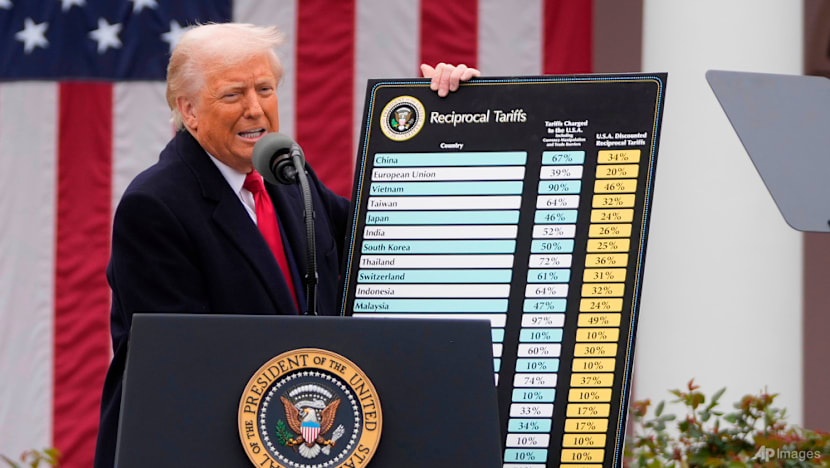
FILE - President Donald Trump speaks during an event to announce new tariffs in the Rose Garden at the White House on April 2, 2025, in Washington. (AP Photo/Mark Schiefelbein, File)
NEW YORK: It’s widely understood that the Trump administration’s ill-conceived decision back in April 2025 to impose broad “reciprocal” tariffs on US imports from around the world, even on an island inhabited only by penguins, has made the goods that Americans buy more costly.
Need new dishes? Those prices were up 15.4 per cent in April from a year earlier. A men’s shirt? Up 7.7 per cent. Some jewellery for a significant other? Up 16.1 per cent. Accessories for your personal computer? Up 13.9 per cent.
Now that we have a year’s worth of data to analyse, we’re finding that the levies have had the opposite effect on the wages of US workers, suppressing earnings growth and helping to explain why, more than ever, Americans say this economy isn’t working for them. It’s also why President Donald Trump’s approval rating has steadily fallen to below 40 per cent from 52 per cent at the start of his second term as measured by Real Clear Politics’ average of polls.
It’s hard to conclude anything other than Americans are the number 1 and number 2 biggest losers from a trade policy that few say makes sense.
NO COHERENT PLAN





Trump’s “Liberation Day” tariffs were never based on a coherent plan.
You may recall that he put forward three primary objectives of the levies. The first was raising tax revenue to help close the federal budget deficit and pay for an extension of the Tax Cuts and Jobs Act of 2017 that was due to expire at the end of last year. The second was to bring back to the US manufacturing that had migrated overseas, igniting a new “Golden Age” of America. The third was to achieve foreign policy goals.
Each of those objectives would be hard enough to achieve on their own, but collectively, they’ve proven to be an impossible trinity.
The bipartisan Congressional Budget Office is projecting 6 per cent deficits on average for the coming decade. Industrial production has expanded just 0.13 per cent per month on average since the start of 2025, no different than in the decade prior to the COVID-19 pandemic.
As for foreign policy goals, the Iran quagmire shows the US is scoreless as the rest of the world diversifies away from America, whose share of global trade continues to shrink.
THE EFFECT OF TARRIFS
The most noticeable effect of tariffs, at least for consumers, has been on the prices of goods.
Despite Trump’s insistence that tariffs are paid by other countries or non-US companies, taxes on imports are paid either by the importer or by an intermediary such as a customs broker acting on the importer’s behalf. Those companies must then decide whether to absorb the cost of the tariffs or pass some or most of it on to their customers, which adds to inflationary pressures. A measure of inflation favoured by the Federal Reserve and which zeroes in on the cost of goods by stripping out food and energy has surged since the start of 2025 after stabilising the prior two years.
But that’s only part of the story. Evidence is mounting that in addition to raising prices, companies also reined in labour costs to cover the expense of tariffs. Morgan Stanley calculates that unit labour costs at non-financial companies were flat in the year since Liberation Day. In the four quarters ending Mar 31, “firms covered higher tariff expenses by controlling labour costs and by pushing output prices higher”, economists including Michael Gapen wrote in a research note dated May 28.
The data confirm their conclusion. The consumer price index rose 3.81 per cent in April from a year earlier, exceeding the 3.4 per cent increase in the Employment Cost Index over the first three months of the year for the first time since early 2023. In simple terms, earnings growth is no longer outpacing inflation.
This is not some esoteric economic theory but something Americans say they know all too well. The Conference Board’s measure of consumer confidence has slipped to levels seen during the depths of the global pandemic, when the worldwide economy was virtually shut. A Gallup poll released May 22 found that just 16 per cent of Americans rate economic conditions as good or excellent.
The White House counters that things can’t be all that bad with the stock market at record highs. A big reason for the stock rally is profit margins have never been wider, due largely to companies’ ability to pass much of the cost of tariffs through to customers as higher prices while paying for the rest by suppressing wages.
As The Wall Street Journal points out, labour’s share of gross domestic income has sunk to 51 per cent, the lowest in records going back to 1947, while profits’ share climbed to 12.1 per cent, the highest since 1950.
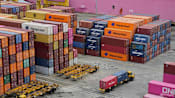
The federal government took in roughly US$175 billion from tariffs instituted under the International Emergency Economic Policy Powers Act before the Supreme court ruled in February that the statute doesn’t allow the executive branch to unilaterally impose tariffs. The money collected is now being refunded.
Undeterred, the White House imposed temporary tariffs under a different statute while it explores other avenues to keep the levies in place - unless Congress finally demands a say in how trade policy is conducted, as is its right.
As Canadian Prime Minister Mark Carney suggested at the Economic Club of New York last week, only by working closer with his allies - rather than treating them as foes - will Trump succeed in “making America great again”. “Examples of where that’s true are legion, where we should work together and compete with the world together,” Carney said.
The debate around what companies would do about tariffs has largely centered on two options: Either companies would pass on the tariffs in the form of higher prices, or they would “eat” the tariffs, essentially absorbing them as a cost of doing business.
Now we know that there was a third option: Pass on some of the costs and pay for the remainder by suppressing wages and benefits paid to workers. Americans may not be conversant with the intricacies of tariff policy, but they sure do know who is paying for them. And those currently running the government and this misguided trade policy may be the next to pay.