Commentary: The battle the US is winning against China
China is a stunted financial power, leaving the US free to rule global markets, says Ruchir Sharma for the Financial Times.
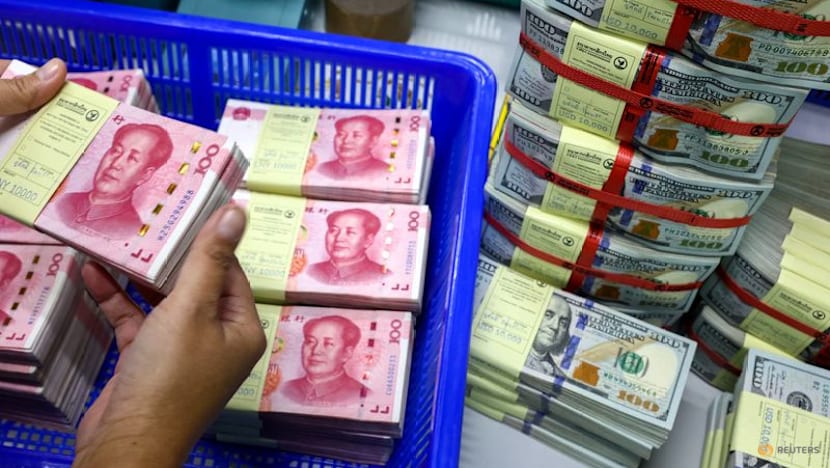
NEW YORK: The Beijing summit last week reignited talk of the “imperial twilight” in which America is supposedly ceding its superpower crown to China.
But in at least one field – financial competition – the opposite is true. China is stagnating, allowing America to dominate by default.
Never has the gap in financial power between the world’s two largest economies been this wide. Follow the list of empires from the United States down through Britain, France, the Netherlands and back to the 15th century. Usually, the emerging challenger built broad strengths from military to trade.
China is typical in every way except finance. Unlike rival currencies past and present, the yuan is far from fully convertible and has gained little traction as an international currency.





HOW YUAN AND DOLLARS ARE USED
Normally after an empire gains economic might, its currency takes an increasing share of reserves held by central banks. With a 17 per cent share of global gross domestic product, but only 2 per cent of central bank reserves, China is trailing 30 to 40 years behind previous superpowers at a similar stage of their ascents.
Likewise in trade, as an emerging power gains ground, the rest of the world accepts more payments in its currency – even if the new power is not directly involved in the transaction.
Britain at its peak accounted for 40 per cent of trade, but 60 per cent of trade payments were in sterling. China by contrast has a leading 15 per cent share of global trade, but only 2 per cent of trade bills are invoiced in yuan.
A Federal Reserve index captures how heavily the world uses major currencies in trade, currency, debt and other large transactions; since 2000, the yuan’s share of this index has inched up from zero to only 2.5 per cent.
This comes in an era when the world is more “financialised” than ever. Stock markets, bank loans, debt levels – all have been growing explosively as a share of the world economy. In the past half-century, the value of financial assets has surged fourfold to more than 400 per cent of global GDP.

The dollar’s omnipresence lets America run the show in more than one way. High demand for dollars lowers US borrowing costs and allows it to run persistently large twin deficits.
No other nation enjoys this “imperial privilege” or the geopolitical influence it buys. Since the US controls the dollar-dominated system, it can and often has pressured countries by cutting off their access to the financial network. The US currency has thus been “weaponised”.
AN INCOMPLETE SUPERPOWER
China will remain an incomplete superpower until it can match this financial firepower.
For decades, it has kept its financial system more tightly sealed than any other major nation. It now ranks in the bottom fifth of nations by international investment position, which captures the level of foreign ownership in the domestic market. Foreigners own less than 5 per cent of the stocks and bonds in China, one-fifth the level in the US.
Its home market is something of a local prison. Beijing has generated economic growth with heavy infusions of government money, corralled at home by capital controls.
Its money supply has multiplied sixfold since 1980 to 230 per cent of GDP, among the highest in the world. This liquidity sloshes around inside the walled economy, much of it in the domestic debt market, battered lately by a property bust. Beijing is wary of easing controls, lest it unleash capital flight.

But with controls in place, the Chinese have to find alternate, often shady routes to get money out of their country, tarring its image as a financial centre. Investors don’t see China as a safe second option and won’t until it has a freely traded currency.
This allows America to launch tariffs and wars but remain the world’s market of choice.
A BOLDER OPENING?
Chinese leaders have taken small steps to internationalise the yuan, and one recently called this a “golden” moment to open further.
Local investors appear less desperate to move money abroad than they were a decade ago. And China is running a trade surplus large enough to counter the impact of capital flight.
The past also offers some reason to question whether opening the capital account would lead to heavy outflows. Open markets usually increase trust. Studies show easing controls can raise inflows more than outflows, lifting economic growth and stock market returns.
China’s situation is novel, given the precarious levels of debt and liquidity coursing around the country. Yet without a bolder opening, China will never challenge America’s financial dominance and fully realise its superpower ambition.
Ruchir Sharma is chair of Rockefeller International. His latest book is What Went Wrong With Capitalism.