analysis East Asia
Suzhou’s APEC meeting offers glimpse of how China could handle Taiwan as host. What are its considerations?
China kept the Taiwan issue largely out of sight during last week’s APEC meeting in Suzhou, but analysts say the leaders' summit in Shenzhen this November could prove harder to manage.

This audio is generated by an AI tool.


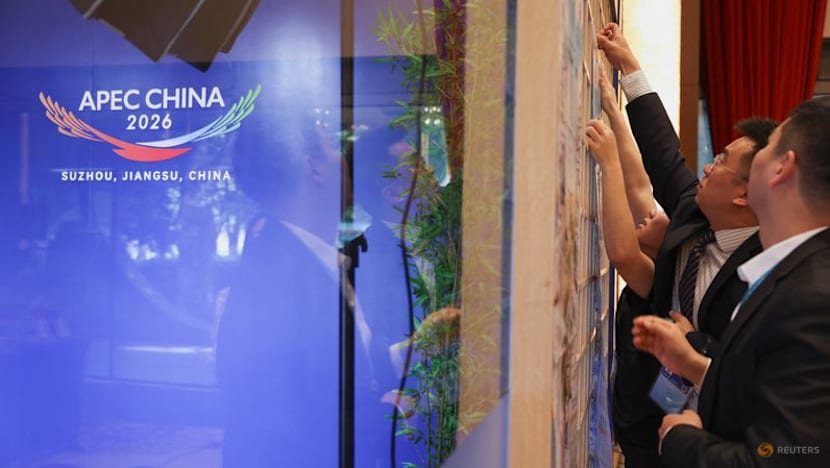
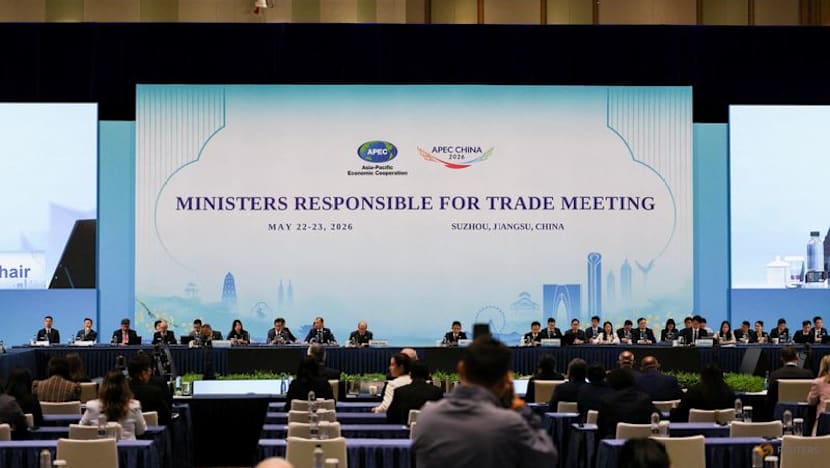
SHENZHEN: The recent Asia-Pacific Economic Cooperation (APEC) trade ministers’ meeting held in Suzhou has offered an early glimpse into how China plans to navigate one of the most keenly watched issues as host this year: Taiwan.
Analysts say Beijing used the latest forum to reinforce its image as a stable, open and cooperative economic power amid rising geopolitical and trade tensions - while carefully preventing Taiwan-related disputes from overshadowing the meeting.
China is hosting APEC for the third time, after previous summits in Shanghai in 2001 and Beijing in 2014.
But this year’s meetings come against a more uncertain global backdrop, observers say - one marked by tariff disputes, slowing growth and concerns over global supply chain disruptions.





The meeting in Suzhou also came just over a week after high-profile visits to Beijing by US President Donald Trump and Russian President Vladimir Putin.
Observers noted there was “little visible friction” over Taiwan’s participation at the Suzhou meeting from Friday (May 22) to Saturday - despite Beijing’s recent criticism of Taiwanese leader Lai Ching-te over a May 20 speech that China accused of advocating “Taiwan independence” and “separatism”.
Analyst and commentator Tang Meng Kit told CNA that Beijing is using APEC to project an image of stability, pragmatism and openness, and is determined to avoid any Taiwan-related disputes that could undermine its broader diplomatic messaging during its APEC host year.
“China is positioning itself as the defender of the multilateral economic order at the moment Washington is seen as undermining,” Tang said, adding that Beijing’s objective during the recent summit between Trump and Chinese President Xi Jinping was also to preserve its export channels.
“APEC is part of broader efforts in projecting multilateral stewardship,” Tang said.
He added that Beijing’s stated APEC theme of “openness, innovation and cooperation” was “a direct counter narrative to Trump’s tariff disruptions”.
Chinese Commerce Minister Wang Wentao similarly framed the Suzhou meeting as taking place amid “escalating geopolitical tensions” and rising “unilateralism and protectionism”, saying economies were placing greater expectations on APEC to deliver stability and consensus.
The joint “Suzhou Statement”, issued at the end of the meeting, reaffirmed support for regional economic integration and deeper cooperation on supply chains, digital trade, artificial intelligence and cross-border data flows - themes observers cited as aligned closely with China’s wider diplomatic messaging this year.
Chong Ja Ian, an associate professor at the National University of Singapore (NUS) and non-resident scholar at Carnegie China, said Beijing also wants to “paint itself as the preferred partner, taking advantage of Washington’s unpredictable and volatile approach to the world at present”.
Meanwhile, Wang Huiyao, founder and president of the Center for China and Globalisation (CCG), said China hopes APEC can send a signal of stability and predictability.
But experts say things could still become more complicated for Taipei later this year.
TAIWAN’S REPRESENTATION IN SUZHOU
Made up of 21 Asia-Pacific economies including Singapore, Australia, Russia, Japan, South Korea and New Zealand, APEC was established in 1989 to promote free trade, sustainable economic growth and regional prosperity.
The forum is held annually and hosts hundreds of smaller working-level, sectoral, and ministerial meetings throughout each host economy's “APEC Year”.
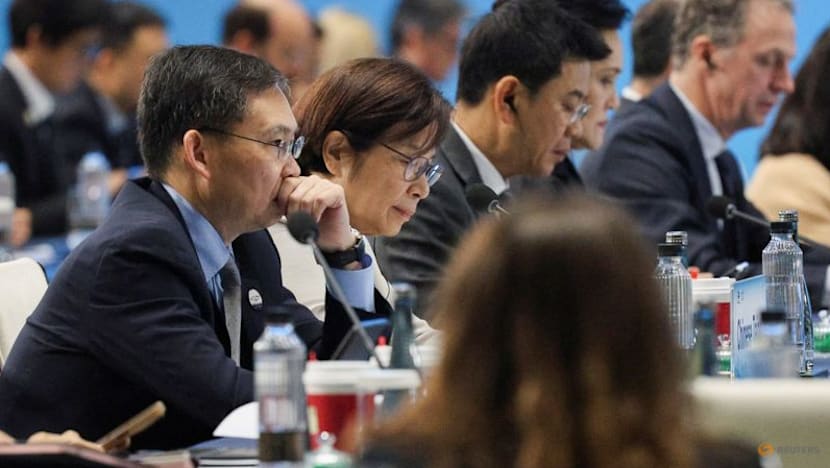
The meeting in Suzhou brought together trade envoys and representatives from all 21 APEC member economies, which included US Deputy Trade Representative Rick Switzer, Japanese Trade Minister Ryosei Akazawa, Australia's trade minister Don Farrell and ASEAN's secretary general Kao Kim Hourn.
It was the first ministerial-level meeting held by China as APEC host, following five others held at the officials' level in Shenzhen, Guangzhou and Shanghai since last December, with Taipei also sending delegations to them.
APEC members are admitted as “economies” rather than sovereign states - making it one of the few international forums where Taiwan participates alongside China.
Under this framework, Taiwan has participated as a full member since 1991 under the designation “Chinese Taipei”, alongside both China and Hong Kong.
Heading Taiwan’s delegation in Suzhou was its top trade negotiator Yang Jen-ni, Taiwan’s Minister Without Portfolio and chief trade representative in charge of the Office of Trade Negotiations under the Executive Yuan.
Yang was also accompanied by Jonathan Sun, director-general of the Department of International Organisations at Taiwan’s Ministry of Foreign Affairs.
During discussions, the Taiwanese delegation “pushed a broad agenda centred on supply chain resilience, digital transformation and green growth”, according to a Taipei Times report published on May 25 - citing Taiwan’s Office of Trade Negotiations.
The delegation had also stressed that economic integration in the region should remain market-driven and aimed at creating a predictable and inclusive economic environment.
It also warned that global supply chains continue to face disruption risks from geopolitical conflicts, maritime blockages and export controls, calling for stronger efforts to enhance supply chain security and resilience.
Experts say the relatively smooth handling in Suzhou does not signal any broader softening in Beijing’s position on Taiwan.
China views Taiwan as part of its territory and has said it would not rule out the use of force to bring the island under its control.
Official communication channels between Beijing and Taipei were suspended in 2016 after former Taiwanese leader Tsai Ing-wen declined to endorse Beijing’s interpretation of the “1992 Consensus” - an understanding that both sides acknowledge there is “one China”, while leaving room for different interpretations.
Since then, Beijing has increased military pressure and diplomatic isolation efforts against Taiwan while opposing what it sees as moves towards formal independence.
China’s foreign ministry said in a statement last November that Taiwan’s participation in APEC activities must comply with the “one China” principle - under which Beijing views there as being only one China, Taiwan as part of China, and the People’s Republic of China as the sole legal government representing China, a position rejected by Taiwan’s current government.
“A senior public servant, rather than a serving elected government official or cabinet-level appointee, tends to represent Taiwan at APEC,” said Chong from NUS, adding that “this has been standard practice for decades”.
As APEC members participate as “economies” rather than sovereign states, Beijing was therefore “open to Taiwanese participation” at the two-day meeting in Suzhou “under its terms”, Chong said.
“Even Hong Kong participates with government officials,” he noted.
William Yang, senior analyst for Northeast Asia at the International Crisis Group, said Beijing likely viewed Yang Jen-ni’s attendance at the Suzhou meeting as falling within acceptable parameters.
“China views the level of Taiwan’s representation as in line with what it can accept, or it doesn’t think APEC is the right occasion to further shrink Taiwan’s international participation,” he said.
Still, he warned Beijing could yet impose additional conditions later this year.
“We should anticipate Beijing trying to use the APEC summit in November as a chance to impose conditions or restrictions on Taiwan’s future participation,” Yang added.

Tang said Beijing was deliberately running “two tracks simultaneously”.
On one hand, Chinese ministries strongly criticised Lai’s May 20 speech and accused him of promoting separatism. On the other hand, Beijing continued engaging with “Chinese Taipei” within APEC’s economic framework.
“Beijing is not being inconsistent but precise,” Tang said.
“Keeping APEC stable serves its broader interest in projecting itself as a responsible host.”
Chong added that Beijing wants to project itself as “the key economic and political pivot”, bringing stability amid global uncertainty.
“This image is especially important given its domestic economic softness as well as the challenges its persistent overcapacity and large exports present to its economic partners,” Chong said.
SHENZHEN MAY BE THE HARDER TEST, EXPERTS SAY
Observers said the more politically sensitive challenge could come later this year at the APEC Economic Leaders’ Meeting in Shenzhen.
Unlike the trade ministers’ meeting held in Suzhou, the APEC Economic Leaders’ Meeting carries greater political weight, they add - bringing together heads of government and special envoys, with summit choreography and even seating arrangements often closely scrutinised.
Shenzhen will host the high-stakes meeting in November.
Tang described the Suzhou meeting as “a green light for the road, not for the destination”.
Arrangements involving Taiwan’s participation in Suzhou proceeded smoothly under the “Chinese Taipei” framework, he said, but the leaders’ summit in November is “structurally different” in one critical way: the envoy.
“Beijing has already stated publicly that Taiwan’s participation at the leaders’ summit in Shenzhen will depend on adherence to the one-China principle - a condition that goes beyond what the APEC memorandum of understanding technically requires,” Tang said.
“At the ministerial level, Yang is a technical trade official whose credentials are hard to object to. But at the leaders' level, Taipei must nominate a special envoy, and that person’s political profile becomes the variable Beijing can manipulate.”
Tang said finding a similar candidate for Shenzhen could prove increasingly difficult, pointing to Beijing’s handling of Taiwan’s representatives at past APEC summits held in China.
During the 2001 Shanghai summit under then-Taiwanese leader Chen Shui-bian, Beijing rejected Taiwan’s proposed envoy, former vice president Li Yuan-zu. Taipei later boycotted the leaders’ meeting altogether.
During former Taiwanese leader Ma Ying-jeou’s term from 2008 to 2016, vice presidents represented Taiwan at APEC summits.
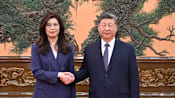
At the 2014 Beijing summit, then-vice president Vincent Siew attended and met with Chinese President Xi Jinping during what was widely viewed as a more stable period in cross-strait ties.
But under Tsai’s leadership between 2016 and 2024 years, rising tensions led Taipei to instead send figures such as Taiwan Semiconductor Manufacturing Company (TSMC) founder Morris Chang, whose relatively non-political profile made him more acceptable to Beijing.
Tang said the Morris Chang template, which he describes as globally respected, politically unthreatening, with gravitas that commands sideline meetings, remains the “gold standard, but will no longer be repeatable”.
He identified three likely pressure points later this year: Taiwan’s envoy nomination, summit choreography - including the family photo - and language surrounding Taiwan in any joint declaration.
“The family photograph carries enormous symbolic weight,” Tang said.
“Whether Taiwan’s envoy is physically proximate to Xi, or visibly marginalised, will invite much reading.”