19 groups, individuals to speak at public hearings on proposed EP changes
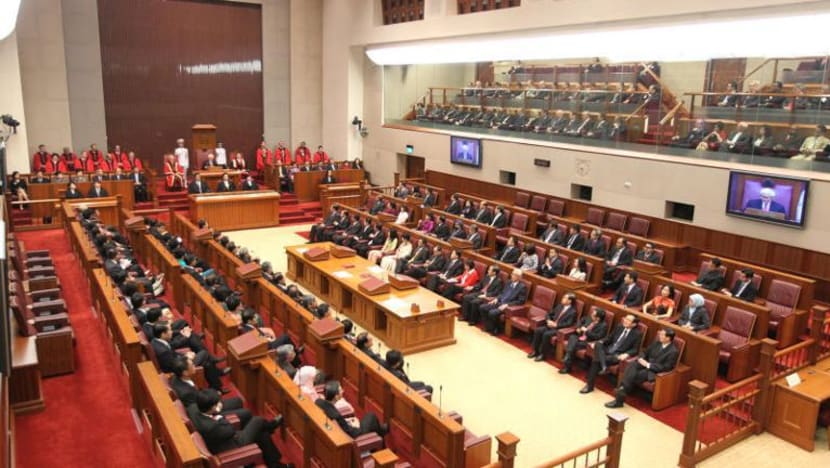
Singapore Parliament in session. TODAY file photo
SINGAPORE — Nineteen contributors who have offered views on the Constitutional Commission’s task to review the Elected Presidency, including former Cabinet Minister S Dhanabalan, academics and advocacy groups such as MARUAH, have been lined up to elaborate on their input at four public hearings starting next Monday (April 18).
The nine-member Constitutional Commission headed by Chief Justice Sundaresh Menon had invited 20 contributors to make their oral representations at the hearings, to be held at the Supreme Court auditorium, and all but the Workers’ Party (WP) agreed to attend.
In a Facebook post, the WP said it declined the invitation as it intends to debate the matter fully when the Constitutional Amendment Bill is presented in Parliament. “This is in keeping with our role as a political party with Members of Parliament,” the party added.
On Feb 18, the Commission invited feedback from the public regarding possible changes to the Elected Presidency and had received over 100 written submissions. The three areas being studied are the eligibility criteria for presidential candidacy, provisions to safeguard minority representation in the presidency and the framework governing the exercise of the President’s custodial powers, particularly the role and composition of the Council of Presidential Advisers. It is expected to complete its report and make its recommendations by the third quarter of this year.





Based on the written submissions made available to the media so far, some of the issues that will be raised at the public hearings include reservations about provisions to safeguard minority representation in the presidency and concern over a more stringent qualifying criteria excessively shrinking the pool of candidates.
For instance, the Association of Women for Action and Research (AWARE) felt the eligibility criteria should be relaxed to avert tension between the President’s custodial and representative roles.
Similarly, human-rights group MARUAH said tightening the eligibility rules would be “undemocratic and elitist”.
In announcing the review, Prime Minister Lee Hsien Loong had noted that the current rules — set over 20 years ago — require a candidate, if he is from the private sector, to have had experience in running large and complex companies with more than S$100 million in paid-up capital. He cited that inflation alone has driven up the dollar value to S$158 million today.
Singapore Management University law don Eugene Tan, on the other hand, supported raising the qualifying criteria for potential candidates — though not at the expense of limiting the pool — but raised concerns about when the changes would be implemented.
On the topic of minority representation, Assoc Prof Tan said he was against having electoral affirmative action as it goes against the ideals of meritocracy and
multiracialism.
Instead, he suggested that to be successfully elected, a candidate not only has to secure the majority of the votes but also a minimum threshold of votes from the minority communities.
“This is a better way because it reduces the saliency of race and instead shifts the focus to multiracialism. It also urges the electorate to think about who among the candidates will be a good symbol, a promoter, as well as practitioner of multiracialism,” Assoc Prof Tan added.