All S’poreans have to reject extremist, exclusivist ideas: Yaacob
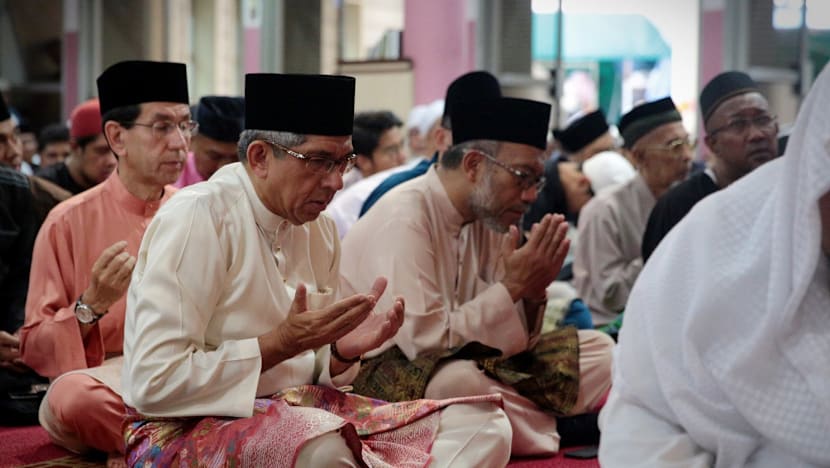
Minister-in-charge of Muslim Affairs, Dr Yaacob Ibrahim performs Eiduladha prayers at En-Naeem Mosque on Sept 12, 2016. Photo: Jason Quah/TODAY
SINGAPORE — Ideas that undermine the integration of Muslims into Singapore society are “not welcome” here, said Minister-in-charge of Muslim Affairs Yaacob Ibrahim yesterday, as Muslims marked Hari Raya Haji.
Speaking after the Mufti of Singapore Mohamed Fatris Bakaram delivered a sermon at En-Naeem Mosque in Hougang, Dr Yaacob, urging Singaporeans to reject extremist and exclusivist views, also said this was an issue that should be tackled as a community and a nation, and not individually.
Speaking to reporters after the sermon, Dr Yaacob also said it was timely for the Mufti and religious leaders to “come out very strongly” against exclusive thinking among the Muslim community.
“We need to raise this to the highest level possible so that our religious leaders understand where we are coming from … as (far) as we are concerned, the Muslims in Singapore are part and parcel of Singapore and anything that serves to undermine their integration are actually not welcome in Singapore,” said Dr Yaacob.





In his sermon, Dr Fatris had cautioned Muslims against interpretations and teachings within Islam that encourage followers to condemn other Muslims as “deviant”, or state that they cannot live in harmony with non-Muslims.
Such teachings are “inappropriate” in Singapore as it is a multiracial society, said Dr Fatris, addressing a 3,500-strong congregation.
In the past, Muslims were concerned over ideologies and concepts that were “contradictory” to Islamic beliefs as it could lead their children astray, but now Muslims should also be careful of interpretations within the religion that can cause “confusion, disorder and problems”.
There are teachings that encourage followers to condemn fellow Muslims as kafir (infidel), or those who judge other Muslims as deviant. This is something that should not be allowed to be perpetuated among the community, he said.
There are also people who are not experts in the field of Islamic studies who “irresponsibly judge” Muslims over matters that are being debated by scholars, and this is “more alarming” as this “exclusive mindset” exists beyond one particular orientation of the religion.
He also expressed concern over people who “selectively choose and search for opinions which are more antagonistic towards non-Muslims”, even though such schools of thought came about during times of conflict and tension for Muslims.
“These opinions are, hence, inappropriate to be applied in Singapore where we live in peace and have good relations with followers of other faiths,” said Dr Fatris.
“Such antagonistic opinions can fan the flames of hatred and discomfort in engaging with people of other religions and will, in fact, give the wrong impression about Islam and Muslims.”
These opinions, he said, can also create unhappiness in Singapore, on the basis that Singapore is not “Islamic enough”.
“What is worse is if they were to believe in the propaganda of groups that call Muslims to acts of violence and terrorism that can claim many innocent lives,” he added.
Urging Muslims to be careful in choosing who would guide them religiously, Dr Fatris said the Asatizah Recognition Scheme, which will be compulsory for religious teachers from Jan 1 next year, was set up to enhance the standing of religious teachers here, and is a reliable source of reference for the Singapore Muslim community.
Primary school teacher Suryadi Mohd Bajuri, who attended the sermon, welcomed Dr Fatris’ message.
“For local people like us, we have a place where we can look at and identify asatizahs (religious teachers) who are teaching the holistic push of Islam, rather than asatizahs who are not recognised, then they will end up teaching Islam in whatever small context that they are looking at it,” said the 34-year-old.
Meanwhile, efforts were being made to ensure that the Korban carried on as scheduled, even though 121 sheep imported from Ireland for the rites died on the way to Singapore, due to heat stress.
Calling the mortality rate “unusual”, Dr Yaacob said: “It is totally unexpected but I am thankful for all the members and various committees who worked hard to make sure that we could find a replacement,” he added.
“We must expect this to happen from time to time … we will get to the bottom of this and investigate what really happened.”
More than 3,500 sheep arrived in Singapore for the rites at 26 venues islandwide. At En-Naeem Mosque, 180 sheep were slaughtered. The meat was distributed to the needy.