Anxious mums-to-be take steps to avoid being infected
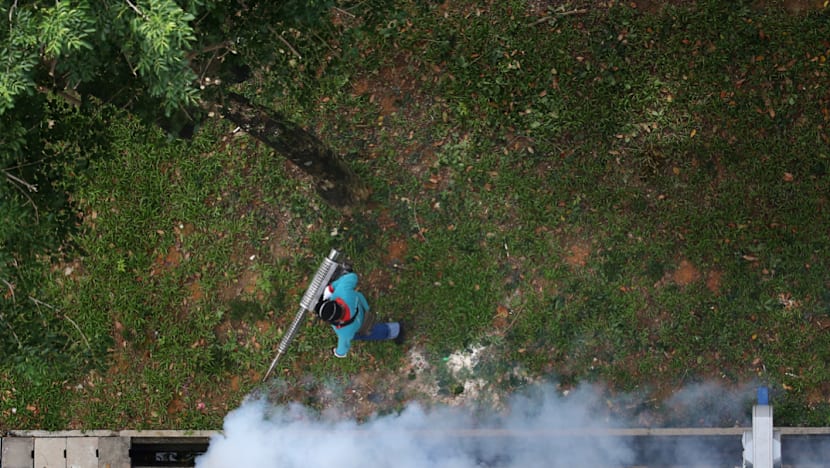
Thermal fogging carried out at 55 Sims Drive, near the Zika virus infection cluster at Aljunied Crescent and Sims Drive area on Sept 1, 2016. Photo: Nuria Ling


SINGAPORE — To protect her unborn child, Ms Chan S H, who is eight weeks’ pregnant, is putting as much distance as possible between herself and the infection clusters.
Already, the 31-year-old researcher moved out of her new home on Joo Seng Road and into her parents’ home in Toa Payoh when the Zika virus hit Aljunied Crescent and Sims Drive, which were just a few bus stops away from Joo Seng.
After Wednesday’s (Aug 31) reports that one Zika patient was living on Joo Seng Road, Ms Chan and her husband decided to move even further to Choa Chu Kang to stay with her husband’s parents until the situation stabilises.
The first-time mum-to-be told TODAY: “When news first broke about Zika, we were already contemplating whether we should continue living at Joo Seng. This is so scary. We haven’t even really had time to enjoy our new house properly.”





While Ms Chan has made the move to temporarily relocate, another expectant mother is trying to go about life as usual.
Ms Felicia Goh, 32, a church pastor who is expecting a pair of twins in December, admitted that the news of the Zika cases in her work area did cause “slight alarm”, but she had already made prior arrangements to work from home because of her pregnancy. “The best I am doing now is to ensure (there are) no breeding grounds in my home, that I stay indoors and go about life as usual.”
Ms Goh, who already has one child, said that she has taken extra precautions such as cancelling outdoor activities with her family. “I see fogging done regularly (at my) condo and work place, so I am assured that they and the Government are doing what they can to contain the situation.”
Singapore saw its first case of a pregnant woman infected with Zika on Wednesday and another one was diagnosed on Thursday.
A small percentage of Zika infections during pregnancy have been linked to microcephaly, where a baby is born with an abnormally small brain and skull.
In an advisory issued by the World Health Organization in June, it noted that people living in areas where the Zika virus is circulating should consider delaying pregnancy to avoid having babies with birth defects.
On Thursday, the Indonesian authorities also urged pregnant women not to visit areas known to have mosquitoes infected with the Zika virus and for women who are trying to get pregnant to put off their plans for eight weeks after their return from these areas.
Doctors interviewed by TODAY reiterated that only pregnant women who show Zika symptoms — such as fever, rash, red eyes or joint pain — or are linked to the affected areas should test for the virus.
However, Dr Leong Hoe Nam, an infectious disease specialist at Mount Elizabeth Novena Hospital, said that there should not be a blanket screening of all pregnant women, because this would exert a major cost to the patient and infrastructure at a time when labs are needed to process the results of patients with Zika symptoms to identify hot spots.
Likewise, Dr Leong noted that there is “no guarantee of microcephaly” among pregnant women who are infected with Zika. The overall risk levels are between 1 and 10 per cent, he added.
Dr Wong Sin Yew, an infectious diseases physician at Gleneagles Hospital, noted that microcephaly or other implications are also dependent on when the pregnant woman is infected with Zika. During the first trimester, the effect of infection tend to be more serious and damaging on the foetus because the organs are still developing.
He echoed the view that it is not necessary for all pregnant women to be tested for Zika. He added that “there is no such thing as a perfect test” and erroneous results may create unnecessary concerns. ADDITIONAL REPORTING BY LIM WEI CHEAN AND LIN YANQIN