From assembly line technician to robot programmer, Panasonic employee finds niche
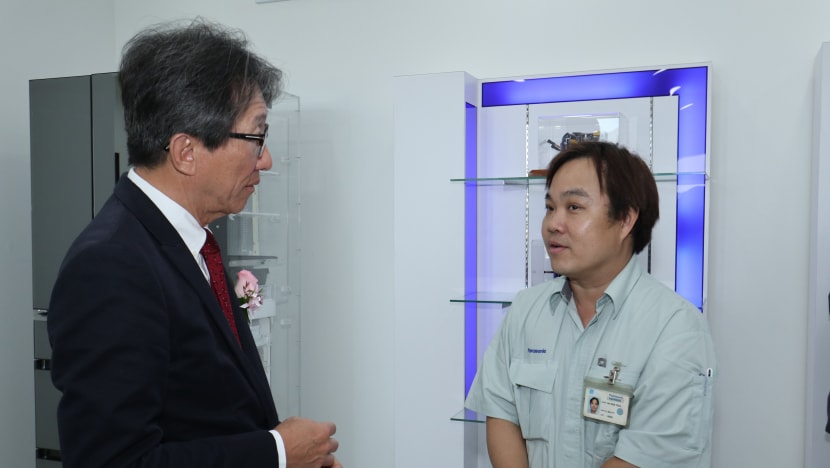
Mr Ng Wee Teck (right) joined Panasonic 16 years ago as a technician, is now a manager of the firm's robotics programme. Photo: Panasonic Appliances Refrigeration Devices Singapore


SINGAPORE — ‘O’ levels holder Mr Ng Wee Teck, 47, has been given many job promotions in his 16 years at Panasonic Singapore’s appliances refrigeration devices unit. Valued for his expertise on the job, the Singaporean rose through the ranks, from a technician role to his current position of production executive, a post which requires him to oversee more than 50 technicians, operators and supervisors.
The Bedok resident is also trained to troubleshoot and programme robots to “talk to each other”.
All this would not have been possible without Panasonic’s strategy to upskill its local workforce here as it continues to transform its manufacturing operations. Mr Ng is one such individual who has improved his skills competencies when the company sent him for courses to develop and train him.
Labour Minister Lim Swee Say highlighted Panasonic as an example of a “progressive and responsible” multinational corporation which has created successful outcomes for the company and its Singaporean workforce. He was speaking at the opening of the Panasonic refrigeration compressor business unit on Friday (Apr 7).





Panasonic, whose history in Singapore dates back to 1972, initially had to bring in foreign expertise with skills in advanced element design, process innovation implementation and precision machining because they were not available here. In turn, the foreign experts “helped train and strengthen our locals to master these skills. As a result, our local workforce has become better,” said Mr Lim.
A few years ago, when the company was evolving its technology strategies, Mr Ng volunteered to go for a course on robot integration to improve his competencies. Through his employer, he then attended automation and robot integration courses from a robot supplier. He clocked long hours at work to learn about robot integration in the factory.
“Initially when I joined the company, most of the lines were manually operated machines. Throughout the years due to a lot of technology changes, we implemented a lot of automation and robot integration for the lines. I was lucky to have various superiors who saw my potential (and) was given a lot of job opportunities and upgraded my skills through courses,” said Mr Ng.
His salary has increased threefold, since he joined in 2001. While he is “satisfied” with his current pay, he still sees the need to continue to keep learning as technology continues to change. He added that the job gives him motivation to succeed in life and he intends to pursue a Polytechnic diploma certificate if time permits.
“I won’t stay put. I still need to upgrade myself. I invest in myself so that hopefully I may have the opportunity to be promoted to a higher ranking.”
Panasonic announced on Friday the relocation of its refrigeration compressor business unit in Singapore from Kusatsu City, Shiga, Japan. The new plant will be situated with the group’s local appliances refrigeration devices branch. Development functions for mass production, which are mostly handled in Japan, will also be shifted here.
The local appliances refrigeration devices plant’s manufacturing functions will be integrated with the headquarters functions to further increase efficiency and to engage in new manufacturing utilising the Internet of Things, said Panasonic. This factory is set to evolve and be fully revamped into a SMART factory over the next five years, a factory that will soon have IoT, advanced automation and collaborative robots.
With the transformation of the factory, existing workers will be retrained and the company will also look to recruit skilled workers to manage the newer technologies. The company is looking at hiring individuals with IT related skills while also making the factory set up more manpower lean. It added that it would retain the local pool of workers but reduce its foreign workforce gradually.
In his opening speech, Mr Lim noted that the upgrading of skills and improvement in productivity has seen the median salary of Panasonic’s local staff increase by 35 per cent with the business transformation. Panasonic Singapore currently employs 1,300 staff, including a 50-man research and development team.