A*Star's commercial foundry in 'pole position' to be supplier of new technology
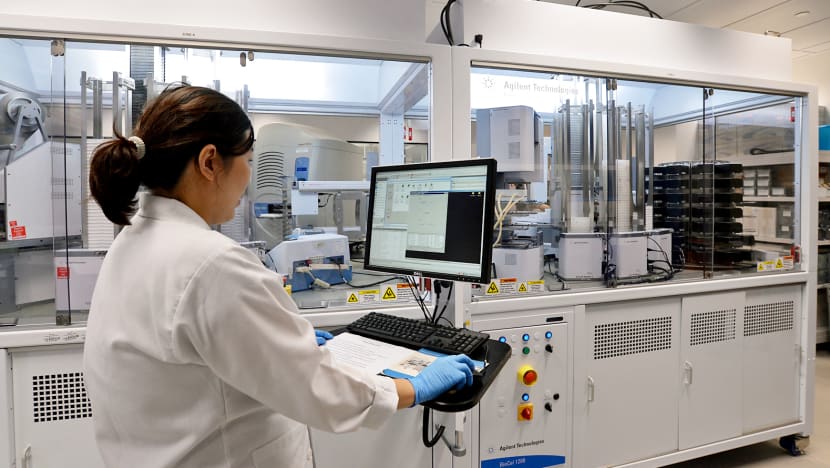
A researcher working at A*STAR.


SINGAPORE — When the Agency for Science, Technology and Research (A*Star) invested in research into silicon photonics more than a decade ago, not many believed the technology could materialise.
Last year, a new specialty commercial factory named the Advanced Micro Foundry (AMF) was launched as a spin-off from A*Star. The foundry specialises in silicon photonics technology and has since broken even.
Valued at US$300 million (about S$403 million), the firm intends to add another 170 more jobs, on top of its pool of 80 employees, by the end of this year.
With that, the agency looks to have a favourable start as silicon photonics is poised to disrupt a range of technologies.





The foundry's chief executive officer, Dr Tan Yong Tsong, who was formerly from A*Star, said of the investment into research in that area: "Because we were doing that, we managed to put ourselves in a pole position."
Silicon photonics, a light-based technology, is going to find greater applications in the next generation of communications systems, being more energy-efficient and providing speedier processing power than traditional conductors.
Its chief advantage is that moving through silicon, photons — or units of light — can transmit data at much higher speeds, since light travels faster than electrons).
The technology can be used in data centres, telecommunications, cloud computing, and sensors to diagnose diseases.
Announcing the developments on Friday (May 18), A*Star chairman Lim Chuan Poh said that the increasing need for high-speed data communications in this digital age is driving the demand for silicon photonics devices.
At the same time, manufacturers are also under pressure to tailor their products to meet the demands of consumers.
These consumers want unique products, whether they are mobile devices, autonomous vehicles or smart home devices, he noted.
Dr Tan said that the foundry intends to fill this gap in the supply chain of this technology, where companies are moving away from "one-size-fits-all" products manufactured in large quantities to more customised products.
"We are going into an era of so-called mass customisation, rather than mass production," he added.
'HIGH-MIX LOW-VOLUME PRODUCTION'
Using the analogy of how shirts are manufactured, Dr Tan said that instead of producing large quantities of white shirts, companies are turning to manufacturing processes that can produce the same shirt in smaller quantities and different colours.
This is known as a "high-mix low-volume production", and AMF will be the world's first commercial foundry capable of manufacturing silicon photonics that way.
AMF has since secured investments in the field of the Internet of Things, artificial intelligence and 5G technology.
It is also in the process of securing more investments for future capital and operational needs that may raise its valuation to US$400 million.
"We are very optimistic about the revenue prospects for AMF. The company will be more immediately focused on ramping up production," Dr Tan said, adding that the company also hopes to venture into the market for medical diagnostic tools.
MORE COLLABORATION WITH COMPANIES
Separately on Friday, A*Star also released findings from its review for the last financial year, which showed that it had worked on more than 2,100 industry projects with companies, a 20 per cent increase from the previous year.
This saw companies investing S$340 million on research and development with the agency.
A third of these projects were also with Singapore enterprises, which kept pace with its overall growth in research projects.
The review showed that more companies here are taking up A*Star licences, to develop antibodies, to provide AI speech services or inventory management tools, among other ventures.
"All these show that some of our local enterprises are stepping up to grow their innovation capacity and undertaking (research and development) to build competitive businesses," Mr Lim said.