Aviation industry must adapt to face new threats, challenges: Khaw
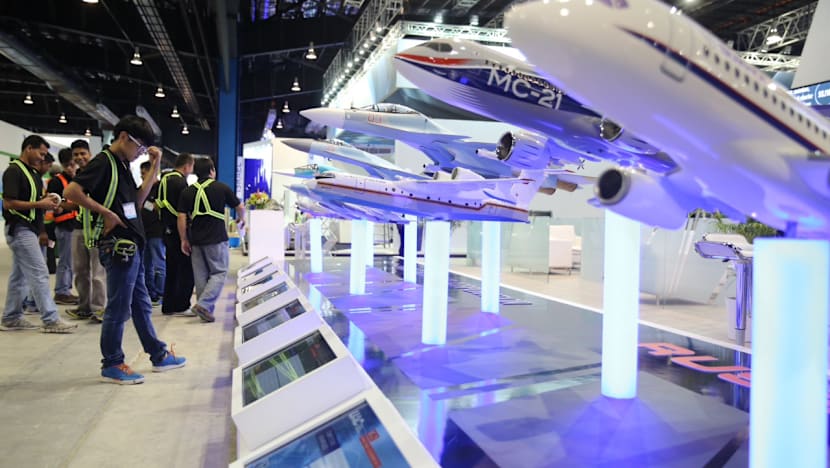
Workers viewing models of planes at an exhibition booth ahead of the Singapore Airshow 2016 at the Changi Exhibition Centre on Feb 15, 2016. Photo: Don Wong


SINGAPORE — The aviation industry can still help lift the global economy, if it manages to adapt to greater economic uncertainties, as well as increased competition, and external security threats, said Transport Minister Khaw Boon Wan.
Delivering the opening address at the Singapore Airshow Aviation Leadership Summit today (Feb 15), Mr Khaw said the industry faces some tough decisions in trying to balance growth targets with safety concerns.
The liberalisation of the air services regime within the Association of South-east Asian Nations (ASEAN), for instance, has led to a proliferation of low-cost carriers, and tripled the number of air passengers in the region over the last decade. ASEAN and the European Union are also discussing an agreement that will allow airlines to tap into the growing demand for air travel in both blocs. But the focus on growth cannot be “mindless”, Mr Khaw, who is also Coordinating Minister for Infrastructure, noted. With aviation safety becoming an increasing challenge as a result of having to share finite airspace with unmanned aerial systems, the minister said there should be better integration of air traffic, so that safety is not compromised.
“We must resolve to make the hard decisions in the interests of aviation safety, first and foremost,” he added.





Governments have a key role to play in this area. One example is the collaborative air traffic management system that will be implemented soon between major cities like Singapore, Bangkok and Hong Kong. “We have taken some steps in this direction but clearly, we can do more together,” said Mr Khaw.
In his keynote address, director general and chief executive of the International Air Transport Association Tony Tyler also noted that demand for air travel remains strong in Asia Pacific — where the sector is expected to support over 70 million jobs and generate US$1.3 trillion (S$1.8 trillion) in economic activity, over the next two decades.
Profitability, however, is not evenly distributed in the region, compared to the situation in the rest of the world. Preliminary figures for 2015 show that average EBIT (earnings before interest and tax) for South-east Asian carriers are at 0.3 per cent — the lowest among all regions except Africa, which generated losses, said Mr Tyler today. By comparison, EBIT for Europe, the Middle East and North America average at 5.9 per cent, 10.8 per cent, and 13.8 per cent respectively.
The possible reasons for this phenomenon are the rising US dollar’s impact, the downward pressure on yields resulting from growing capacity for air cargo, and the “ever-intensifying competition” in the low-cost sector in the region. Preserving the social and economic benefits of the air transport sector in South-east Asia is a challenge not just for airlines alone, he said. “Governments and infrastructure providers will also need to contribute with efforts to keep costs low and efficiency high,” he said.
At a separate event held in conjunction with the Singapore Airshow today, Minister for Trade and Industry (Industry) S Iswaran said the Republic is cementing its position as the leading Asia-Pacific aerospace hub by enhancing capabilities and developing new growth clusters, as it continues to support local aerospace companies.
“We will continue to leverage research and development, and innovation, to push the frontiers of technology and develop complex capabilities that will help Singapore-based companies address industry needs arising from global trends,” he said in his keynote address at the A*STAR Aerospace Technology Leadership Forum.
Singapore aims to help these companies better compete and grow in the existing stronghold of maintenance, repair and overhaul (MRO) services, the new market segments of aero-engine development, engineering and manufacturing, as well as premium aftermarket services. Singapore is currently the top MRO hub in Asia, contributing over 10 per cent of global output, Mr Iswaran said.
With the average age of aircraft having increased from 15 years in the mid-1970s to 25 years today, the MRO market is set to thrive, potentially growing to reach US$89 billion by 2023, from US$60.7 billion in 2013, Mr Iswaran said.
“Beyond R&D and innovation, we are committed to supporting industry-led co-innovation and supplier partnerships ... We will continue our efforts to develop a steady pipeline of highly-skilled talent for the aerospace industry by deepening synergies between our pre-employment education and industry needs,” he added.