Bloomberg reporter admits under questioning that GCB records 'possible' to find despite 'secrecy' claim in article
Reporter Low De Wei took the stand for the first time in the defamation trial involving his employer Bloomberg, Home Affairs Minister K Shanmugam and Manpower Minister Tan See Leng.
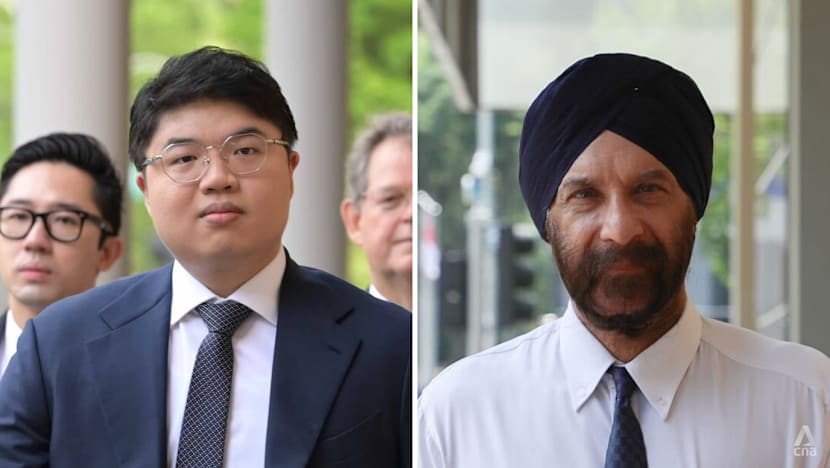
Bloomberg reporter Low De Wei (left) and Senior Counsel Davinder Singh. (Photos: CNA/Lim Li Ting, Alyssa Tan)

This audio is generated by an AI tool.


SINGAPORE: A Bloomberg reporter on trial for allegedly defaming two Cabinet ministers on Monday (Apr 13) admitted that it is "possible" for the public to search for non-caveated property transactions, despite his article describing such deals as being "shrouded in secrecy".
Mr Low De Wei, the journalist behind an allegedly defamatory article on Good Class Bungalow (GCB) transactions, conceded under cross-examination that these records could be obtained through public searches on the Singapore Land Authority's (SLA) INLIS (Integrated Land Information Service) database, albeit with certain effort and expense.
The admission came on the fifth day of a defamation suit brought by Home Affairs Minister K Shanmugam and Manpower Minister Tan See Leng after their lawyer, Senior Counsel Davinder Singh, questioned Mr Low on the availability of public property records.
Mr Low accepted that for both caveated and non-caveated transactions, the identities of buyers and sellers and purchase prices could be obtained through searches on INLIS.
In his defence, he maintained that such information was considered "secret" because of the effort and cost involved, testifying that it is "prohibitively expensive" to conduct INLIS searches.
But Mr Singh attempted to draw a distinction between difficulty of access and secrecy.
"You are saying because it entails a cost, the information is secret to the public, is that your evidence?" the lawyer asked. Mr Low replied it was not just the cost, but the need to know what one was looking for.
The exchange culminated with Justice Audrey Lim pressing Mr Low to clarify his stance: "What you are saying is (it is) not impossible to search, just that it takes effort and expense to do so."
Mr Low eventually agreed by saying: "It is possible, yes."
The civil trial, which began at the High Court last Tuesday, saw Mr Low taking the witness stand for the first time.
The ministers have been released as witnesses after testifying last week, but Mr Shanmugam attended the hearing on Monday partway through Mr Low's testimony.
What the trial is about
Mr Shanmugam and Dr Tan sued Bloomberg and reporter Low De Wei for an allegedly defamatory article in December 2024 about Good Class Bungalows (GCBs).
The article mentioned Mr Shanmugam selling his GCB in Astrid Hill for S$88 million to UBS Trustees when he had bought it for S$7.95 million in 2003. It also referenced Dr Tan buying a GCB in Brizay Park for nearly S$27.3 million.
The ministers alleged that the article had defamed them by suggesting that they had taken advantage of the lack of checks and balances and disclosure requirements in carrying out property transactions in a "non-transparent manner".
So far, Mr Shanmugam has testified that he formed the view from a series of internal Bloomberg emails that he was being targeted. The emails show the news reporters wanted to write about his sale early on but needed more information to "wrap around" it.
He claimed the story was presented as an article about a broader trend about GCB transactions but was really meant to justify writing about his property transaction.
Bloomberg's defence lawyer has argued that the minister had been told early on that his transaction would be mentioned in the article, and early "drafts" or iterations of the article did not even mention his name.
The Bloomberg article says that more people are buying mansions using trusts to keep their identities private, and that buyers pay a premium for transactions "under the radar".
Mr Shanmugam said this was "utter nonsense" and that a caveat being filed or not does not affect the price agreed on between the buyer and seller.
The article had also stated that non-caveated deals are "harder to track" because they do not show up in an Urban Redevelopment Authority database. But Mr Shanmugam contended that while a non-caveated deal does not appear in the URA database, it can be found in an SLA database after the deal is completed.
Because transaction records have to be filed with government agencies, not filing a caveat and using a trust for the transaction does not make the transaction a secret one.
Dr Tan testified that he did not understand why his property transaction was described as "off the radar" since it would appear in public records eventually.
The difference between a caveated and a non-caveated deal was that it took some weeks before it showed up in public records, he said.
WHAT MR LOW CONSIDERS TO BE "SECRET"
After a brief re-examination of Bloomberg's first witness, senior executive editor of Bloomberg News Madeleine Lim, Mr Low was called to the stand. He was briefly taken through his affidavit by his lawyer, Senior Counsel Chelva Retnam Rajah, who finished within 10 minutes.
Mr Singh then began his cross-examination of Mr Low.
Over the next few hours, Mr Singh pressed The London School of Economics and Political Science graduate on portions of his article, its choice of words, and the manner in which Mr Low conducted his research.
In particular, Mr Low was asked on what he meant by the word "secret", to which he answered that it meant it was secret from the public but not the government.
In his testimony, Mr Low made a distinction between caveated transaction records that appear on the URA's Real Estate Information System (REALIS) and non-caveated records that appear in SLA's INLIS.
When questioned by Mr Singh on the difference between the two, Mr Low agreed that retrieving records from both systems required payment, except that one must pay "a lot" for INLIS searches.
To this, Mr Singh said: "So it would appear you are suggesting (that) information in REALIS is not secret, but information (that) would be available in INLIS is secret because you have to pay 'a lot', to use your own words, yes?"
Mr Low responded: "In practice, yes."
Following this, Mr Singh then asked Mr Low why he included Dr Tan's GCB deal in the article, to which the Bloomberg reporter said the transaction was an example of a non-caveated deal.
Mr Singh suggested to the witness that, by including Dr Tan in an article framed around deals “shrouded in secrecy”, the report conveyed that his transaction was likewise secret.
Mr Low initially disagreed, saying Dr Tan’s purchase was cited as an example of a non-caveated or “off the radar” deal, rather than one involving secrecy.
Under further questioning from both Mr Singh and the judge, Mr Low accepted that non-caveated transactions were described in the article as being “shrouded in secrecy”, and agreed that Dr Tan’s deal was included as part of that category.
"DISINGENUOUS"
At one point in the trial, Mr Singh accused Bloomberg reporter Low De Wei of “disingenuously” recharacterising a government parliamentary reply to support a narrative of a lack of checks and balances in Singapore’s property market.
Mr Singh suggested that the journalist had created a false impression that the Singapore government did not know the identities of beneficiaries of trusts, and it was left to property agents and other service providers to perform verifications.
Taking Mr Low through an Oct 14, 2024 written parliamentary reply from the Ministry of Law (MinLaw), which Mr Low was aware of and had cited in his article, Mr Singh pointed out that foreign individuals and foreign entities that wish to acquire landed residential property in Singapore must seek approval under the Residential Property Act (RPA).
The law states that Singapore citizens are not required to seek approval under the RPA to acquire landed residential property, and MinLaw stated that SLA tracks all cases where approval is required, such as if the buyer is foreign.
MinLaw's reply also included a line that "beyond that, SLA does not collect general data on landed residential property that are acquired through trust companies". This was paraphrased in Mr Low's article as saying that SLA "does not collect general data on landed residential properties acquired through trust companies if the beneficiaries are Singapore citizens".
Upon questioning, Mr Low said he was uncertain if he or an editor had paraphrased the words.
Mr Singh then turned to how the article drew conclusions from MinLaw's reply.
He referred to the following paragraph in the published article which stated: "In essence, that means that property agents and other service providers involved in the transactions are primarily responsible for verifying the identities and source of wealth of Singaporean mansion buyers."
Mr Singh argued that this was a misleading inference, creating the impression that the government did not know the identities of beneficiaries and that responsibility was left to property agents and other service providers instead of the authorities.
Mr Low disagreed, stating that property agents and other service providers were mentioned as "gatekeepers" and that it was based on his understanding from what SLA told him.
At this point, Justice Lim questioned the basis of how Mr Low made the inference, stating that she was not interested in what Mr Low understood, but what he said in the article.
"I will read the article like an ordinary person," she said, noting that the phrase “in essence” would be understood as a conclusion drawn from the preceding paragraph stating that SLA does not collect general data in certain cases. Readers would link the two paragraphs – that SLA did not collect such data, and that property agents and other intermediaries have the primary responsibility instead.
Mr Low stated again that his use of the word "primarily" did not indicate that property agents and other service providers were the only responsible parties.
Hearing this, Mr Singh asked Mr Low again why he falsely created such an impression that the responsibility was left to private service providers, adding: "I suggest to you, it becomes quite clear that you have written this piece to convey falsehoods."
Mr Low disagreed.
The trial will resume on Tuesday with the continued cross-examination of Mr Low.