Centralised college to give judges more education, training
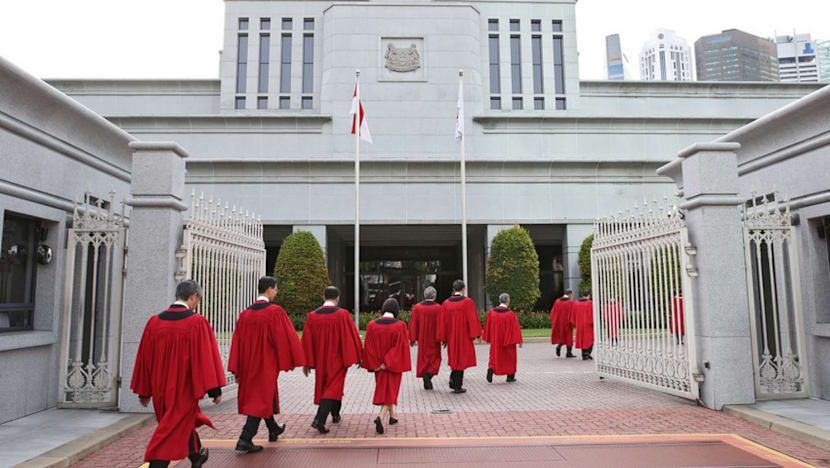
Judges entering Parliament House after photo-taking during the opening of the legal year. Photo: Wee Teck Hian
SINGAPORE — A new college covering the training of judges here and programmes for overseas judges will be set up, announced Chief Justice Sundaresh Menon yesterday, as he noted that efforts to push the boundaries of work within the justice system will not be possible without a strong judiciary.
The Singapore Judicial College will bring all of the Republic’s judicial training — which had been decentralised until now — under its auspices and develop and strengthen the curricula.
Housed within the Supreme Court, it will cover induction as well as continuing the training and development of Singapore’s judges. Until now, each court has been overseeing its own training programmes.
“Our judges have been at the core of our legal development and they must continue to lead this effort in changing times,” said CJ Menon at the opening of the legal year yesterday. “It is, therefore, imperative not only that the right people are appointed but also that they are provided with ample opportunities for continuing education and development.”





Reflecting on the development of Singapore’s legal sector over the past 50 years, CJ Menon said that going forward, the judiciary’s “first and paramount guiding principle” is to serve the people — a point also alluded to by Attorney-General V K Rajah and Law Society president Thio Shen Yi.
“For most Singaporeans, legal issues concern intensely important and personal matters regardless of whether they also concern large amounts of money. Liberty, family distress and trauma and the accessibility of our justice system are what viscerally concern our citizens,” CJ Menon said. “We must, therefore, continue to design our legal frameworks and our processes with these imperatives in mind.”
To that end, while steps have been taken to improve access to justice in criminal cases, the management of litigation costs in civil cases is next on the agenda. For a start, cost scheduling, where parties are required to furnish their cost estimates before the outcome in a case, has been introduced in the Supreme Court.
A Civil Justice Commission has also been set up. Chaired by Justice Tay Yong Kwang, it will examine issues such as how to simplify court rules, eliminate time-consuming and cost-wasting processes and allow for more judicial control of the litigation process to ensure “proportionate” conduct.
Meanwhile, with regard to access to criminal justice, the State Courts will explore two more avenues to complement measures already in the works. These include enhancing case management, minimising pre-trial delay and providing legal assistance for accused litigants in person before the matter reaches the court.
On the international front, CJ Menon said the Singapore International Commercial Court — launched yesterday — builds on Singapore’s success as an arbitration hub, and will help grow the legal services sector here, and even expand the scope for internationalising Singapore law.
He noted that diversity among legal systems, especially in Asia, can hold back transnational commerce. A committee under the Singapore Academy of Law has been established to look into promoting transnational convergence of commercial laws in Asia. An international conference and the establishment of a permanent institute to support these efforts are also in the works.
As such, the Singapore Judicial College is timely, with judges now facing a different operating climate. The college will guided by a Board of Governors consisting of judges and academics chaired by Justice Andrew Phang, with Justice Quentin Loh as deputy chair. Apart from training, the college will also serve as a judicial research laboratory to test new or existing practices. The college has invited the two law schools here to submit research proposals.
Making his maiden speech as Attorney-General, Justice V K Rajah said no one is above the law here and the legal system is increasingly moving towards an individual’s experience of justice, within the wider framework of public interest.
While the public appreciates the state of rule of law in Singapore and has confidence in the Attorney-General’s Chambers (AGC) in upholding it, more can be done, he said.
Among the changes is the setting up of the AGC Academy to raise standards and improve situational awareness. An AGC spokesperson said training pedagogies include practical workshops and officers are sent for attachments with local and foreign law firms, as well as with the AGC’s counterparts in other jurisdictions.