Challenge for S’pore: Turning human resource into capital
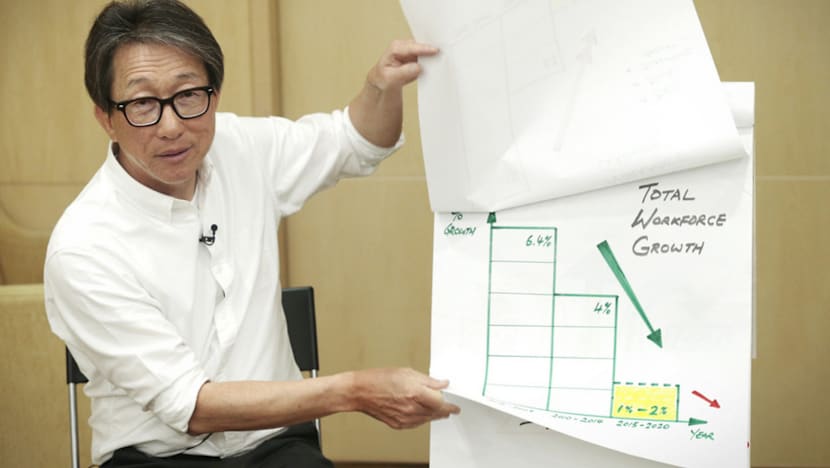
Manpower Minister Lim Swee Say. Photo: Jason Quah


SINGAPORE — Stressing the need to turn human resources into “capital” to drive growth, Manpower Minister Lim Swee Say yesterday said the Government will be helping to drive this at the sectoral level, noting that tighter strategies will be targeted at firms with a weak “Singaporean core” that were also not contributing to the economy.
Setting out various challenges without naming any particular sector, Mr Lim, referring to industries which hire few Singaporeans and yet remain crucial to the economy, said the question for these industries was: “How can we help our local talents and nurture them into global talent so that they can take on many of these jobs that can be competitive?”
As for industries with a sizeable number of local hires but lack social and economic impact, the minister said that the Government will continue to help them grow.
However, they will also be keeping their eye on these companies and “ask questions more and more”, said Mr Lim, who was speaking to reporters on the Ministry of Manpower’s (MOM) Labour Market Advance Release report yesterday.





Sub-sectors with a weak Singaporean core, as well as social and economic impact, will be monitored closely. Mr Lim said: “If you’re mainly employing foreigners, and at the same time, you’re not making significant contribution to society, economy, then what is your role here?”
“The main outcome is to find ways to ensure that locals and foreigners will be able to work together, compete for jobs out there, rather than to compete for jobs in here,” he added.
In “low value-added” sectors such as security, construction and cleaning, Mr Lim said that becoming more manpower-lean would be a high priority, and the MOM would aid the sector in its transition.
For emerging high valued-added fields such as cyber security, data and analytics, the MOM would be working with various agencies to better support and grow them, said Mr Lim.
For other industries like manufacturing, deemed high value-added but with a falling employment share, the Government will be looking to transform them “so that we can create better jobs for Singaporeans”.
At the national level, the MOM will be working closely with various industries to optimise their deployment of resources, while at the enterprise level, companies will be encouraged to improve their human resource practices.
“For enterprises, we want to make sure that they can continue to grow profitably. If Singapore-based enterprises cannot grow profitably, eventually we’re going to see them holding up certain sectors of the economy,” said Mr Lim. Employers must also not view workers as “headcount”, but as a valuable resource. “How do you invest in this capital?” he said.
Mr Lim also noted being manpower-lean was only one-half of the success strategy, and productivity also mattered. “As we go through this process, the job growth will slow down but we hope that the quality grows. Hopefully this means good jobs, better careers for the workforce,” he said.