Commemorative book marks 50 years of healthcare in Singapore
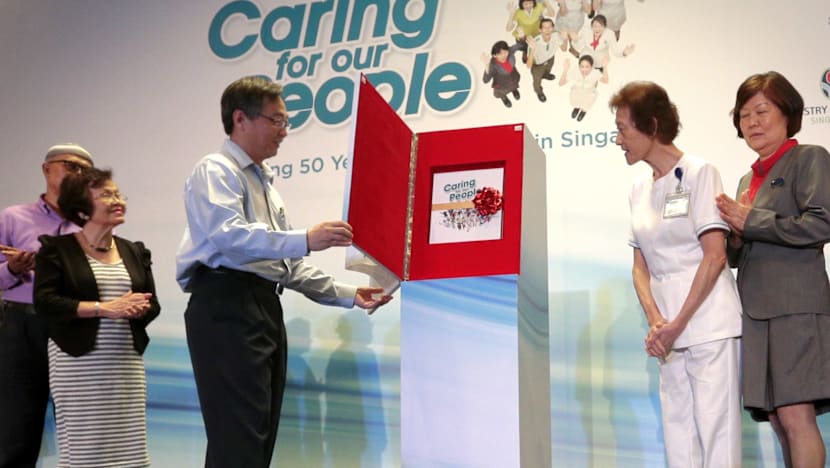
Health Minister Gan Kim Yong at the launch of the book today. Photo: Jason Quah


SINGAPORE — Once a month, retiree Ellen Toh goes to KK Women’s and Children’s Hospital (KKH), dons a wig and a shiny red nose, and smears white paint on her face. There, she sings, dances and performs tricks for sick children. Mdm Toh, 60, is one of the founders of Caring Clowns, a 10-man volunteer group at KKH. The volunteers met at a clown camp in 2004 and banded together shortly after.
Reflecting on the experience, she said: “The most memorable incidents are not the ones that made me laugh, but (that) made me cry.”
One incident involved a boy who had attempted suicide.
“It was a classic case of bullying, and I guess he wanted to talk to someone. Since I was in my clown persona, he felt comfortable,” said Mdm Toh. When she returned the following month, the boy had been discharged.





Another volunteer, Mdm Vivienne Tan, recounted meeting a 15-year-old girl, listless and weakened by an infection. “I told her mother, ‘How about I try and reach out to her?’ I told her how pretty she is, and wished her well through my puppet,” she said. The girl attempted a smile — through her oxygen mask — and touched the puppet.
“Her mother had tears in her eyes because she hadn’t responded to anyone in quite a while,” said Mdm Tan, 59.
The Caring Clowns are featured in a commemorative book marking 50 years of healthcare in Singapore. Launched today (Oct 8) by Health Minister Gan Kim Yong, it features over 50 interviews with doctors, nurses, volunteers and patients, including Asia’s first test-tube baby Samuel Lee.
“My friends used to be sceptical about test-tube babies. But once they see me, they know that the process is not that tedious. So that’s why they tried to accept the idea and, after many years, they conceived,” said Mr Lee, now 32.
Today, 187 healthcare professionals also received the Ministry of Health Long Service Awards. Among them was Associate Professor Sonny Wang, an emeritus consultant at Tan Tock Seng Hospital, who has chaired MOH’s Haze Advisory Panel since 1997.
Asked about the panel’s contributions, Assoc Prof Wang said: “The panel has helped to provide medical evidence of the effects (of the haze) to the MOH. The (haze health) advisories are a result of the interaction of the haze advisory panel, which consists of an eye expert, lung expert, cardiologist ... with the MOH.”