Companies expect rough waters next year: Survey
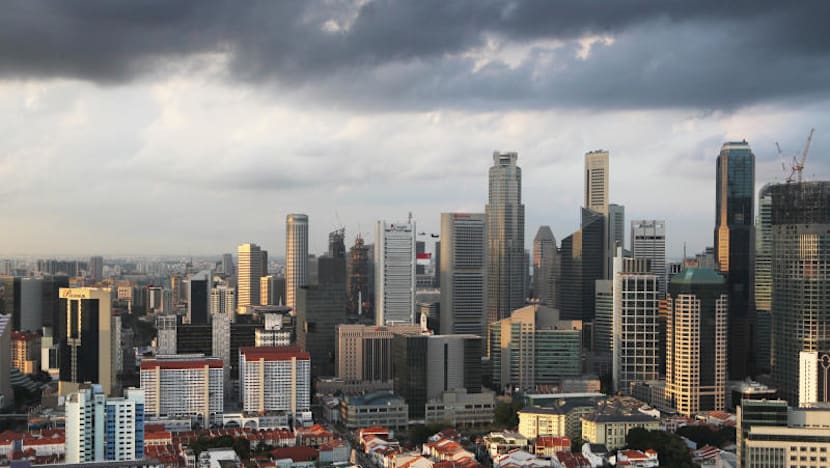
The Central Business District of Singapore bathed in evening light on 19 July 2014. Photo: Ooi Boon Keong/TODAY


SINGAPORE — A sizeable number of companies here expect the economy to worsen next year, after a weak 2016 which saw businesses grappling with operational costs and manpower issues.
And despite the Government’s huge push for economic transformation, most businesses are “not embracing the ... message”, said the Singapore Business Federation (SBF) on Wednesday (Dec 28), following an annual survey among its members. Apart from a negative outlook on the economy, the companies involved in the survey were also lukewarm towards existing government business policies and called for short-term support measures to help tide them over the sluggish conditions.
The survey findings — which were released on Wednesday — showed that among more than 1,100 companies which responded, almost half (48 per cent) expect the economic situation to deteriorate in the next 12 months. Only 11 per cent predict it will be better while 41 per cent expect the situation will remain the same as this year.
The National Business Survey was conducted in October and last month by the SBF among its members across all major industries. About two-thirds of the firms said that the economic climate has worsened over the past year. Apart from rising costs, companies also cite government regulations including bureaucratic red tape, fees and levies as among the challenges.





The survey also found that while 43 per cent of the businesses agree on the need for companies to transform in order to adapt to slowing economic growth, technological change and disruption, only 18 per cent indicated that they “strongly agree”. “More can be done to mobilise companies to be ready for further economic transformation,” said the SBF, which noted that less than one fifth of the respondents felt the Budget 2016 measures were sufficient in helping businesses cope on the various fronts.
On the Government’s broader business policies, only 28 per cent of the businesses said they were “satisfied” or “very satisfied” while a majority of the respondents (52 per cent) were “neutral”. “This indicates that the steps taken in Budget 2016 are not far-reaching enough and do not have significant near-term impact,” the SBF said.
The slew of Budget initiatives announced in March included raising corporate income tax rebates, subsidising wages of older workers and loan assistance for small and medium enterprises (SMEs). But the SBF said: “Overall, none of the measures ... appear to have left a lasting impression with businesses.”
For next year’s Budget, companies felt that short-term measures “to counteract economic conditions” should be the Government’s main objective, followed by support for the growth of SMEs and homegrown firms, and assistance for businesses to adapt to technological changes. Specifically, steps to address manpower issues and lower compliance cost, fees and taxes topped the companies’ wish list.
The Government has said it will hold fast to its goal of having a two-thirds Singaporean core in the economy, as the country embarks on a new stage of growth. Pointing out that manpower is a perennial issue among companies, CIMB Private Banking economist Song Seng Wun reiterated that it is “unlikely that the Government would back down” from its position on imported labour.
Nevertheless, he felt that there is scope for policymakers to look at how compliance costs can be lowered. “This could come in as a relief for companies in the current economic climate. Especially for smaller businesses, this becomes more of an issue to them when times are tougher,” said Mr Song.
Business owners TODAY spoke to were concerned about the gloomy economic outlook. Ms Cyan Ng, co-owner of The Singular Brewers, said: “People will think twice before spending money on meals ... We hope to see some assistance in rental and labour costs, and increased incentives for entrepreneurs, to tide us over the next two years.”
Despite a better official forecast for Singapore’s economy next year compared to this year, an industry index last week also showed that SMEs here are pessimistic about their prospects for the first half of next year — the first time the quarterly SBF-DP SME Index showed such negative sentiments since it was started seven years ago. Compared with the previous survey, the index fell by 0.4 point to 49.8, with business owners expecting turnover and profitability to sour in the coming months. The index seeks to measure a six-monthly outlook among SMEs, with a reading of 50 and above indicating optimism.
Last month, the Ministry of Trade and Industry (MTI) cut the top end of its full-year growth forecast for this year by half a percentage point. The economy is now expected to grow between 1 and 1.5 per cent for the whole of this year. For next year, the MTI forecasts gross domestic product to grow between 1 and 3 per cent.
Association of Small and Medium Enterprises president Kurt Wee said: “Sentiments are negative and in the meantime, costs remains high. However, we must note that a recovery always starts at the bottom, and businesses should take the opportunity to strengthen and build their market reach, so that they will be ready when there is a reflection point for recovery.”
SBF chairman Teo Siong Seng stressed that transformation requires a “continuous effort”. “Some companies think that (transformation) is (all about) high technology and IT. So when they are having problems, of course they don’t think about changing. But transformation can be a way of doing things,” he said. The association will look at how it can better convey the Government’s message to the companies, he said.
CORRECTION: In an earlier version of this report, we had wrongly referred to Ms Cyan Ng as Mr Ng. We are sorry for the error.