Covid-19: Rise in infections at dorms due to ‘final stretch of clearance work’, Lawrence Wong says
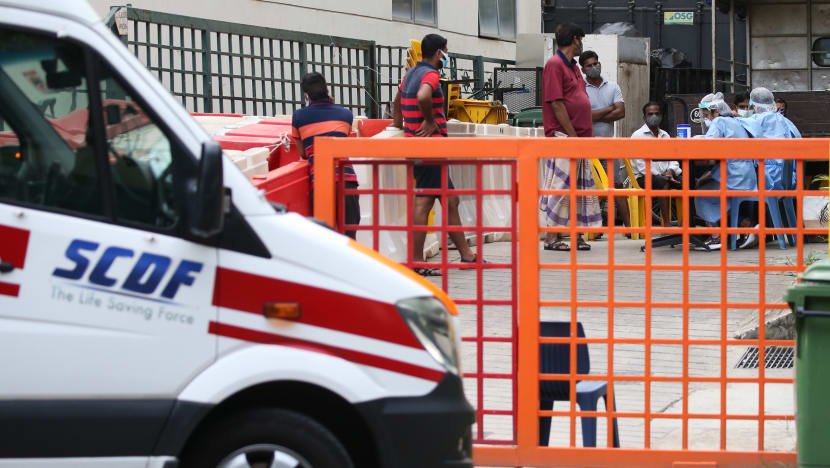
Migrant workers waiting to have a consultation with medical workers at a factory-converted dormitory. National Development Minister Lawrence Wong said that the aim is to clear all workers staying at dormitories of Covid-19 by mid-August or earlier if possible.


- More than 300 foreign workers tested positive on three days this week so far
- This is happening as dormitories with higher prevalence of infections are being “cleared” and workers tested, Mr Lawrence Wong said.
- Target is to clear all workers of the disease by mid-August or “possibly earlier than that”, he added
- Singaporeans should be “mentally prepared” to remain in Phase Two of the circuit breaker exit for some time, Mr Wong said
SINGAPORE — There has been a rise in the number of Covid-19 cases involving foreign workers in dormitories as the authorities are in the “final stretch of clearance work” to make sure workers with a higher chance of catching the disease are tested and certified fit to get back to work.
This was what National Development Minister Lawrence Wong said on Friday (July 17) when he was explaining why dormitories have seen infections gone up from 100 and 200 new cases earlier this month to more than 300 on three days of this week so far.





“In this final phase, as we clear through this last group of workers, we are finding more of them (testing) positive at the tail end or at the final test,” he said. “And that’s why you have seen some increase in the Covid cases from the dormitories in recent days, including today.”
The authorities do expect this trend to continue over the coming days, he added.
Mr Wong, who co-chairs the governmental task force handling Singapore’s response to the Covid-19 pandemic, was speaking at a virtual press conference to give an update on the situation here.
On Friday, the Ministry of Health (MOH) reported another 327 new cases of Covid-19 in Singapore, including nine in the community and three that are imported. The rest of the 315 cases are linked to migrant workers at dormitories.
The two other days this week when more than 300 cases were reported were Monday and Tuesday, when 306 and 338 cases respectively were confirmed.
Just last Thursday, the number of reported infections at dormitories dropped to 103, the lowest since mid-April, about a week after the circuit breaker to restrict movement and activities kicked in on April 7.
Mr Wong said at the press conference that the aim is to clear all workers in the dormitories of the disease by mid-August or “possibly earlier than that”.
He noted that more than 230,000 workers have either recovered or have been tested to be free from the coronavirus.
More than 300,000 workers here live in dormitories, be it purpose-built or factory-converted ones.
Calling this an “important milestone” since the flare-up of infections at these living quarters in April, he said: “We are reaching the final stretch and are able, very soon, to complete the clearance of all the workers, all the dormitories and eventually have these workers back at work.”
When asked why dormitories with higher prevalence of infections were dealt with only at the tail end of the testing process, Associate Professor Kenneth Mak, director of medical services at MOH, said that it is part of the strategy to weed out Covid-19 spread at dormitories.
The priority of the inter-agency task force that was set up to handle the outbreak at dormitories was to clear venues with lower prevalence since “it was easier” to handle those, he said.
“That’s not to say that we are only belatedly finding higher prevalence in some of these dormitories,” he added.
“We were already aware that the prevalence might be higher in some dormitories, but it was easier to clear those (with) lower prevalence much earlier. Therefore those were prioritised in the overall clearance strategy.”
PHASE 3 ‘NOT GOING TO HAPPEN ANYTIME SOON’
When asked if Phase Two of the progressive exit from the circuit breaker might stretch on longer than planned, Mr Wong said that Singaporeans need to be “mentally prepared” that Phase Three “is not going to happen anytime soon”.
“We are not going back to life before the circuit breaker anytime soon,” he said.
Phase Two began on June 19.
In May, the task force had said that this was expected to last several months.
Then, depending on the disease transmission and the authorities’ risk assessment, measures and regulations will continue to be eased gradually until Singapore reaches “a new normal” in Phase Three.
This is where Singapore can expect to remain until an effective vaccine or treatment for Covid-19 is developed.
Mr Wong said on Friday that the authorities will try their best, through a range of measures, to not have to impose another broad-based circuit breaker or lockdown.
“We want to avoid that. We don't know if we can achieve that outcome. But I believe if everyone cooperates, and through the enhanced capabilities that we have now for testing and tracing, we will be able to do it,” he added.
“But, again, it cannot be done by the Government alone. Everyone must do their part.”