Education system championing skills, academics possible: Ong Ye Kung
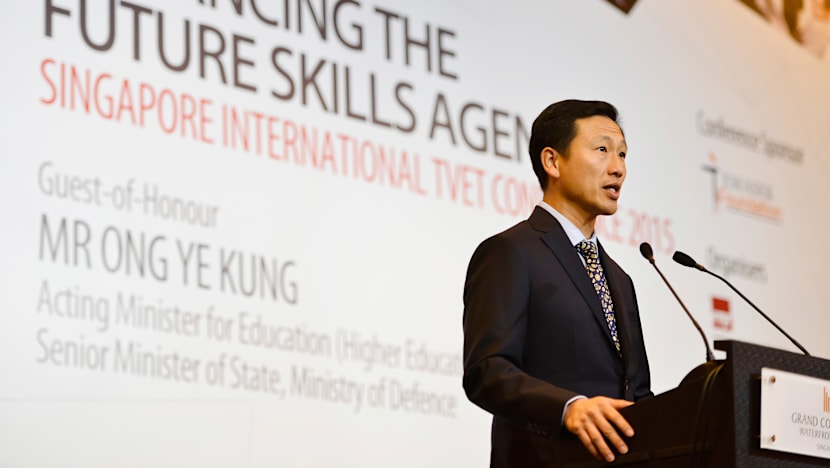
Acting Minister for Education (Higher Education and Skills) Ong Ye Kung speaking at the TVET Conference 2015. Photo: ITE
SINGAPORE — Pointing to the blurring distinction between vocations and academics, Acting Minister for Education (Higher Education and Skills) Ong Ye Kung said Singapore is in a position to develop its own system by combining the best of examples set by other countries: The rigour of a European vocational training system and the pragmatic nature of the United States employment market.
A young and multicultural country like Singapore does not have “deep-seated historical biases or baggage” of countries like China, India and the European nations, Mr Ong said. This makes it possible to create our own system, “one in which skills are not subordinate to academic knowledge, one in which both are needed for our society and economy to excel”, said Mr Ong, in his speech delivered at the Singapore International Technical and Vocational Education and Training Conference.
For instance, the ancient Chinese concept of “Shi” (court official), “Nong” (farmer), “Gong” (vocational tradesmen) and “Shang” (businessmen) appeared to be a social hierarchy where academics were held in higher esteem than tradesmen. Similar hierarchies through occupation were also entrenched in the Indian civilisation, noted Mr Ong.
In contrast, the tradition of guilds created by tradesmen and craftsmen from the Middle Ages have seen the vocational pathway develop parallel to, and not subordinate to, the academic pathway, especially in countries such as Switzerland and Germany. Meanwhile, in the US, a pragmatic approach with a myriad of certification courses has been taken when it comes to skills and vocational trade.





“Given economic realities today, the distinction between vocational training and academic tracks is becoming less meaningful,” he said. “Traditional craftsmen need knowledge to distinguish their work and academics need hands-on skills to excel.”
Citing the examples of accomplished vocational tradesmen such as the late Apple chief executive Steve Jobs, Mr Ong attributed his success to an early foundation in vocational skills combined with knowledge of technology, markets and consumers. And while author JK Rowling’s Harry Potter has become a brand and a multibillion dollar enterprise of movies, merchandise and theme parks, she began as a writer.
“I believe that to excel and accomplish something innovative and extraordinary, one must have deep skills sets hardwired into your anatomy, so your movements and responses are visceral and instinctive,” said Mr Ong, likening it to the years of training and hard work of professional players such as footballer Lionel Messi.
Mr Ong, who had previously spoken of the need to develop an education system that caters more to individuals’ aspirations, also reiterated the need to include personal aspirations into admission systems of educational institutions.
“I think we can also afford to dial in a greater bias towards personal aspirations in that admission system. That is to say, to build a choice architecture that better allows individuals to enter a course of study that can better fulfil personal aspirations and help them go as far as possible,” he said.
Urging educators and employers to not be “too quick to dismiss individuals’ interests and aspirations” if they can demonstrate their strengths in ways beyond academic qualifications, Mr Ong said educational institutions will place greater emphasis on holistic admissions.
“This will be a cultural shift. One that requires employers, education institutions and training providers and society to move in tandem, and openness in viewing the world and our society through new lenses,” he added.