Elected Presidency: Rules to regulate campaigning methods needed, says Commission
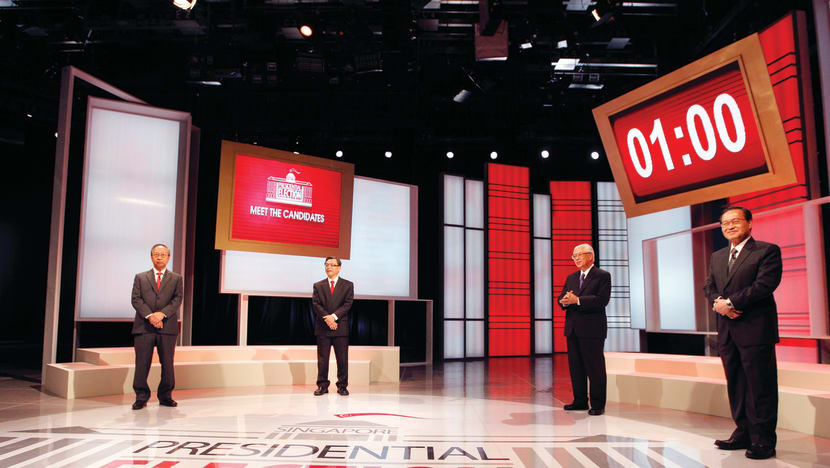
The last time Singapore held a contested presidential election was in 2011. (L-R) Candidates Tan Cheng Bock, Tan Jee Say, Tony Tan and Tan Kin Lian at the recording of Mediacorp's Meet The Candidates programme.
SINGAPORE — Citing how some candidates promised to pursue particular policies if they were elected in the 2011 Presidential Election — despite it being beyond a President’s constitutional remit — the Constitutional Commission has proposed that it be an offence for candidates to make promises “incompatible with the office of President”, and for such breaches to be punished, such as with criminal sanctions.
And with little need for a “vigorous contest of ideas” when it comes to presidential elections, the commission proposed that rules be drawn up under the Presidential Elections Act to regulate campaigning methods, such as excluding acts that might “inflame emotions”, noting that it was “unclear” whether the holding of rallies, for example, was “necessary or helpful”.
A “white list” of approved campaign methods, such as televised debates or speeches, could be drawn up, said the commission, in its report on the Elected Presidency released on Wednesday (Sept 7).
It also agreed that there was a strong need for greater education on the role and powers of the Elected President, which had been a widely-held view among those who had offered their views on the EP during public consultation earlier this year.





The nine-member commission, led by Chief Justice Sundaresh Menon, noted that Prime Minister Lee Hsien Loong had said in Parliament in January that some candidates “campaigned for President as if they were going to form an alternate Government”.
“The Constitution gives him power to block certain actions of the Government, in areas which are specifically carved out for him,” Mr Lee said. “But it does not give him the power to initiate policies or generally to champion policies.”
The commission also noted that former Cabinet Minister S Jayakumar had, in his memoir, observed that the promises given by candidates during the last presidential election were “disappointing, misleading and a great disservice to the electorate”.
Addressing whether the rules governing campaigning for the Presidency should be changed, the commission pointed out that the President plays “no role in setting the national agenda nor does he make policy decisions as to the course that the nation should chart”.
While a parliamentary election is a “contest of ideas and policies”, candidates for presidential elections have no policy agenda to advance, the commission said, adding: “There is little, if any, need for the vigorous contest of ideas that takes place during a parliamentary election.”
Presidential candidates, said the commission, should be required to conduct their campaigns “with rectitude and dignity as befits the office and comports with the unifying role and purpose of the Presidency”.
But the commission felt there was no need to prohibit endorsements of presidential candidates by political parties, as suggested by some who had offered views on the EP.
Explaining its views, the commission said political parties are likely to have strong and potentially relevant views on the merits or demerits of presidential candidates.
It would also “not be feasible” to prevent endorsements by politicians speaking in their public capacity as compared with their personal capacity, as it would be “very difficult to distinguish between the two in practice”, the commission said. On public education on the EP, the commission said it should focus on the role and powers of the President, and the interplay of powers between the President and the Government, among other things.
“The commission views with grave concern the fact that elections to the office may have been contested without a correct understanding of the precise scope of the roles and responsibilities of the Presidency,” said the commission. “This needs to be remedied.”
Apart from concerns that the voting public would be misled by candidates’ “grandiose promises”, the commission also noted some may downplay the role of the President on the basis that it has no power to advance a policy agenda. “The commission considers that this would be a serious mistake,” it said.
Public education should start in schools, but it should also continue beyond that, it added.
TIMELINE OF SINGAPORE'S PRESIDENTIAL SYSTEM