Employment growth sinks to lowest in 12 years
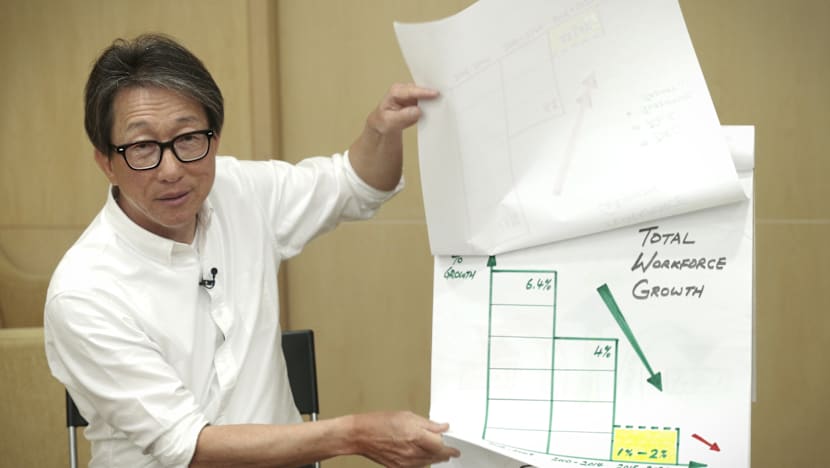
Manpower Minister Lim Swee Say estimates that local workforce growth would remain slow for the next five years - at about one per cent yearly. TODAY photo: Jason Quah


SINGAPORE — The Republic saw its worst year-on-year employment growth last year since 2003 — with close to no local employment growth — but citing real growth in median income, the consistently low unemployment rate and high labour force participation, Manpower Minister Lim Swee Say today (Jan 28) assured Singaporeans there was no cause for panic.
Total employment grew an estimated 31,800 — or 0.9 per cent — amidst the gloomy global economic conditions, slower economic growth and the clampdown in foreign manpower supply. Of this, only 100 jobs were filled by Singapore citizens and permanent residents, following growth of 82,900 and 96,000 in 2013 and 2014 respectively.
Speaking to reporters today as the Ministry of Manpower (MOM) released these figures, Mr Lim noted the “sustained growth” in real wages — for full-time employed citizens, the nominal median monthly income, inclusive of employer Central Provident Fund contributions, rose 6.5 per cent to S$3,798 over the year.
He also noted the resident labour force participation rate was 83.1 per cent, and the employment rate of 80.5 per cent. At 2.8 per cent, resident unemployment rate was also low. According to MOM figures, in 2003, when total employment shrunk by 12,900 (0.6 per cent), resident unemployment was high at 5.2 per cent.





“In 2009, when local employment growth dropped, unemployment went up. The main cause was due to a lack of jobs,” said Mr Lim “In 2015, the drop in the growth in local employment did not lead to any change in the unemployment rate. The constraint was not on jobs, but due to the workforce.”
Over the next five years, local employment growth would likely hover at about 1 per cent. “Looking beyond that, this decline is likely to continue because our local workforce growth will eventually meet a negligible growth, if not stagnation, given that the baby boomer generation is now entering retirement age,” said Mr Lim.
As for the foreign workforce, Mr Lim estimated that it would continue to grow at about 2 per cent: “We think we’re at the right level, at least for the next five years.”
Stressing the restrictions on foreign manpower must remain, Mr Lim said Singapore will continue to strive for a manpower-lean economy, noting that manpower could be “bottleneck of our future growth”. The Government will address the restructuring issues at a sectoral level, he added.
The MOM, which released these preliminary estimates in a labour market report today, pegged the flatness in local employment growth to the exit of casual workers in retail trade, and the slowdown in sectors such as manufacturing and real estate services.
Excluding foreign domestic workers, foreign employment grew by 22,600 last year, down from 48,400 and 26,000 in 2013 and 2014 respectively. The spike was led by the services sectors, such as information and communications, construction, transport and storage, food and beverage and administrative and support services.
The manufacturing sector saw a sharp decline of of 22,400. The construction and services industries saw employment increasing by 9,000 and 45,000.
The overall unemployment rate dipped to 1.9 per cent last year, down from 2 per cent in the year before, while citizen unemployment rate was largely unchanged at 2.9 per cent.
More workers (14,400) were laid off last year compared to the year before (12,930). This increase was led mainly by the manufacturing and services sector.
Economists told TODAY that more lay-offs – especially in the manufacturing, oil and gas sectors - may be on the cards this year, with many companies downsizing given the uncertain global economy.
“The need for headcount is not going to be there,” said Barclays senior regional economist Leong Wai Ho. “The global demand is not there, with China’s drive to be more self-sufficient.”
OCBC economist Selena Ling said: “On the retail side, if you look at the number of malls that have sprung up in the last couple of years, a lot of them are run-of-the-mill. So a little bit of consolidation may came at the retail or trade level.”
Employment growth could be negative, she warned. “The reality is that local businesses, especially small and medium enterprises, have a really hard time trying to recruit and retain talent. They either pay more or become more labour-lite.”
CIMB private banking economist Song Seng Wun added that young graduates may take longer than usual to find jobs, and Professionals, Managers, Executives and Technicians could face challenges in rejoining the workforce after being laid off.
CORRECTION: In an earlier version of this story, we reported that employment growth for locals was 82.9 per cent and 96 per cent in 2013 and 2014, respectively. This is incorrect. Growth in the number of locals employed was 82,900 and 96,000 in 2013 and 2014, respectively. We apologise for the errors.