US onshoring could create new opportunities for Singapore manufacturing firms: EnterpriseSG
Some Singapore firms expanding into the US believe the market is too important to ignore, especially as advanced manufacturing grows and shifting trade policies drive production back to America.
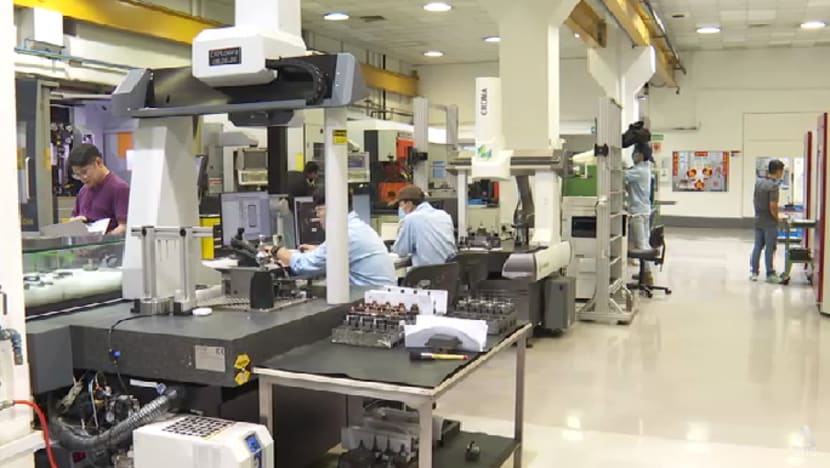
Homegrown firm Sunningdale Tech's facility in Arizona, United States. The precision plastic components maker says global uncertainty has made it increasingly important for suppliers to be physically present in the US.

This audio is generated by an AI tool.


AUSTIN, Texas: At a manufacturing facility in Austin, self-programming robots are making finishing touches to machine components with little human intervention.
Powered by artificial intelligence, the software allows robots to scan parts to determine the geometry, generate their own tool paths and adapt to variations in shape or orientation to deliver precise production results.
Behind the technology is Singapore robotics software startup Augmentus.
“The problem we're solving is really around the high difficulty and the long downtime that exists in conventional robotics,” said the company’s CEO Daryl Lim.





Typically, manufacturers need highly trained engineers to manually programme industrial robots – a process that can take days or even weeks for a single component, especially if it is complex. With orders constantly changing, the entire procedure is often repeated to cater to different components, making production even more tedious.
Mr Lim said Augmentus’ software cut that setup process and costs dramatically. The company provides the “eyes and brains” – cameras, AI software and automation tools – that can be quickly integrated into existing production lines in mere minutes.
The homegrown company opened its Texas office in 2024 to meet rising demand and gain access to a bigger market, particularly in metal fabrication.
Its tech is designed to be plugged into any step of the manufacturing process, ranging from welding and sanding to grinding, spraying and coating.
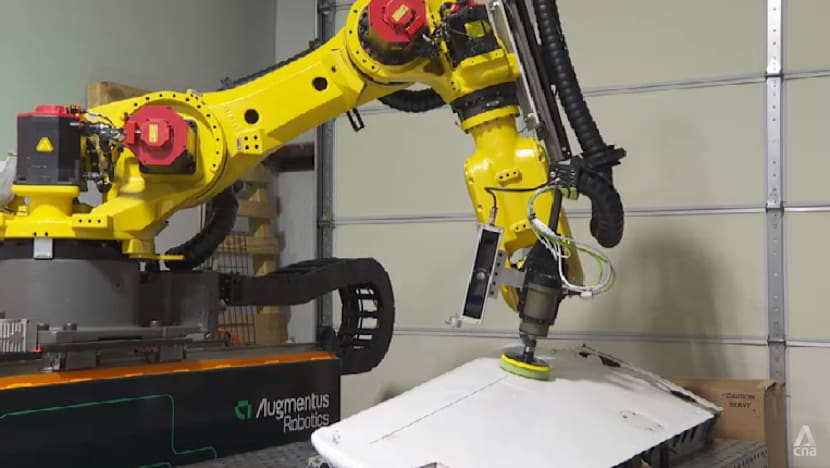
“The United States is a much more homogeneous country … with a much bigger market. And a lot of metal fabrication processes are in America,” said Mr Lim.
The firm is betting that a push to bring manufacturing back to the US will create fresh opportunities for companies with advanced automation capabilities.
Mr Lim added that rising labour costs are accelerating the need for automation across industries, giving his firm opportunities to fill the gaps.
“Automation is not a good-to-have, it's actually a must-have, a necessity,” he said. “With all these factors in mind, America was a bit of a no-brainer for us to double down."
MEDTECH FIRM DEEPENS US PRESENCE
Another Singapore company growing its US presence is plastics parts maker Sunningdale Tech, which operates a plant in Arizona serving the medical technology sector.
The facility manufactures components for products such as glucose monitors and diabetes care consumables.
CEO and executive director Khoo Boo Hor said global uncertainty has made it increasingly important for suppliers to be physically present in the US.
“Customers are really looking into their supply chain strategy,” he said. “Being present (in the US) gives us an opportunity to be close to them, grow with them and participate in new product development.”
Sunningdale has already doubled capacity at its Arizona plant and expects its US medtech business to grow at a double-digit pace over the next few years.
With the US home to the world's biggest medtech market, the firm wants to expand its US business to half of its total medtech revenue.
The company also plans to deepen relationships with existing customers, while exploring merger and acquisition opportunities to expand further across the US market.
OPPORTUNITIES AND CHALLENGES
Enterprise Singapore (EnterpriseSG) said the reconfiguration of global supply chains could create significant opportunities for Singapore firms with strong manufacturing capabilities.
US President Donald Trump has made rebuilding America’s industrial base a central part of his economic agenda. Since returning to the White House for a second term in January last year, he has rolled out tariffs and policies aimed at encouraging companies to manufacture more products domestically and reduce reliance on overseas supply chains.

“Precisely because the current government is trying to grow the manufacturing capabilities of the US, we will definitely see manufacturing activities in the US grow in the next few years,” said EnterpriseSG’s Americas director Lim Seow Hui.
“This will provide a lot more manufacturing opportunities for Singapore companies to partner with US firms.”
She added that Singapore companies are attractive partners because they are known for high-quality production standards, strong intellectual property protection and come with an established network or launchpad in Asia.
Still, expanding into the US comes with challenges. Companies must navigate rising operating costs, regulatory requirements and uncertainty around tariffs and trade policy.
Augmentus said tariffs initially raised costs for some hardware it shipped from Singapore, forcing the company to rethink sourcing and supply chains. Sunningdale, meanwhile, pointed to rising material, labour and energy costs as major concerns.
EnterpriseSG said it continues to support Singapore firms by connecting them with legal advisers, consultants and local networks to help them navigate regulations and grow overseas.