Factory activity grew for 11th straight month in July
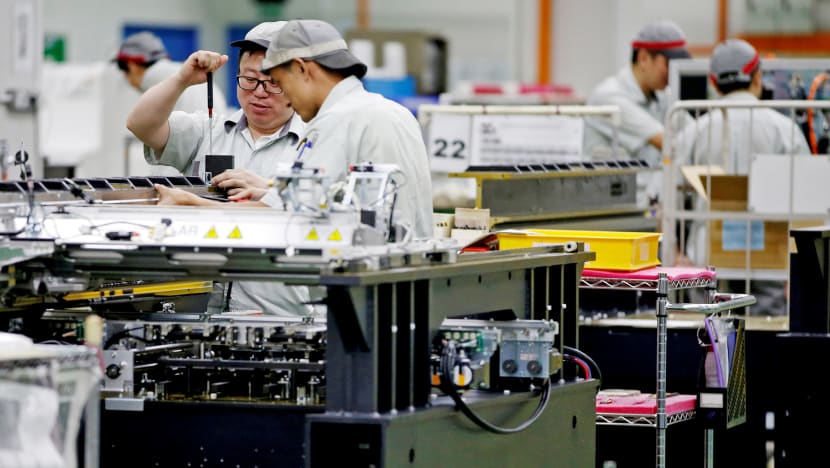
Reuters file photo


SINGAPORE — Manufacturing activity posted its 11th consecutive month of expansion last month, as the tech segment continued to provide support. Economists have a mixed view on the manufacturing sector going forward, with some expecting it to moderate, while others say a seasonally stronger second half of the year could continue to prop up the sector.
The Purchasing Managers’ Index (PMI) edged up by 0.1 point from June to 51 points last month, according to data released by the Singapore Institute of Purchasing & Materials Management (SIPMM) yesterday, above the 50-point mark that separates expansion and contraction.
The increase was attributed to improvements in new orders, new exports, and factory output. However, the reading was affected by a lower inventory level and contraction in employment, said SIPMM.
The electronics sector PMI recorded its 12th straight month of expansion, up 0.1 point from the previous month to 52.2 points, attributed to increases in electronics new orders, new exports, factory output, and inventory level.





“The interesting thing is that the tech sector continues to expand and sentiments seem to be fairly positive. The tech PMI is holding well and the overall PMI suggests that quality-wise there is broad-based improvement in manufacturing activity beyond just tech,” said CIMB Private Bank economist Song Seng Wun. “We will still see fairly robust growth in manufacturing from a year ago ... As the second half of the year is seasonally always stronger than the first half, notwithstanding political risks, things look good for the rest of the year.”
Meanwhile, Ms Selena Ling, head of treasury research and strategy at OCBC Bank projected that manufacturing growth would likely moderate from the “stellar” 8.3 per cent growth seen in the first half of this year to a more modest 5.1 per cent year-on-year growth in the July to September period, and possibly contract 2.4 per cent year-on-year in the fourth quarter due to a high base a year ago.
Ms Ling noted that Singapore’s manufacturing improvement for last month was surprising because the recent global and regional PMI prints were mostly softening.
Some manufacturing PMIs in Asia have dipped back into contractionary territory or remained in contractionary mode, as seen with PMIs for South Korea, Thailand, Malaysia, Indonesia and India, she observed.
Mr Song, however, was not as worried about the softening growth in the region, as he attributes the distortion to Ramadan and the Hari Raya festivities in the weeks surrounding the period, as well as India’s softening due to the introduction of the goods and services tax.
Growth is still seen coming from the United States and European Union, as well as from China, said Mr Song. “In the US and EU, it looks like there is sufficient momentum supportive of tech for the second half of the year. China’s PMI is holding above 50 and the Caixin went up from the previous month. Underlying momentum there is still positive,” he said.
The world’s manufacturing hub, China’s private sector Caixin/Markit manufacturing PMI, came in at a four-month high at 51.1 points last month, from 50.4 points the previous month.
The official China PMI, which mostly covers larger state-owned manufacturers, continued on expansionary mode at 51.4 points.