Factory activity shrinks in March, but at slower pace
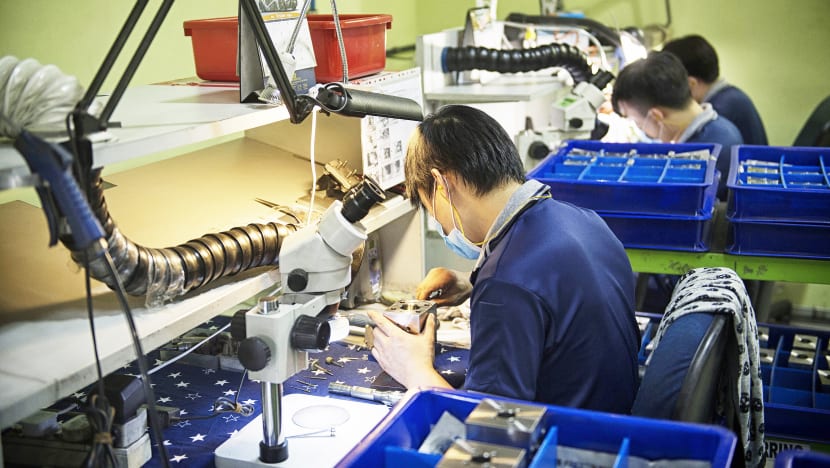
Employees working at a manufacturing facility in Singapore. Experts say it is hard to tell if last month’s PMI improvement can be sustained. Photo: Bloomberg


SINGAPORE — Manufacturing activity in Singapore shrank for the ninth straight month in March, but the pace of contraction slowed markedly as factories in China, Asia’s largest economy, recorded an unexpected pickup. Despite the improvement, economists warned of continued weak prospects for the city-state for the rest of this year.
The Purchasing Managers’ Index (PMI) stayed below the 50-point threshold that separates expansion from contraction, but rose 0.9 of a point from the previous month to 49.4 points last month, said the Singapore Institute of Purchasing and Materials Management (SIPMM) Monday (April 4).
New orders, new export orders, factory production, input prices and manufacturing sector employment all continued to contract, although at a slower rate, showed the data. Imports, inventory, and stocks of finished goods continued to record expansion, but at an uneven pace. Meanwhile, the key electronics sub-index shrank for the ninth straight month but recorded a slower rate of contraction at 49 points in March, a marked improvement from the 48.2 points the previous month.
“In a broad sense, we have a rebound in activities after the Chinese New Year holidays and less bad figures. This shows a very weak recovery. The figures are essentially a slight reprieve but it is still at a contraction with subdued activity,” said Mr Song Seng Wun, CIMB Private Banking economist. “For Asian factories, the across-the-board rebound in the March readings for the various components from orders, output to employment had to do with factories being busier after the holiday-shortened month of February. So we could say that a busier China had contributed to the global rebound in manufacturing activities in March.”





Last month, the PMIs for Indonesia and Taiwan rebounded into expansion while those of Malaysia and South Korea contracted at a slower pace. The official Chinese PMI, which covers larger state-owned manufacturers, rose to 50.2 points in March from February’s 49.0, returning to growth for the first time since July.
Meanwhile, the private sector Caixin/Markit Chinese PMI, which focuses on small and medium-sized firms, remained in contractionary mode but rose sharply to 49.7 from 48 in February.
Economists said it is hard to tell if last month’s improvement in the Singapore PMI can be sustained given the uncertain macro-environment.
“Both Singapore’s new orders and new export orders gauges for headline and manufacturing and electronics remain in contraction territory, despite the March improvement, suggesting that a full-fledged domestic recovery is still some way off … The first half of this year’s growth picture remains lacklustre. Gross domestic product growth may expand by 2.2 per cent year-on-year in the first quarter of this year, dragged down by manufacturing, which is tipped to shrink 2.1 per cent year-on-year,” said Ms Selena Ling, head of Treasury Research & Strategy at OCBC Bank.
Mr Song said: “Fingers crossed for the rest of the year because there are still plenty of downside risks. Geopolitical risks have not subsided. Downward pressure on energy prices remains. Brexit (with the referendum on June 23) and the divisive US presidential election (on Nov 8) are also key events that could affect consumer and business confidence.”