Fees at polytechnics, ITE to increase for next year’s cohort
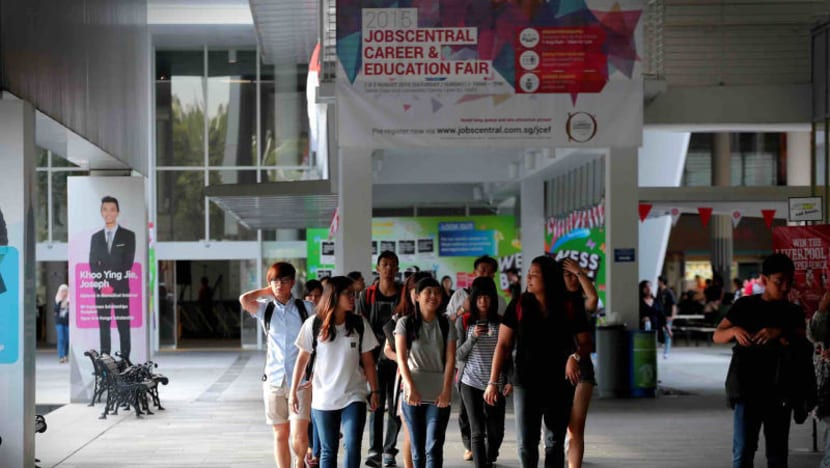
Tuition fees for students who enrol in polytechnics and ITEs will go up in the coming academic year. TODAY file photo
SINGAPORE — Tuition fees for students who enrol in polytechnics and Institutes of Technical Education (ITEs) will go up in the coming academic year.
For polytechnics, this will be at least the sixth consecutive increase (beginning from 2013). For Singapore citizens, full-year fees will go up by S$100 to S$2,800. For Singapore Permanent Residents (PRs), fees will increase by S$200 to S$5,600 and, for international students, the S$400 increase means full-year fees will hit S$10,000.
Meanwhile, for ITE students enrolling next year in a Nitec course, fees will go up by S$20, to S$370 a year for Singapore citizens; by S$300, to S$4,950 for PRs; and by S$900, to S$13,350 for international students.
There will be no change in fees for those enrolling in a Higher Nitec course in 2018 — fees for citizens, PRs, and international students, will remain at S$590, S$7,760 and S$20,360, respectively.





The academic year for polytechnics will commence in April, while the ITEs have two intakes: One in January, and another in April. Students will be informed of the increased fees before they enrol.
The Ministry of Education said tuition fees are reviewed annually and adjusted when necessary to defray the increased cost of quality education. “Where possible, it is preferable to have regular but small fee increases than a significant hike in any one year,” it said.
Even after the increases, the Government continues to heavily subsidise about 85 per cent of the cost of a polytechnic education and over 90 per cent of the cost of an ITE education for Singapore citizens, said the ministry.
A spokesperson for the polytechnics and ITEs said financial assistance would be available for needy students.
The polytechnics and ITEs adopt a cohort-based fee structure. This means that a student’s fees will remain constant throughout his/her time in school.
“This fee structure will provide greater certainty regarding tuition fees and help students to better plan the financing of their studies,” the spokesperson said.
“ITE and the polytechnics will continue to receive a substantial subsidy from the Government to cover the bulk of the costs,” the spokesperson added.
As for the Autonomous Universities, TODAY understands that the tuition fees are still under review, and that any fee changes will be made known to prospective students prior to enrolment.
For parents such as Ms Juliana Ho, 44, whose 16-year-old daughter is considering heading to a polytechnic, the fee increase “has come at a bad time”, given recent talk of an impending tax increase.
But others such as Mr Kelvin Seow, 50, whose youngest son will be applying to a polytechnic, said he did not mind “paying a bit extra”.
“As long as the increase is not too extreme … (and) the quality of education doesn’t drop, I am fine with it,” the businessman added.
The five polytechnics have increased their fees for the incoming cohort since 2013.
The increase has been greater for international students. Those who matriculated in the academic year of 2016 paid S$700 more than their seniors from the previous year.
As for ITE, fees were also on the up and up, with the exception of 2014 for Nitec students, and 2018, where fees for Higher Nitec students will remain unchanged.
International students who enrolled in Higher Nitec courses in the 2016 academic year paid S$1,350 more than the previous year – the largest jump in fees for this group since 2012.
This year, international students who enrolled in ITE’s Nitec courses paid S$1,050 more than their seniors from a year ago.