Food industry uses innovation to widen its menu
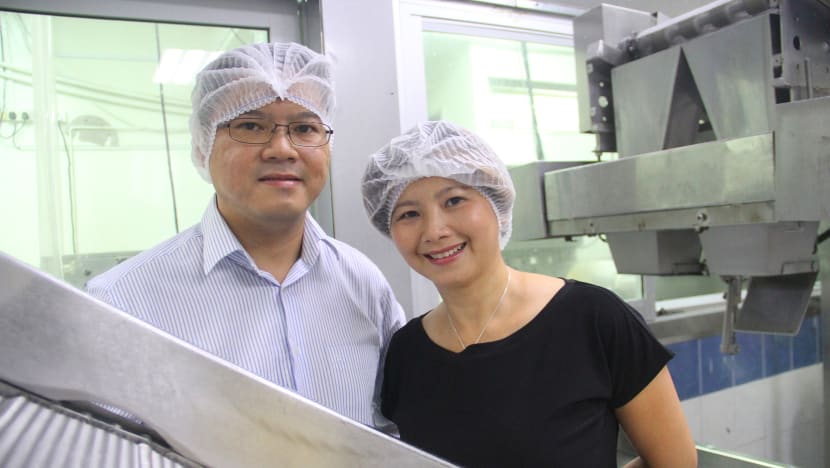
Annie Tan and her brother Raymond Tan of Tan Seng Kee Food inside the company's factory. Photo: Damien Teo


SINGAPORE — With a big vacuum blender, a bakery can produce 500 cakes a day with only three employees, compared with needing about 10 previously. Meanwhile, an 80-year-old noodle company is now able to export its assortment of Hokkien noodles, mee tai mak and kway teow to overseas markets with a new formula that has extended their shelf lives.
These are among the ways food manufacturers have benefitted from innovation.
In his Budget speech on Thursday (March 24), Finance Minister Heng Swee Keat cited the food-manufacturing industry as an example of how innovation is used in business.
Companies such as noodle-maker Tan Seng Kee (TSK) and bakery Foodgnostic have made use of innovation to transform their business models and enhance growth through internationalisation and food exports, the minister said.





Foodgnostic founder Daniel Tay said: “With the invention of the new big vacuum blender, we can now blend a cake mix of 300kg in five minutes in one session, bigger in quantity than the 80kg of cake mix that previously took 30 minutes to blend. This has helped us with our internationalisation efforts, as we can produce more cakes at a cheaper cost.”
The company also has an online platform shared with other partners, selling its array of cakes, with its best-selling cake being the Fickle Feline, which features an assortment of 10 slices of various flavours.
Noodlemaker TSK started conducting research and development in 2008 and achieved a breakthrough two years later by producing a formula that can extend the shelf life of its noodles from the initial two days to up to one month in normal temperatures. The noodles, when chilled, can last up to six months.
“The noodles are without preservatives,” said Mr Raymond Tan, executive director of TSK.
“With the new formula, we are able to consider overseas markets, something that was not feasible in the past. Even though we are still considered very new entrants to the export market, there is a lot of potential and we expect overseas markets to contribute to up to 50 per cent of our turnover in three to five years.”
Mr Thomas Pek, the president of the Singapore Food Manufacturers’ Association, said he is encouraged that the food-manufacturing industry was recognised as one that is working on innovation. He said that food companies should continue to innovate in order to constantly keep up with the times.
“The Singapore Government has constantly helped us and our industry, and we are very encouraged by the move. Companies have to constantly look to innovation and produce good quality products for not only the Singapore market but also for the world,” Mr Pek said.
“The food-manufacturing industry is not a sunset industry, as Minister Heng mentioned,” Mr Pek added. “Because everyone needs to eat! Be it in good times or bad times, we will still be here.”