Govt to reinforce defence and domestic security know-how in face of new threats
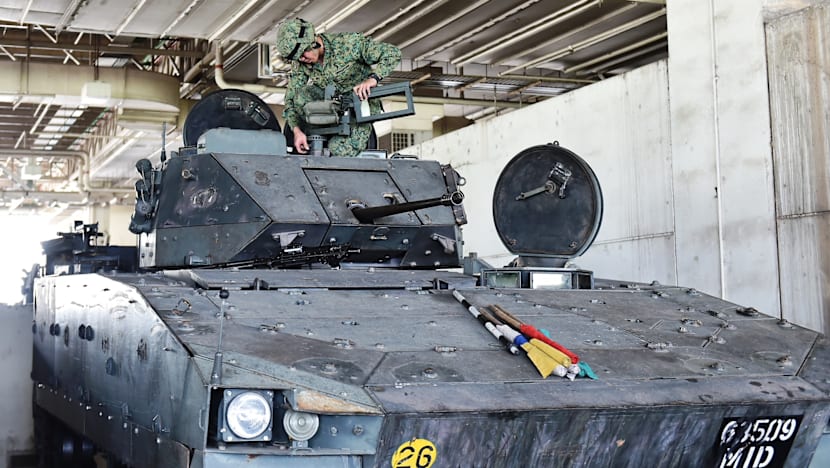
The Singapore Armed Forces will develop new fighting concepts and tap on technological advancements to become more effective.


SINGAPORE — To guard against the emergence of new and unconventional threats, the government will continue to bolster its defence and domestic security capabilities, noted several ministries in their addenda to the President’s Address on Tuesday (May 8).
They will also partner citizens and the community to strengthen social resilience, as well as work with neighbouring countries to ensure Singapore remains relevant globally, they added.
In his ministry’s addendum to the President’s Address, Minister for Defence Ng Eng Hen said new threat scenarios have evolved, as less advanced militaries and even non-state actors can acquire sophisticated technologies and weaponry that were previously the domain of professional militaries.
“Through both physical and virtual threats in the cyberspace, attackers have more avenues to disrupt and destabilise Singapore,” said Dr Ng.





To that end, the Singapore Armed Forces (SAF) will develop new fighting concepts and tap on technological advancements. This will help SAF become more effective, and efficiently use its manpower amid a shrinking manpower pool.
To deal with the regional terrorist threat, which is now at an all-time high, the SAF will also work closely with the Home Team to ensure that they respond effectively and in a coordinated manner. More SAF and Singapore Police Force servicemen will undergo joint security operations training at the SAF’s Island Defence Training Institute, for instance.
In the Ministry of Home Affairs’ addendum, its Minister K Shanmugam described a complex security environment, where criminal syndicates exploit technology and the Internet, and operate across national boundaries. He also noted that there is a worsening global drug situation as new psychoactive substances emerge, even while some countries adopt a more liberal approach towards drugs.
Singapore also needs to guard against attempts by foreign parties to exploit fault lines and influence developments here to advance their own agenda. He added: “It is for Singaporeans to decide on our domestic politics and policies. We must defend our sovereign right to make choices for ourselves.”
The Home Team will make a strong push in digital transformation and robotics in order to deal with these security challenges. These can range from integrating robotics in the operations of the Singapore Civil Defence Force, the Immigration and Checkpoints Authority of Singapore employing more biometric solutions, to the police digitalising the investigation process.
Meanwhile, the National Security Coordination Secretariat under the Prime Minister’s Office will tap on a wide range of experts in the relevant fields to identify emergent risks to national security. This can range from new disruptive technologies to unintended consequences of existing developments.
The secretariat will also conduct national security education programmes to keep public officers up to date with the changing security environment.
Nonetheless, Dr Ng said the strongest weapon against external forces is the unity and resolve to protect Singapore’s way of life, and keep the country independent and sovereign.
He added: “No amount of tanks, planes, or ships – no matter how sophisticated the systems we build – can make up for a divided nation.
“More than ever, Total Defence is needed and every Singaporean has to play his or her part to safeguard Singapore. Only together, can we continue to keep Singapore safe and secure for another generation.”
Likewise, Mr Shanmugam said Singapore’s security response to terrorism threats must be complemented by “community vigilance and resilience”, and SGSecure will continue to be one of the priorities.
As chair of this year’s Association of South-east Asian Nations (Asean), Singapore will not just strengthen Asean’s collective resilience and promote innovation, as it will also enhance the group’s cooperation in areas such as cybersecurity, counter-terrorism and people-to-people linkages.
For Singapore’s long-term security and prosperity, engagement with regional and key powers will also be deepened, said Minister for Foreign Affairs Vivian Balakrishnan in his ministry’s addendum.
He added that relations with immediate neighbours Malaysia and Indonesia remain of “utmost importance”, such as through the connectivity projects with Malaysia and closer economic links with Indonesia.
Key initiatives for each ministry:
Ministry of Defence:
- Develop new fighting concepts, and leverage on technological advancements such as the use of the Aerostat surveillance systems, which can scan Singapore’s seas and skies for threats, high-tech warships like the Littoral Mission Vessels, among others.
- Strengthen cyber defence by training and using qualified full-time national servicemen (NSF), as well as build a capable cyber defence force through partnerships with local Institutes of Higher Learning.
- More effective deployment of servicemen by tapping on technology, which reduces physical demands of selected National Service vocations, and take into consideration NSFs’ interests when assigning vocations.
- Work with neighbours and regional partners to enhance regional stability and address common security challenges
Ministry of Home Affairs:
- New Home Team Operations Centre will use new technologies and harness data for swift response to incidents.
- Push for digital transformation and use of robotics, such as the use of exo-skeletons by the Singapore Civil Defence Force, biometric solutions by the Immigration and Checkpoints Authority, among others.
- Introduce new legislation to allow law enforcements agencies to deal with security threats more effectively. The review of the Penal Code will be completed to enhance protection for vulnerable persons
- Build on community networks, such as prioritising SGSecure and ensuring that various sectors of the community are prepared for emergencies.
National Security Coordination Secretariat, Prime Minister’s Office:
- Work with a wide range of experts, including academia, to enhance the government’s ability to identify emergent risks to national security.
- Identify risks that cut across different networks and domains, and factor these into the Government’s long-term planning.
- Conduct national security education programmes to keep public officers up to date with the changing security environment.
Ministry of Foreign Affairs:
- Emphasise the importance of Asean’s unity and centrality through initiatives such as the Asean Smart Cities Network.
- Deepen engagement with regional and key powers such as China and the United States. Maintain relations with immediate neighbours such as Malaysia and Indonesia through connectivity or economic projects.
- Continue to promote free trade and regional economic integration, such as pushing for progress on the Regional Comprehensive Economic Partnership and Economic Union-Singapore Free Trade Agreement.