Govt unveils road map to transform food services industry
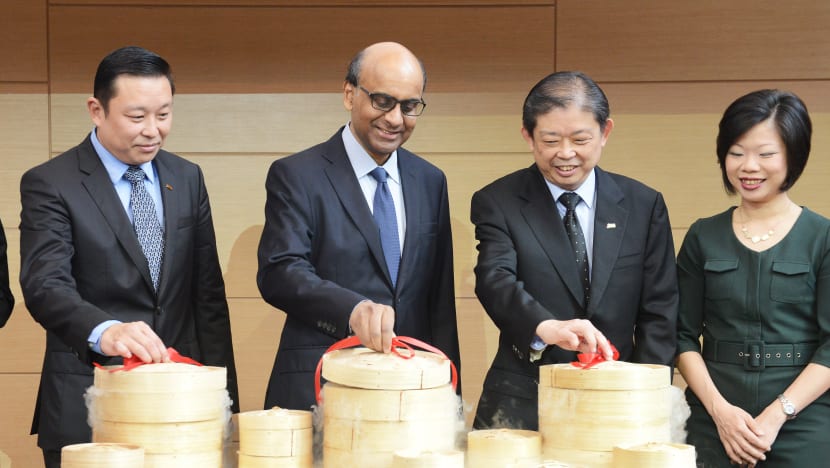
(From left) Select Group executive director Jack Tan, Deputy Prime Minister Tharman Shanmugaratnam, Select Group managing director Vincent Tan and Senior Minister of State (Ministry of Trade and Industry) Sim Ann at the official opening of the Select headquarters at Senoko South Road on Thursday (Sept 8). Photo: Select Group


SINGAPORE — The heartland coffee shop will be transformed in several years’ time with digital ordering and cashless payment systems reducing the reliance on labour, while vending machines offering ready-to-eat meals will be spread all over Singapore.
This is the vision for Singapore’s food services sector by 2020, according to the industry transformation map (ITM) unveiled by Deputy Prime Minister Tharman Shanmugaratnam on Thursday (Sept 8). The food services ITM is the first of the 23 road maps being developed under the S$4.5 billion industry transformation programme to drive Singapore’s longer-term economic progress.
The heavy reliance on manpower remains one of the top challenges for the food services sector, and there is a need for a major makeover to help food enterprises progress and seize new growth opportunities, Mr Tharman said at the opening of Select Group’s new S$60 million headquarters at Senoko South Road on Thursday.
While the industry contributes to 0.8 per cent of Singapore’s gross domestic product, it employs about 160,000 workers, or 4.5 per cent of the total workforce here.





“We are running out of manpower in the industry. Our strategies for the future have to address this squarely. We must develop a food services industry that is highly efficient with no loss in quality of food offerings and with high-quality jobs. It has to be a major makeover,” Mr Tharman said.
“(Enterprise development agency) Spring, together with its partners, plans to have at least 50 per cent of the industry having adopted technology-enabled operations by 2020. They estimate that it will make possible productivity growth in food services at 2 per cent per year on average from now until 2020,” he added.
Spring estimates that by 2025, three out of eight dining experiences in Singapore will involve new formats such as grab-and-go and vending machines, as opposed to traditional dine-in options. In the food services ITM, a key strategy is to introduce innovative business formats and technology, such ready-to-eat or ready-to-heat meals and food vending machines.
Spring is working with the Restaurant Association of Singapore to encourage more companies to venture into the ready meals market. Other strategies in the food services ITM include driving productivity through the mass adoption of technology, and the retraining of workers to take on value-added roles.
With traditional coffee shops heavily reliant on manpower and finding it increasingly difficult to hire workers, operators will have to rethink the way they run their businesses to remain sustainable. Spring and the Housing & Development Board, in consultation with major coffee shop operators, have reviewed the tender requirements for bidders of new coffee shop spaces. These new requirements include productivity considerations beyond just rental bids.
The revised tender system will be piloted at two sites in Tampines and Choa Chu Kang later this month. The private sector will be invited to put in proposals for new coffee shop designs that feature manpower-lean formats in addition to a good variety of affordable food. When launched, consumers can expect a different experience, such as digital ordering and cashless payments.
“This is also a good example of a more domestically oriented sector in which innovation as well as transformation will bring about a very big difference. It is also a good place to showcase innovation. Where there are benefits to be reaped from transformation, adoption of technologies, I think these are changes that when shared with more sectors can inspire more business owners to think about what can be done for their businesses,” said Ms Sim Ann, Senior Minister of State for the Ministry of Culture, Community and Youth & Ministry of Trade and Industry.
She will co-chair a team with Mr Vincent Tan, managing director of Select Group, to oversee the implementation of the ITMs for the lifestyle cluster, which encompasses food services, food manufacturing, retail and hotel ITMS.