Govt urged to try new methods to raise productivity
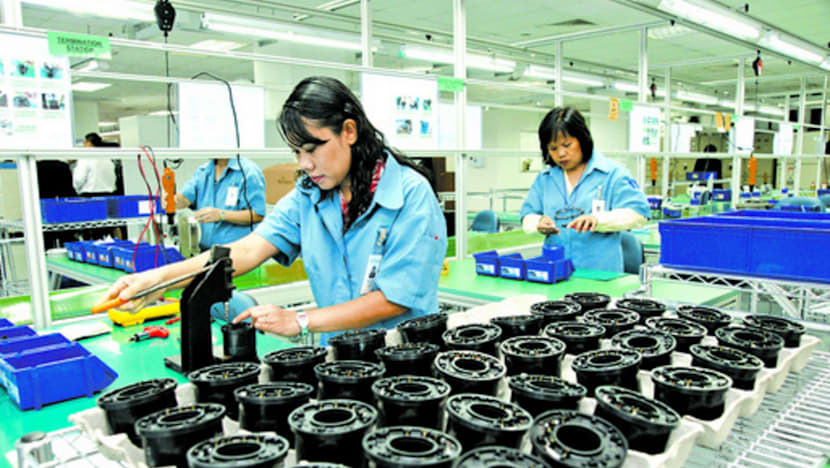
Initiatives to support training will help workers take greater ownership of productivity gains. TODAY File photo


SINGAPORE — With productivity showing limited growth over the past five years, economists are urging the Government to consider new approaches to help businesses make bigger gains in this area, with an emphasis on helping small and medium enterprises (SMEs).
Data released last week by the Ministry of Trade and Industry showed that Singapore’s labour productivity fell by 0.8 per cent last year — marking the third consecutive year of decline in productivity, with the externally oriented sectors doing well, but domestic sectors faring poorly.
Speaking ahead of the Budget Statement being delivered today, DBS economist Irvin Seah said new initiatives to encourage international expansion of local companies can be expected in the Budget this year, including policies to promote joint ventures that Government-linked companies (GLCs), multinational corporations (MNCs) or foreign SMEs can have with local companies.
Other measures, he said, might include streamlining of criteria for existing funding and productivity enhancement schemes for start-ups, SMEs and research and development activities, so more companies can benefit.





“This Budget will probably focus on further restructuring of the economy. (Singapore) has reached a halfway mark. Still, a lot needs to be done, especially given the fact that productivity growth figures have not been in line with what we targeted. I hope policymakers will take a different approach because more of the same (measures) is not going to give you the kind of results we hope for,” he said.
He added that too much focus had been placed on downsizing foreign manpower and subsidising the cost of investment over the past five years. “If you want to increase productivity, you need to improve your top-line growth,” he said.
In a research note, OCBC economist Selena Ling said more creative incentives and schemes to help local enterprises, especially SMEs, to venture abroad in search of greater business opportunities and to cope with restructuring challenges would provide some relief. A reversal of foreign manpower curbs is unlikely, but the Government can “pause” the pace of tightening, she added.
Mr Vishnu Varathan, a Singapore-based economist at Mizuho Bank, said the Government’s Productivity and Innovation Credit scheme — introduced in 2010 to offer tax incentives and cash payouts to defray costs of productivity improvements — had been a “pretty useful scheme, but could use a bit more enhancement”.
For example, it can make clear details such as the exact amount of tax rebates that should be offered and for what purposes.
Barclays economists Leong Wai Ho and Bill Diviney said measures to support mid-career training and development of Singaporean workers would also help employees take greater ownership of productivity gains, which would in turn be an incentive for workers to improve their career prospects.