Growth 'not likely' to slip further after poor first half
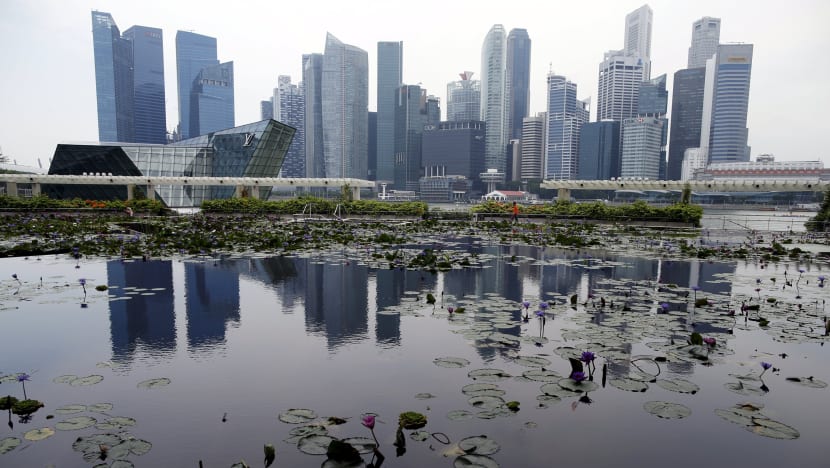
A general view of the skyline in the central business district of Singapore. Reuters file photo
SINGAPORE — The Monetary Authority of Singapore (MAS) and Ministry of Trade and Industry (MTI) are reviewing the Republic’s growth forecasts for this year following a weak economic performance in the first half of the year, the central bank’s managing director Ravi Menon said today (July 21), but he added that growth was unlikely to deteriorate further in the second half.
Singapore’s economy contracted 4.6 per cent in the second quarter from the previous three months on a seasonally-adjusted annualised basis, advance estimates from the MTI showed last week, as trade-related industries declined due to weak external demand and domestic-oriented businesses pulled back partly because of a tight labour market. On a year-on-year basis, gross domestic product grew 2.3 per cent in the first half, hovering at the lower end of the government’s full-year target of 2 to 4 per cent expansion.
“The growth momentum is not expected to deteriorate further in the second half this year. The global and regional economic recovery remains broadly intact, domestic non-tradable sectors should remain resilient and financial services should continue to pull up overall growth,” Mr Menon said at a news conference for the release of the MAS’ annual report for financial year 2014/15.
However, he warned that external risks have risen.





“First, Greece, where the situation remains highly fluid and uncertain. Second, China, where downside risks have increased. Third, the region, as financial conditions could tighten sharply as the United States Federal Reserve hikes interest rates,” he said.
UOB economist Francis Tan said: “Growth in the first half has been below expectations, primarily led by cautious global sentiment with uncertainties and risks around Eurozone and China. We expect GDP growth rates to settle around 2.5 per cent by the end of the year.”
Barclays economist Leong Wai Ho said: “We must facilitate a labour policy with long-term productivity increase high up in the priority list and have greater tolerance for lower growth.”
On consumer prices, Mr Menon noted that while Singapore has been experiencing negative headline inflation for seven months, it is not facing deflation, as the price decline is neither persistent nor pervasive.
“We cannot be said to be in deflation because most items in the CPI (consumer price index) basket continue to experience price increases,” he said. Temporary factors, such as lower Certificate of Entitlement premiums and accommodation costs, are keeping inflation muted but underlying pressures persist, he noted.
Headline or CPI All-Items inflation averaged minus 0.4 per cent year-on-year in the first five months this year. For the full year, it is expected to land at the lower half of the forecast range of minus 0.5 to 0.5 per cent, MAS said.
MAS’ core inflation, which excludes private road transport and accommodation, should stay near current levels before rising in the fourth quarter, Mr Menon said. The measure eased to 0.8 per cent in first five months and it is expected to be in the lower half of the 0.5 to 1.5 per cent forecast range.
Mr Tan said: “While increasing wages will continue to put pressure on the total cost of production, it is yet to offset the cost benefit arising out of lower oil and other commodity prices. So inflation continues to remain subdued but is likely to pick up early next year.”
The MAS’ current policy stance remains appropriate for ensuring medium-term price stability, Mr Menon said. “As of now, I can only say that the monetary policy settings are something that we are very comfortable with... Whether that will change in October, I can’t say. It will be data-dependent.”
MAS today also reported a sharp decline in net profit to S$281 million for the fiscal year ended March 31 from S$15.8 billion previously due to currency translation effects. Holding the Singdollar exchange rate constant to strip out currency effects, foreign investment gains amounted to S$10.4 billion, little changed from S$10.6 billion a year earlier, the MAS said.