Industrial output sputters for 7th straight month
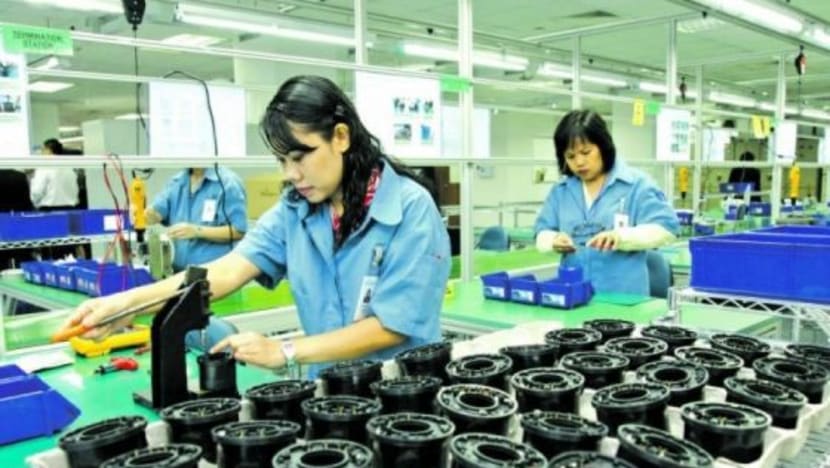
A manufacturing and logistics facility in Singapore. TODAY file photo


SINGAPORE — Manufacturing output contracted for a seventh consecutive month amid a factory slowdown across the region, lending weight to views that Singapore will slip into a technical recession during the third quarter and raise the case for a monetary policy easing next month.
Singapore’s industrial production (IP) last month declined 7 per cent compared to a year ago, extending from July’s revised 6.4 per cent decline, Economic Development Board data showed today (Sept 25).
“Part of the performance for last month was due to weak demand. With China slowing down, August was a bad month … Regionally, demand was also weak especially with Malaysia due to the depreciating ringgit. Domestically, with the economy in a shift of focus towards services, challenges are also faced, but we see the Government spending more on public projects and there is continued support from the public sector,” said Mr Michael Wan, economist at Credit Suisse.
With the latest IP data, analysts are now more certain Singapore may enter a technical recession. “A technical recession come the third-quarter advance gross domestic product (GDP) print is likely. The stronger performance in services might not completely offset the weakness in manufacturing activity,” said Mr Wan.





A technical recession is defined by two consecutive quarter-on-quarter contractions. On a quarter-on-quarter seasonally adjusted annualised basis, the economy contracted by 4 per cent in the three months through June, a reversal from the 4.1 per cent growth in the previous quarter.
“We had earlier warned of a possible technical recession in the third quarter, with our GDP growth forecast penciled at minus 0.4 per cent on a quarter-on-quarter seasonally adjusted annual rate. The last time the Singapore economy experienced a technical recession was in the first quarter of 2009,” said Ms Selena Ling, Head of Treasury Research and Strategy at OCBC Bank.
“To avoid a technical recession, September’s industrial production would have to expand by 0.1 per cent year-on-year, which in turn would require a strong pick-up in both electronics and biomedical output.”
In light of the recent slew of weak economic indicative results, including soft core inflation data on Wednesday, economists now say the risk of monetary policy easing by the central bank in its bi-annual policy meeting next month has increased. “We see the risk of easing by the Monetary Authority of Singapore (MAS) as quite high and rising, given the weaker labour market, softer global and regional growth outlook, and lower inflation estimates,” said Mr Wan.
Weaker demand in the region and the haze is also likely to impact tourism and keep consumers at home, said Nomura analysts Mr Euben Paracuelles and Mr Brian Tan. Taking that, along with risks to inflation undershooting official forecasts and rising financial-market volatility, an adjustment of MAS monetary policy next month through the widening of the Singapore dollar nominal effective exchange rate (NEER) band is likely.
Last month’s industrial output fell in five out of six clusters. General manufacturing products, biomedical manufacturing, precision engineering, electronics and transport engineering all registered declines in output, leaving chemicals as the only sole bright spot.
The key electronics cluster, which carries the largest weight in the IP index, contracted by 10.9 per cent, extending from the revised 7.4 per cent decline in July.