Jail sentence the starting point for drink drivers who injure or damage property: Chief Justice
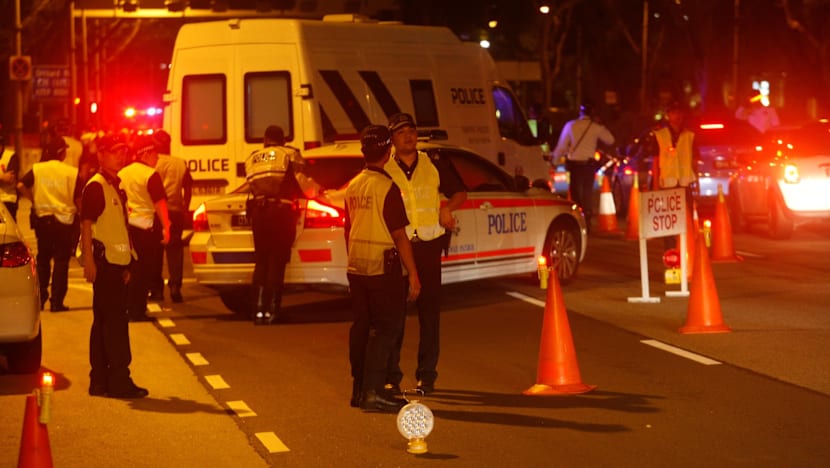
Traffic Police enforcement operations against drink driving on Dec 3, 2015. Photo: Singapore Police Force
SINGAPORE — Drink-drivers who injure road users or damage property should expect to be sentenced to jail, unless they have strong mitigating reasons, Chief Justice Sundaresh Menon said on Friday (July 28).
Setting sentencing benchmarks for drink-driving cases involving injury or damage to property for the first time, the judge also noted the uptrend in such offences, stressing that the punishment handed out to offenders must have a deterrent impact on the general public.
“The causing of injury to others — and even more so, death — by a drunk driver represents the very evil that the ban on drunk driving was intended to prevent,” he noted.
The top judge’s ruling came as the Ministry of Home Affairs and the Traffic Police said recently they were reviewing existing penalties for road traffic offences, with a view to increasing the penalties for offences resulting in death or hurt to others, especially in cases where drivers are under the influence of drugs or alcohol.





In a 57-page judgment, CJ Menon said that except in an “exceptional” category of cases, where there was a low level of harm caused and the offender had low culpability, jail was warranted, as long as a driver hurt someone or damaged something after taking the wheel after drinks.
How long the jail term should be depends on the overall gravity of the offence, which involves assessing the actual or potential danger posed by the driver, and the consequences wrought. The driver’s blood alcohol levels and his reasons for getting behind the wheel after drinks will determine how culpable he is.
CJ Menon said cases at the lowest end of the spectrum involve only slight harm, such as slight physical injury with no hospitalisation or medical leave. The offender also has low blood alcohol levels and did not drive dangerously.
All other cases more severe than this type of cases would lead to a custodial sentence, as a starting point, he added.
His comments came as he halved a Singapore Armed Forces (SAF) major’s jail term to one week on Friday.
Stansilas Fabian Kester, 35, had had three mugs of beer when he drove home from a lunch gathering on the afternoon of Jan 29 last year. When he saw the lights turning amber as he approached the junction of South Bridge Road and Upper Pickering Street, he accelerated instead of slowing down.
As a result, he beat the red light, and his car brushed against a pedestrian and collided into a motorcycle, four seconds after the lights had turned red against him.
Kester was found to have 43 micrograms of alcohol in every 100ml of breath — 8 micrograms above the prescribed limit.
He was sentenced to a two-week jail term last year, banned from driving for three years, after he admitted to one count of drink-driving. Another count of dangerous driving was taken into account for the purposes of sentencing.
Represented by Mr K Muralidharan Pillai and Mr Jonathan Lai, he argued that he deserved only a fine, given that his victims suffered minor injuries, court documents showed.
CJ Menon disagreed, saying Kester had crossed the custodial threshold, since he had caused moderate harm and was of medium culpability.
Although his blood alcohol levels were low, “(Kester) was a source of immense danger when he accelerated into a junction at the intersection of two busy roads in the Central Business District during peak traffic hours”, he noted.
Kester also had “no good reason” for choosing to drive, he added, noting that he had “decided to drive home for no better reason than that it was convenient to do so”.
On Kester’s argument for leniency because of his public service and contributions in the SAF, CJ Menon said these factors would matter only if they were indicative of one’s capacity to reform and not reoffend. Even then, however, the court would place little weight on this aspect, especially if there were more important general considerations, such as deterring similar would-be offenders.
The judge said: “Any evidence concerning the offender’s public service and contributions must be targeted at showing that specific sentencing objectives will be satisfied were a lighter sentence be imposed on the offender.”
Kester had also argued that he had already been disciplined by the SAF and a custodial sentence would be “crushing” as he would lose his job.
But CJ Menon said what other professional consequences befalls a convicted offender should be of little relevance to the courts, adding “a person who breaches the criminal law can expect to face the consequences that follow under criminal law”.
Nevertheless, he cut Kester’s jail term to one week, given that he had compensated the victims to the tune of more than S$40,000; a “substantial” amount — something the sentencing judge had made no mention of in his ruling.
CJ Menon added: “The overall impression one gets is that the appellant was sincerely attempting to make it up to the victims.”