Key exports rebound in February, but no sustained recovery in sight
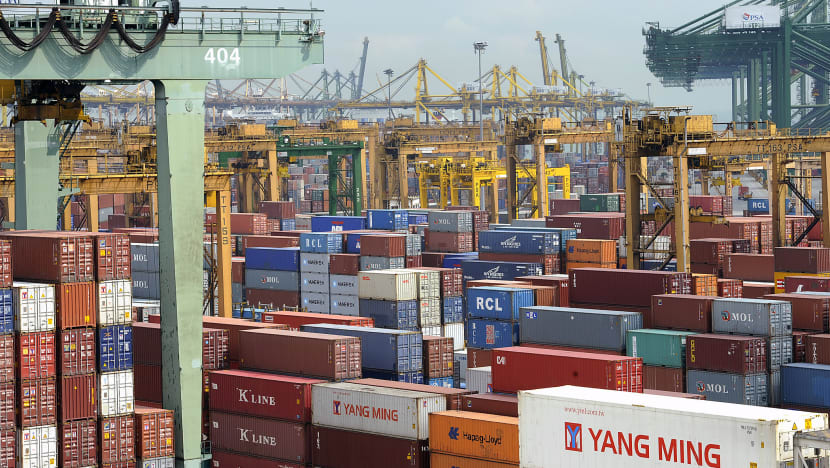
Containers are stacked at the Keppel Container Terminal, operated by PSA International Pte Ltd. Bloomberg file photo


SINGAPORE — The Republic’s non-oil domestic exports (NODX) beat expectations in rising last month, as growth in both electronic and non-electronic shipments spurred a rebound from the previous three straight months of contraction, but economists called the performance a “one-month wonder” and ruled out a sustained recovery as global demand continues to wane.
NODX increased 2.1 per cent last month from February a year earlier, recovering from the revised 10.1 per cent decline in January, trade agency International Enterprise Singapore said on Thursday (March 17). Economists in a Reuters poll had expected NODX to continue to slide at a rate of 2.6 per cent.
DBS senior economist Irvin Seah said: “The surprise 2.1 per cent uptick is due to the low base effect from the same period last year. This is purely arithmetic and not a real improvement in fundamentals. February 2015
recorded one of the lowest NODX readings in recent years. It was the lowest reading in 2015, as well as the lowest since February 2009 … With such a low comparison base, last month’s NODX number … isn’t that great after all. So, don’t pop the champagne yet.”
Other economists also called for caution, warning that the NODX reading will retreat into negative territory in the months ahead.





“We think that the better-than-expected NODX performance in February is just a one-month wonder, as it was mainly due to the low base in the same month a year ago. In fact, looking at the January-February performance together, NODX contracted 4.7 per cent year-on-year in 2016.
Going forward, we are projecting that NODX will be back in the contractionary mode in the next two months (March and April),” said UOB economist Francis Tan.
Standard Chartered economist Jeff Ng said: “Looking at the breakdown, the support does not look broad-based. Both electronic and non-electronic exports only grew at a modest pace.”
Last month, shipments of electronic products grew 0.7 per cent, rebounding from the 0.6 per cent decline in the previous month, due mainly to an
increase in exports of disk media products, telecommunications equipment and personal computers. Shipments of non-electronic products grew 2.7 per cent, rebounding from the 14.1 per cent decline in the previous month, helped by a 40 per cent surge in the exports of pharmaceuticals.
Exports to six out of the top 10 NODX markets fell last month, with the exceptions being the European
Union, Hong Kong, Japan and the United States. Shipments to China fell
1.2 per cent last month, slowing sharply from the 25.2 per cent decline in January, but still making it the eighth consecutive month of contraction.
Looking ahead, growth in the US and Europe are expected to slow, said Mr Ng. “This may also mean that the support from developed economies weaken. Singapore thus will need Asia demand to improve to get some improvements in NODX growth.”
But even as the flagging global economy does not appear to provide much support for Singapore’s
exports, Mr Tan said that the possibility of monetary easing from the central bank still remains low.
“We view the possibility of the Monetary Authority of Singapore (MAS) lowering the S$NEER (Singapore dollar Nominal Effective Exchange Rate) slope as very low. From past experience, a neutral S$NEER path was only activated during economic recessions, and we are currently not in one nor expecting one,” he said.
Should global economic conditions stagnate but remain just shy of a recession, there is a possibility the MAS may ease by recentring the mid-point by 1.0 per cent, he added.
Mr Tan has maintained the 2016 NODX growth forecast at 2.1 per cent, where most of the improvement is expected to take effect in the second half of the year. However, he noted that there could be downside risks to his forecast “should the uncertainties in China’s growth and oil prices perpetuate”.
CLARIFICATION: The report “Key exports rebound in February, but no sustained recovery in sight” (March 18, 2016) quoted a DBS senior economist as saying that February 2015's non-oil domestic exports reading was the lowest since January 2009. DBS has clarified that the reading was the lowest since February 2009.