LTA to raise the bar on rail maintenance standards
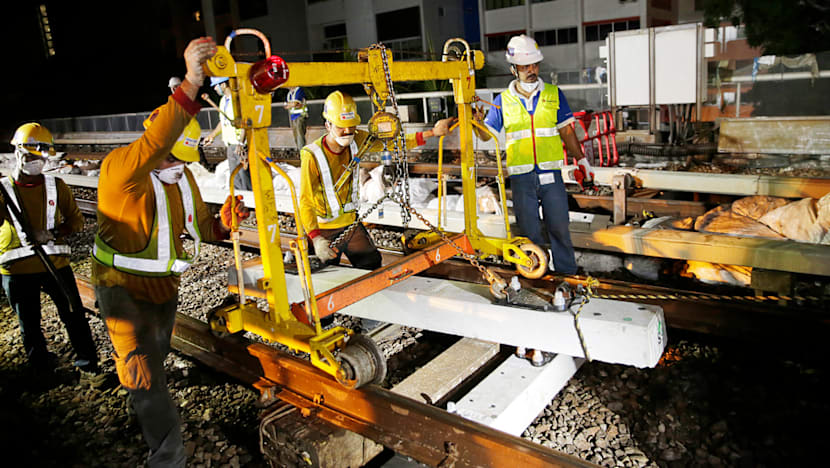
MRT workers working on the track for the Sleeper Replacement project. Photo: Wee Teck Hian


SINGAPORE — Instead of only holding rail operators to good service standards, the Land Transport Authority (LTA) will extend its supervision to the maintenance performance of SMRT and SBS Transit (SBST).
It is drafting a “stringent set” of maintenance performance standards, Transport Minister Khaw Boon Wan said on his blog today (Nov 17), as he laid out a multi-pronged strategy — which includes replacing, overhauling and upgrading the system as well as creating a culture of strong maintenance and less finger-pointing when things go wrong — to restore the reliability of the North South East West Lines (NSEWL).
He also suggested that more time could be set aside on early Sunday mornings or the school holidays for maintenance of the MRT lines. “If revenue service can be reduced by even half an hour during such off-peak periods, it will mean a lot to the maintenance crew, especially for the inspection and repair of tunnels and tracks. We hope to get commuters’ support for such a measure,” said Mr Khaw, noting that the crew currently have a “limited window” to carry out routine maintenance and major overhauls.
In 2012, former Transport Minister Lui Tuck Yew had mooted the idea of temporarily closing some train stations over the weekend or just for a few hours on Sunday for scheduled maintenance and upgrading work.





Currently, the shutters on certain East-West Line MRT stations come down half an hour early from Sundays to Thursdays, excluding the eve of public holidays, for sleeper replacement work. This work, along with other replacement and refurbishment exercises, is scheduled to be completed by 2018. Commuters will then have an “almost new” NSEWL, Mr Khaw said.
Dr Walter Theseira, a senior lecturer at SIM University (UniSIM), noted that maintenance work that requires shutting down the track during operating hours are common around the world. “However, rail systems in many major systems have high redundancy — commuters are frequently able to access alternate rail lines within a short distance. Singapore’s MRT system does not have this kind of redundancy for many commuters,” he said.
On the new maintenance performance standards, Mr Khaw said these will have “more prescriptive, process-based requirements” for the operators to complement the existing outcome-based approach. “We are strengthening our regulatory regime, so that we can catch problems upstream, before they result in disruptions and delays to commuters,” said Mr Khaw, who is also Coordinating Minister for Infrastructure. “Till recently, we have taken a more outcome-based approach. But really, by the time a fault happens, it is too late.”
Analysts said the move to prescribe maintenance performance standards was an indictment of the operators’ capabilities.
SIM University (UniSIM) adjunct professor Park Byung Joon said: “It’s a little unfortunate that LTA has to come to this stage. If the current operator had done a good job in terms of the management, LTA shouldn’t have come to this position in the first place.”
Agreeing, Dr Theseira cautioned against over-regulation. Still, he noted that LTA’s objective of improving maintenance might not be aligned to private operators’ profit-maximising behaviour.
Mr Khaw, who took over the transport portfolio early last month, reiterated that a stronger maintenance culture “cannot be cultivated overnight”. To drive this, LTA will, for a start, embed dedicated teams of engineers for the NSEWL.
Another new culture that he wants to instill is “an enlightened approach of transparency and open collaboration among all parties”. “I am insisting on such a culture,” Mr Khaw said.
Noting that problems with rail reliability can emerge from design, operations or maintenance, he added: “It is more important to focus first on understanding the cause and addressing it, rather than to attribute fault (which can come later especially if it is criminal or negligence). I believe that the outcome everyone wants is for commuters to enjoy reliable service. Finger-pointing in the first instance will not get us anywhere near this outcome; it only causes distrust between parties or, worse, leads to under-reporting or even cover-up.”
Mr Khaw reiterated that the current level of maintenance is inadequate. SMRT and SBST are committed to significantly ramping up their maintenance resources, including manpower, he said. “Building up the numbers is one thing. Building a strong engineering core with deep skills is another and will take time. The availability of skilled manpower is a challenge which we must overcome.”
Mr Khaw stressed the need for “clear corporate and top management focus on engineering excellence”. “Corporate focus on engineering excellence is essential and the management must reiterate it at every opportunity ... Shareholders too, must, first and foremost, realise that they are buying into a specialised engineering company,” he said.
At the industry level, there also needs to be greater integration, with all parties involved in the different stages — design, build, operate, maintain — working closely together, he said. The Government is currently mulling over “whether to rework the (industry) structure or perhaps implement new processes to realise the ideal outcome”.