Maths-based storybooks used to ignite students’ passion for subject
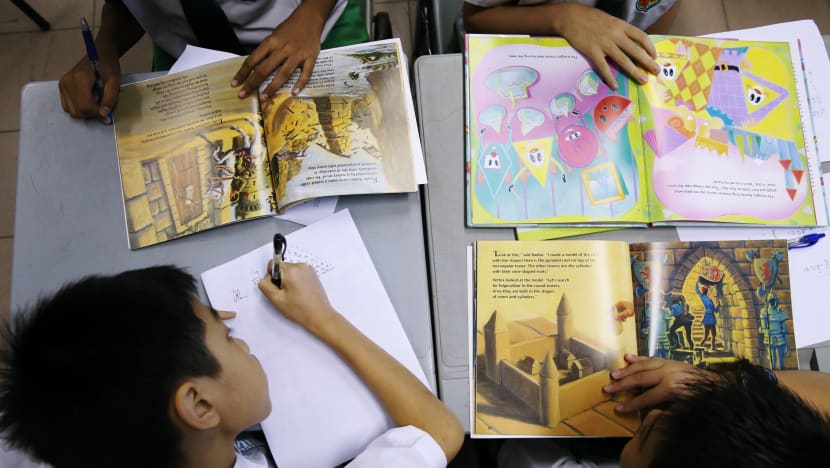
Students from Woodgrove Primary School seen working on their Math-based storybooks in the classroom. Photo: Koh Mui Fong/TODAY


SINGAPORE — Noticing that students’ enthusiasm levels tended to wane during maths lessons, Ms Tan Hong Kai decided to experiment with maths-based storybooks to mix things up for Primary Four pupils in 2014.
The book, Pattern Fish, was used to spark interest in picking out patterns — in the colours of the fish, their movements and backgrounds of pages, for instance. A knight’s adventures in the Sir Cumference series helped introduce concepts such as geometry and radius.
“It captures the children’s attention and gets them interested in what they are going to learn ... Maths is (usually) very task-based, but by introducing this, we get students to like what they learn ... It really benefits the kids,” said Ms Tan, the level head for maths at Woodgrove Primary School.
Today, teachers at the school can choose from more than 50 maths-centric books for the various levels to ease them into new maths topics.





A literature-based approach is one of the innovative strategies the school has for sparking students’ passion for maths. Another is giving pupils open-ended maths questions to encourage critical thinking and build their reasoning skills.
During a TODAY visit to one of the Primary Five classes earlier this month, students were asked this question: “Take any two-digit number, reverse the digits, and subtract the smaller number from the larger number. What can you say about the results?” They eagerly threw out various answers — such as the result is always a multiple of three — which they would then discuss.
Woodgrove also runs a programme called ICAN aimed at Primary Three and Four students who are weaker in maths, as well as a games-based programme for students who are stronger in the subject.
Primary 6 student Gary Gan, one of the students who sat for the Trends in International Mathematics and Science Study (Timss) tests, found that his homework — which often merged two topics and maths games — helped him to prepare for the tests.
“The questions were interesting and provided good exposure for us,” he said.
School principal Josephine Ng noted that getting children to enjoy the subject is key to ensuring that they can learn independently. “If you can’t get them interested and motivated to want to learn maths, they will be very dependent on the teacher ... We hope to move towards (the students becoming) collaborative and independent learners, and the strategies also help them effectively understand maths,” Ms Ng said.