'Work has already begun,' says Josephine Teo in outlining National AI Missions
Speaking at the ATxSummit 2026, Minister for Digital Development and Information Josephine Teo said that the National AI Missions would be driven by "problem statements worth solving, not just for Singapore but for the world".
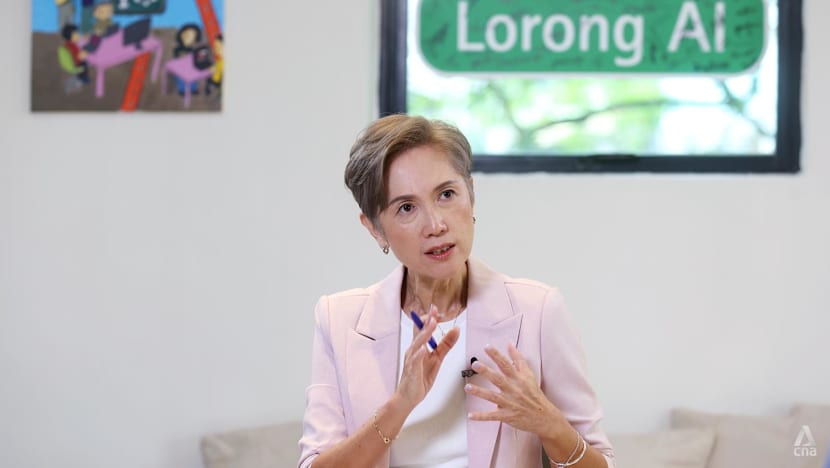
Minister for Digital Development and Information Josephine Teo speaking to reporters at Lorong AI@One-North Space on Mar 27, 2026. (File photo: CNA/Ooi Boon Keong)

This audio is generated by an AI tool.


SINGAPORE: Singapore has begun work on its National AI Missions aimed at transforming key sectors of its economy, said Minister for Digital Development and Information Josephine Teo on Wednesday (May 20).
Speaking at the ATxSummit 2026, Mrs Teo said that the National AI Missions would be driven by "problem statements worth solving, not just for Singapore but for the world".
"They aim to be 'beachheads' for deep, game-changing AI adoption in their sectors," she said.
"Work has already begun."





The National AI missions are being overseen by the National AI Council, which is chaired by Prime Minister Lawrence Wong.
The council will broaden adoption across the economy, build deep artificial intelligence capabilities and make Singapore a leading hub for AI innovation, said Mrs Teo.
Four sectors have been prioritised under the National AI Missions: connectivity, advanced manufacturing, healthcare and finance.
"Singapore has global standing in each of these sectors," said Mrs Teo, adding that they make up more than 40 per cent of the country's gross domestic product.
"They are also areas where government enablers like data access and regulatory sandboxes can catalyse AI breakthroughs," she said.

Against this backdrop, Mrs Teo highlighted three areas where AI can be implemented: aviation, maritime operations and advanced manufacturing.
In aviation, she pointed to Changi Airport's Terminal 5 which will increase the airport's passenger handling capacity by about 50 million passengers annually, and this poses challenges beyond the construction of infrastructure and will require a rethink of how the air hub operates, she said.
Among the operational challenges Mrs Teo identified were passenger movement between gates, baggage delivery across terminals and the sequencing of aircraft landings and take-offs on runways.
She said that Singapore would also need a next-generation air traffic management system that prioritises safety and not just volume.
"This is just one of the many exciting opportunities in aviation that AI can help with," she said.
Singapore's maritime sector is another area where AI deployment will be explored.
Mrs Teo pointed to Tuas Port, which she described as "the world's largest automated container terminal along one of the world's busiest waterways".
She said the port generates "rich datasets of complex operations" that can be used to develop new AI-powered solutions.

In advanced manufacturing, Mrs Teo highlighted the potential of physical and embodied AI technologies.
She said that Singapore’s industrial robot density is about five times the global average and is consistently among the highest in the world.
As such, physical AI could support simulations for process redesign while digital twins could improve predictive maintenance, reduce material wastage and minimise production downtime.
Still, Mrs Teo cautioned that technologies developed in research labs do not always perform effectively in real factory environments.
"To see real impact, we will need collaborators from the hardware, software and operational domains," she said. On that note, she welcomed NVIDIA's new research lab in Singapore, which will focus on embodied AI and efficient AI technologies.
Mrs Teo added that Singapore is also developing the Punggol Digital District as a "frontier testbed", with integrated data platforms, real-world test scenarios and rules that enable robots to safely operate across the district.
"A growing network of industry partners is using Punggol's ecosystem for testing and experimentation," said Mrs Teo.
"These sandboxes and collaborations help to spread acceptance and adoption," she added.
Mrs Teo said that Singapore's National AI Missions provide strong reason for leading AI firms to anchor themselves in the country, to develop, test and scale AI solutions that are trusted and globally relevant.
She added that Singapore is also harnessing AI in other areas like healthcare and education for "the public good" and to improve the well-being of citizens.
"We will speak more about them at suitable platforms," Mrs Teo said.
Mrs Teo on Wednesday also announced an update to Singapore's National AI Strategy (NAIS). The update builds on the foundations laid by NAIS 2.0, which was launched by Mr Wong in 2023.
She described the refresh as a "'double-click' rather than a system reboot".
The refreshed strategy introduces 10 updated priorities centred around three broad focus areas: deepening sectoral and public sector transformation; mainstreaming AI adoption and strengthening workforce readiness; and building an AI hub.
Editor’s note: This article has been updated to reflect that Changi Airport’s Terminal 5 will increase passenger handling capacity by about 50 million passengers annually rather than the previously stated 70 million, after the Ministry of Digital Development and Information issued a clarification.