Merits of ensuring minority EP under scrutiny at hearing
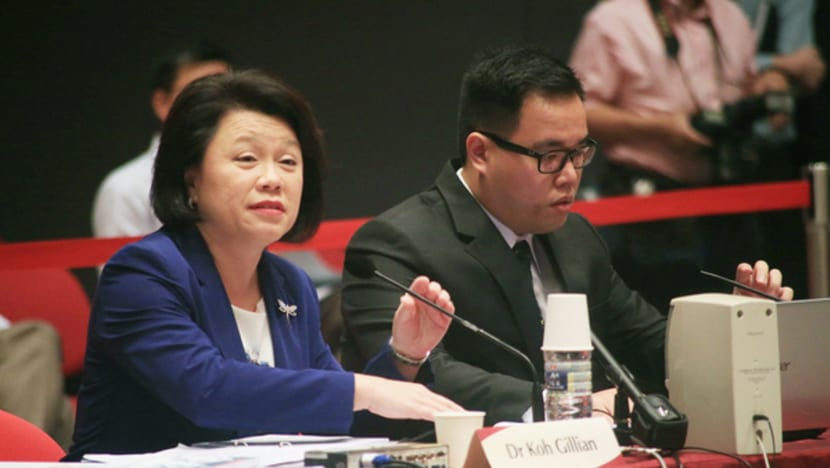
Dr Koh Gillian and Mr Tan Min-Wei of the Institute of Policy Studies \at the Constitutional Commission's public hearing on specific aspects of the Elected Presidency at the Supreme Court Auditorium on 26 April 2016. Photo: Koh Mui Fong/TODAY


SINGAPORE — With Singapore making progress in becoming a race-blind society, would safeguarding minority representation in the highest office in the land be a regressive step or a nudge in the right direction?
This was the question that dominated the third public hearing for the review of the Elected Presidency yesterday, with three out of four groups of speakers disagreeing with the need to tweak the rules to ensure a minority President.
Dr Gillian Koh, deputy director (research) at the Institute of Policy Studies (IPS), said it would be a “great pity” to restrict the Elected Presidency contest based on ethnicity, thus holding back the current process of moving towards a society that selects a President based on the candidate’s track record and regardless of ethnicity.
“We are on a journey and we have to look at the future, and we don’t want to stop the process of growing this multiracial, multicultural ethos,” she said.





Among other things, she argued that there is no empirical data to show that Singaporeans vote along racial lines in the Presidential Election. She cited an opinion poll done after the 2011 Presidential Election, in which 85 per cent of the 2,000 respondents agreed that a minority President could be elected through the current system.
Dr Koh also referred to the parliamentary elections in her submissions, where Deputy Prime Minister Tharman Shanmugaratnam, for example, and his team were among the best performers.
Having an ethnic-based pre-qualification might undermine the “full gravitas and political legitimacy” of the candidate who eventually got elected, she added, and this might result in debate and unhappiness when the President decides on public sector appointments, for instance.
Ms Braema Mathi, president of human rights group Maruah, thinks the minorities would put themselves up as candidates without the authorities having “to make it into a clause”.
“(In Singapore) we seem to continue putting things into boxes because ... (either) we are not confident in our own structuring (or) we are worried that minority communities become upset that we have forgotten about them ... We have to shift away from this,” she said.
On this point, Professor Chan Heng Chee, a member of the Constitutional Commission reviewing the Elected Presidency, noted that inclusiveness has to be demonstrated and be visible, and asked if it was “unwise” to design a system to help every ethnic group attain the Elected Presidency.
National University of Singapore law professors Jaclyn Neo and Swati Jhaveri suggested having a Council of Presidents comprising three persons, of which two would come from different ethnic backgrounds. An alternative is for each election cycle to be open only to candidates who were not of the same ethnic group as that of the outgoing President.
On the matter of society being race-blind, Dr Neo said: “I agree that we are on a journey, but we are not really there yet and we have a long way to go.”
Constitutional Commission chairman Sundaresh Menon asked whether there was a need to have a “nudge” along the journey, and that a system may be needed “once in a while” for the election of minorities, when there has been a lack of minority representation for a period of time.
To this, Dr Koh pointed out that it may result in a “worst-case scenario” where minority communities would not actively search for candidates, merely waiting for their turn to come.
Singapore Management University law don Jack Lee similarly felt that more should be done to get minorities to step forward, proposing a body similar to one that appoints Nominated Members of Parliament to encourage suitable minority candidates to run for the Elected Presidency.
Chief Justice Menon said that even if more time were needed to reach a situation that accepts all regardless of race and religion, Singapore has done “incredibly well” over the past few decades in terms of progress towards that goal.
“We have to be careful not to lose sight of the journey for the sake of the destination,” he said. “I think if we accept that we all have a common destination, the real question is whether making some provisions, and there may be a range of possibilities ... is going to hold us back or spur us on.”