Ministers must do what is right, and not be sidetracked by vocal minority: Shanmugam
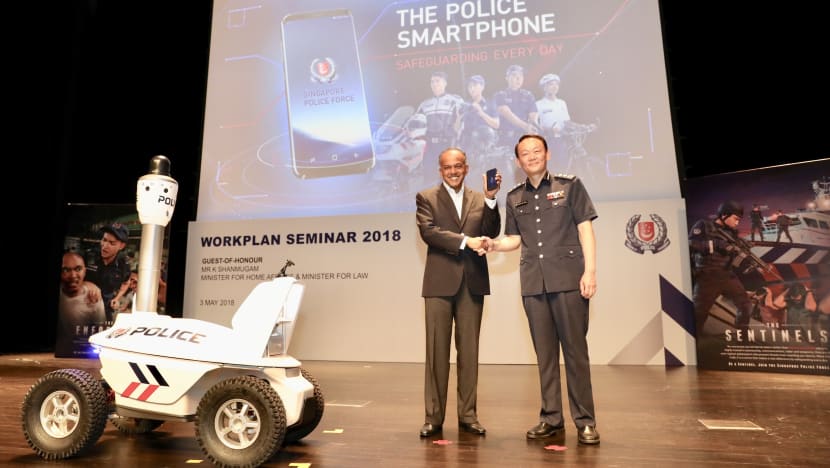
Law and Home Affairs Minister K Shanmugam launching the Police Smartphone together with Commissioner of Police Hoong Wee Teck.


SINGAPORE — The Republic's Cabinet ministers have the "ultimate decision-making responsibility" to do what is right and "not be sidetracked" by a vocal minority, said Home Affairs Minister K Shanmugam on Thursday (May 03), citing the Public Order and Safety (Special Powers) Act (POSSPA) which has been criticised by some quarters as an overreach of police powers as an example.
Speaking at the annual Police Workplan Seminar held at the Singapore University of Technology and Design, Mr Shanmugam said the online discussion on POSSPA "would have created the feeling that there was a lot of opposition and we are doing something that is terrible".
"My duty in these things, as having the ultimate decision-making responsibility, is really having the common sense to distinguish between first of all what is right," he said.
A minister also has to consider what is good for the society, in the short to long term, he added. On top of that, if the majority agrees, then the minister should not be distracted by a vocal minority, which can contain both genuine views and those who oppose for the sake of doing so, he stressed.





The POSSPA was passed in Parliament in March. The Act, which replaces the Public Order (Preservation) Act (POPA) enacted in 1958, will grant police the powers to direct building owners to take certain actions, such as closing their premises, to facilitate security operations. The police can also stop individuals and demand information from them if they are near a security incident.
It also allows the police to issue a "communications stop order" to prevent the public and media from taking videos, pictures, audio recordings, or text messages that could compromise ongoing security operations. Those who breach the order can be jailed for up to two years, or fined S$20,000, or both.
Mr Shanmugam reiterated his confidence that introducing POSSPA was the "right thing to do", noting how the 2011 United Kingdom riots started off as a peaceful demonstration against a court ruling but degenerated into rioting that left five dead and 205 injured.
Singaporeans trust the Government and the police, and the majority will agree that they will not want to see a similar situation here, Mr Shanmugam said. "But if you look at that small handful — who put out their views and propagated them continuously and tried to get them all over the world — (they) paint a false picture of the police force and paint a false picture of Singapore for political ends, and if you only read that, you'll start wondering," he said .
Noting that the POSSPA gives power to the police in a way that may not be possible in many countries, he reiterated: "I believe it was doable in Singapore because people trust the police and that we will exercise powers responsibly and you need those powers to deal with the situations that are evolving. You can't deal with new threats with legislations that are outdated, which is a problem that many countries are having."
Mr Shanmugam also pointed to survey findings from government feedback unit Reach, which saw 82 per cent of the 1,038 respondents supporting POSSPA.
Disclosing the findings which had not been made public previously, Mr Shanmugam said about three-quarters of the respondents agreed that POSSPA was necessary to enable the police to handle major security incidents effectively. About two-thirds (67 per cent) thought it was reasonable for the police to have the powers to stop individuals from taking or sharing messages and videos about ongoing security operations, while 78 per cent trusted that the police will exercise these powers fairly.
In his speech, Mr Shanmugam also touched on the issue of trust between the ministerial leadership and the police force. "The police need to know where the minister stands on issues when tough situations come about," he said.
For instance, he cited the example of the Ministerial Statement on Benjamin Lim he delivered in Parliament on Mar 2016. He said then that if there are issues with the protocols, the responsibility lies with him and the police officers should not be attacked.
He made it clear on Thursday that if something goes wrong operationally, Singapore's approach would be for the ministers to be held accountable and responsible to the public. But at the same time, the relevant authorities will have to sort out the problem and make sure it is not repeated, as well as ensure professionalism and internal accountability.
"The (uniformed) services need to know that very clearly, so that you can go about your work confidently, do your duties and have faith and trust in the system," he said. "That is what is asked of you. Leave the rest to us and be assured that we will answer the questions and shield you from political attacks."