Mobile app to track children on school buses
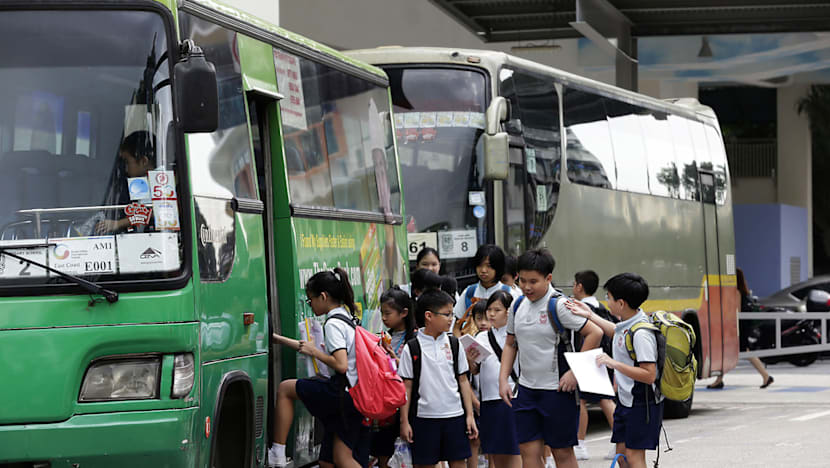
Primary school students boarding a school bus on Nov 11, 2015. TODAY file photo
SINGAPORE — Parents anxious to track their children’s movements on board the school bus could soon have one more way of doing so, following a well-received pilot of a a mobile application last year.
The app, which notifies parents when school buses are arriving or when their children have safely arrived at school, is part of the Singapore School Transport Association’s (SSTA) new School Bus Management System (SBMS). After testing it last year, the association now hopes to roll out the SBMS to the 3,500 school buses in its fleet.
During the pilot scheme, held from October to December, 70 primary school children were each provided with a small electronic tag that would alert bus drivers, via an app, when a child gets on and off the bus. The tag also acts as an electronic attendance marker.
An alarm on the driver’s app will also go off if a child misses his stop, or is still on the bus after everyone else has got off.





The children’s parents also had a specific app that would push notifications for when the bus was arriving, when their child got on or off the bus, as well as track the bus location on a map.
However, the electronic tag could not be tracked after the child left the bus.
The pilot scheme was a collaboration involving the SSTA and the Singapore Institute of Manufacturing Technology (SIMTech) at the Agency of Science and Technology and Research (A*STAR).
Dr Lee Eng Wah, SIMTech’s deputy executive director, noted that while the pilot was aimed at improving the bus drivers’ productivity, the system also enhanced “the safety of the students”.
Other features of the SBMS include an operation command centre hosted by the SSTA that will monitor bus movement and location, driver information and other emergency notifications, among others.
The system also simulates and recommends the best route for a bus, depending on its pick-up locations.
An alert would be sent to the command centre if a bus deviates from its assigned route or if the system detects erratic driving behaviour such as speeding.
Eight cameras — four inside and four outside of the bus — were also installed in 15 buses during the pilot.
SIMTech senior scientist Dr Liu Wei said the pilot received positive feedback and demonstrated real productivity improvement.
The time spent at each pick-up point, including waiting for students to board the bus and taking attendance, was reduced by an average of 14 minutes per trip.
The average travel duration from the first to last pick-up point – usually about 40 minutes to an hour – was also cut by 4.3 minutes per trip, while the distance travelled by the bus was reduced by about 2km per trip.
SSTA chairman Wong Ann Lin noted that complaints about buses being late or students missing the bus was a daily affair, and having the SBMS helped to clear up misunderstandings.
When there were incidents between children on the bus, or accidents between school buses and private vehicles, the cameras also provided transparency when settling disputes.
During the pilot, the recorded footage was only transmitted to the command centre.
Before the SBMS is fully rolled out, Mr Wong said the SSTA will consult parents, schools and relevant authorities on how the data will be handled.
He added that while, SSTA’s 1,200 members were generally interested in the SBMS, 800 of its self-employed drivers had expressed concerned about the additional cost.
It is not clear how much the operators would have to fork out to install the SBMS, since the SSTA is still working on getting government funding, said Mr Wong.
When asked if school bus fares would be raised, he said there were no plans to do so at the moment.
Parents involved in the pilot lauded the SBMS, especially its app notifications.
Madam She Xiao Yong, 28, said previously, her eight-year-old daughter had to wake up earlier as they were not sure when the bus would arrive. They sometimes had to wait for as long as 20 minutes for the bus.
The app notifications proved to be “very convenient”, since Mdm She knew where her daughter was, and when she had alighted at school.
Other parents not involved in the pilot also said the app notifications would be helpful, especially in gauging when their children would be arriving home and arranging for their pick-up.
While parents TODAY spoke to did not seem concerned about privacy issues, they were divided on whether they should be given access to the camera footage on the bus.
Madam Jennifer Chan, mother of two primary school children, said the footage would come in handy if there were any incidents, but she would not actively check it.
Administrative officer Noorulain Sheik Mohideen said the children might behave themselves if they know they are being monitored on the bus, and this would allow the driver to focus on the road. However, she did not feel that it would be necessary to give parents access to the camera footage.
“Nowadays, kids are very sensitive ... They will ask you: ‘Why you dont trust me’. So, why bring unnecessary fear to them?” she added.