More can be done to reduce education stress, say MPs
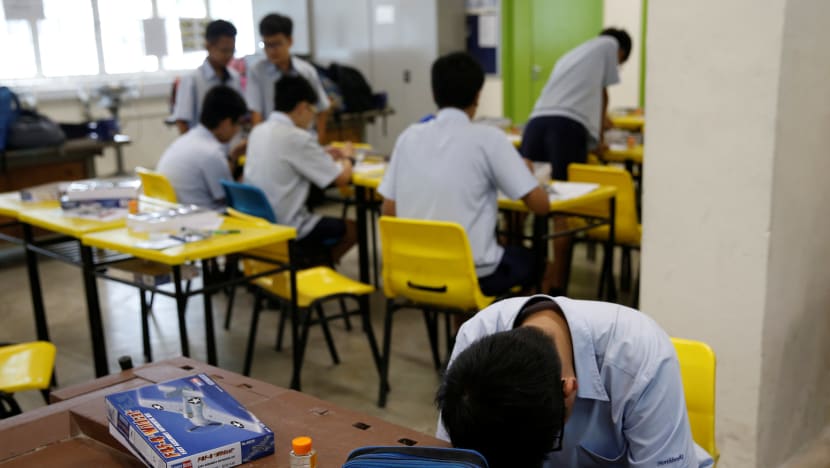
Reuters file photo
SINGAPORE — Despite the recent changes to the education system, examinations and several other education policies continue to serve as stress-points for students and their parents alike, said Members of Parliament (MPs) yesterday.
Nineteen MPs rose to speak on a wide range of issues, from obsession with grades to special-needs education, at the start of the Ministry of Education’s (MOE) Committee of Supply (COS) debate. Dr Intan Azura Mokhtar (Ang Mo Kio GRC), noting that streaming “tends to pigeon-hole students”, and causes undue worry and stress among parents, urged the ministry to “cull this sacred cow” by replacing streaming with subject-based banding.
On exam stress, Mr Lim Biow Chuan (Mountbatten) noted that it was not uncommon for schools to “deliberately set exams” with higher standards, leading to many students not doing well. “Why do such schools take away the joy of learning by imposing an unrealistic standard for the students?” he asked.
Mr Lim and Mr Edwin Tong (Marine Parade GRC) also touched on the Primary School Leaving Examination (PSLE), pointing to the lack of avenues for appeal that students have after the exams, when they fail to meet the cut-off point.





Urging the MOE to allow school principals and teachers some level of discretion in admitting students who may have missed the cut-off point by a small amount into their schools, Mr Lim said: “Please don’t send a wrong signal to the students that PSLE score is everything.”
Mr Tong suggested that there should be “some guidelines and parameters” so that the system will not be abused. “Trust our educators with the discretion to consider the merits of each admission appeal,” he said.
Several MPs also called for certain aspects of the Direct School Admission (DSA) scheme to be relooked.
Mr Tong noted that, currently, students who enter a school via the DSA through their achievements in sports or performing arts must stick with their chosen fields for the subsequent four to six years.
Noting that the co-curricular system cannot be “rigid and unbending”, Mr Tong said: “We have to remember that a child at 11 or 12 can have different interests and talents from when he or she is 16 or 17, and our system must be flexible enough to allow it.”
Ms Denise Phua (Jalan Besar GRC), in an impassioned speech on bringing special-needs education to a higher level, said her “biggest concern” lies with the “dearth of learning opportunities for adults with special needs”.
Noting that the number of continuing education and training courses customised for the special-needs workforce was “miserable”, she said: “Without continued training both in life and job skills, more and more will remain at home or will require external day care help — all of which are costly options to the families and to the State.”
Ms Phua also spoke of the need to help students with special needs gain employment after graduating from institutes of higher learning. While she noted that most institutes have support services for students, the link between these students and employers is “either non-existent or weak, making internships and eventual employment dicey and at risk of failing”.
Non-Constituency MP Leon Perera also spoke about the need to help special-needs students get around. He noted that voluntary welfare organisations had observed that it was not easy to engage school-bus operators to support special-needs schools, because of the need to deploy additional manpower or special equipment.
He thus expressed hope that measures, such as the provision of grants or subsidies, could be introduced to help make it more attractive to bus operators to offer their services.
The MOE’s COS debate will continue today, with Education Minister (Schools) Ng Chee Meng and other MOE political officeholders slated to address issues raised by the MPs.