More help for madrasahs to bolster secular education
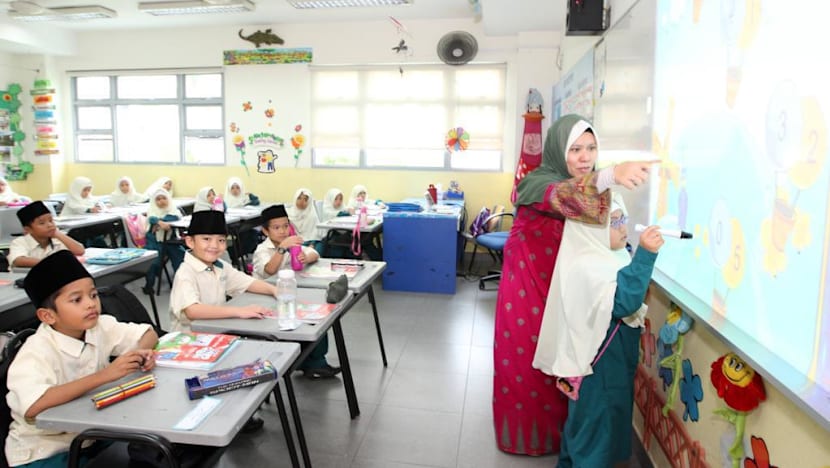
Photo: Lee Hsien Loong/Twitter
SINGAPORE — Madrasahs, or Muslim religious schools, will get financial support from the Government to upgrade their staff teaching secular subjects such as mathematics and science, while students who do well in these subjects will also receive fund awards, Prime Minister Lee Hsien Loong announced today (Aug 23).
While madrasah standards have improved, Mr Lee said, it is important that religious scholars and leaders have a good grounding in non-religious subjects so they can guide Singapore Muslims to live in a modern, technological society.
To that end, the Government will work with the Islamic Religious Council of Singapore (MUIS) to strengthen the teaching of secular subjects in madrasahs. There are six madrasahs in Singapore, with about 3,500 students enrolled.
Welcoming the news, Minister-in-charge of Muslim Affairs Yaacob Ibrahim said: “We want to be a part of the Singaporean family, and I think the madrasah is an important institution to the community ... it is part of the mainstream and, therefore, the graduates of the madrasah system must be able to operate in the mainstream ... having that proficiency in mainstream subjects is an important prerequisite.”





Mr Lee said Singapore madrasahs play an important role in nurturing religious scholars and teachers.
The Republic’s Malay-Muslim community needs religious leaders who have grown up in Singapore and understand its society, he added.
This lends them familiarity with the nation’s history and multi-religious context, and appreciation of “the importance of tolerance and give-and-take with other groups”, said Mr Lee. “This will help us achieve the Singapore-Muslim identity.”
Having such religious leaders has helped Singapore protect itself from the threat of violent extremism, said Mr Lee, citing the Religious Rehabilitation Group’s vital role in refuting wrong interpretations of Islam.
“The government will continue to work with and support the Malay-Muslim community in these efforts,” said Mr Lee.
The Prime Minister also thanked the community for taking a firm, united stand against violent extremism.
Mr Lee noted that the Malay-Muslim community has consistently built a culture of self-reliance over the years without losing the spirt of “gotong royong”, citing self-help institutions such as Mendaki and the Association of Muslim Professionals as examples.
On its part, the Government has strongly supported the progress of the community by providing resources, advice and leadership by Malay-Muslim ministers and Members of Parliament.
“The Malay community has also benefitted equally from national policies such as housing, education and healthcare,” said Mr Lee.
While the Government must be secular and neutral in a multi-religious society, he said, the Government understands the vital role of Islam in the community.
The support was behind the setting up of MUIS, the Mosque Building and Mendaki Fund and the Mosque Upgrading Programme, he added.
Mr Lee had recalled founding Prime Minister Lee Kuan Yew’s promise to all Singaporeans at the press conference on the Republic’s separation from Malaysia 50 years ago that opportunities in the country would be blind to language, culture and religion.
The late Mr Lee’s equal, egalitarian approach was on display at another press conference two days later, when he asked a Malay journalist to dispense with addressing him as “Tuan Perdana Menteri” (Malay for Prime Minister) and stick to “Saudara Lee” (Malay for Brother Lee).