More Opposition MPs will enable greater scrutiny of Bills, says WP
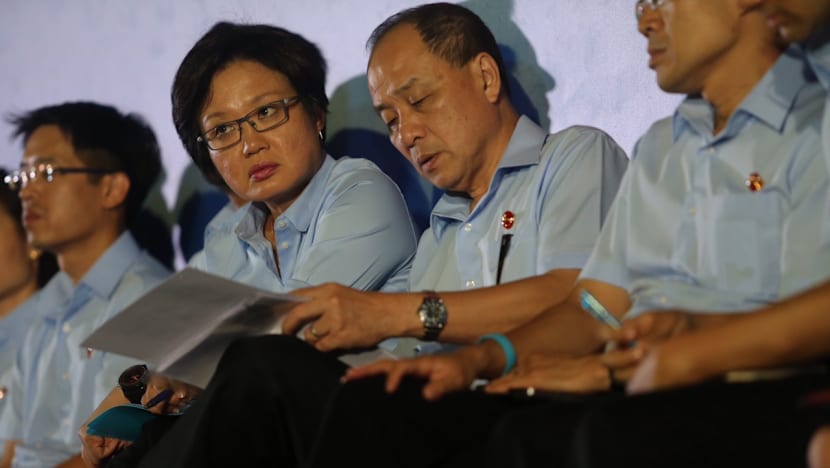
The Workers' Party's chairman Sylvia Lim (left) and secretary-general Low Thia Khiang. Photo: Don Wong/TODAY


SINGAPORE — It has been 11 years since any Parliamentary Bills underwent a third reading, where a select committee is set up to scrutinise specific clauses while taking into consideration the views of other Members of Parliament (MPs).
This was pointed out yesterday by Workers’ Party (WP) Aljunied Group Representation Constituency (GRC) candidate Pritam Singh, as he argued for the need to strengthen the oversight of Government and the scrutiny of Bills.
Noting eight new legislations were passed in the final sitting of Parliament last month before it was dissolved for the elections, Mr Singh explained why the WP MPs abstained from voting on the Human Biomedical Research Bill, which was one of the eight Bills that were passed.
Speaking at a WP rally in Marine Parade GRC, Mr Singh said human biomedical research can be potentially controversial due to the use of human cells and animal specimens. Yet, because of the “supermajority” of People’s Action Party (PAP) MPs in the House, the Bill was passed, said Mr Singh.





Without sending the Bill to a select committee, it meant that doctors and scientists were not called to Parliament to provide expert input, among other things, he said.
“Are MPs even suitably qualified to comment and debate on such highly technical Bills?” he said. “Parliamentary select committees are uniquely placed to give meaning to a rational, responsible and respectable realm of lawmaking in Singapore for the next 50 years. Unfortunately, we do not use Parliament as often as we should to fully understand and debate policies.”
Mr Singh also cited the Remote Gambling Act, which contained a provision for exempt operators. More could have been done to scrutinise whether there are proper safeguards in place, he said.
During the parliamentary debate in October last year, Mr Singh, along with WP colleagues Png Eng Huat and Yee Jenn Jong, had asked that the Bill be committed to a Select Committee to look into the provision for an exempt operator.
Last night, Mr Singh added: “There is a lot more scope for Parliament to function like how it does in mature economies in so far as its oversight role is concerned.”
He also highlighted the fact that no Opposition MP was appointed on the Parliament’s public accounts committee to oversee the Government budget and how taxpayers’ monies are being spent. For other committees such as the Committee of Privileges, which looks into complaints of alleged breaches of parliamentary privileges, there was Opposition presence.
Mr Singh lamented that the media did not pick up on this, but he said: “It’s not the media’s fault ... because they are also the result of a one-party dominance state that has governed us for the last 50 years. And that is why it is so important for us to empower our future by increasing the strength of the parliamentary Opposition.”
In 2004, provisions in the Building Maintenance and Management Bill that allow for prosecution of owners of condominiums and other strata-titled units for falling windows and other fixtures were forwarded to a select committee, along with other recommended provisions in the Bill. The proposed amendments would affect some 170,000 households and 2,700 management councils here at that time.