More Opposition voices in Parliament crucial to S’pore’s development: Low
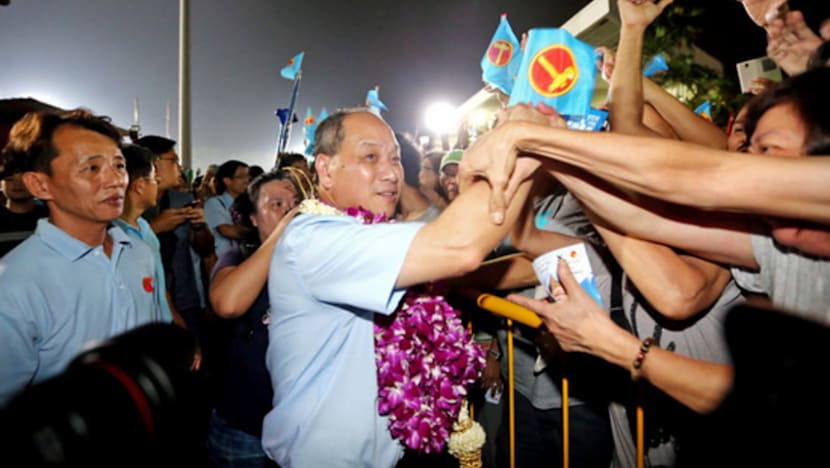
WP chief Low Thia Khiang with supporters at the end of the rally at Bedok Stadium yesterday. Mr Low said Parliament must be representative of different strata of society so people can be confident of building and showcasing their own strengths and talents. Photo: Ooi Boon Keong


SINGAPORE — The journey towards a more balanced Parliament has just begun and it is crucial to Singapore’s development over the next 50 years that voters send more Opposition members into the House, said Workers’ Party chief Low Thia Khiang.
Holding the party’s eighth and final rally in East Coast Group Representation Constituency last night, Mr Low said voters took a big step in the last General Election towards his party’s vision of a “First World Parliament”, where there are more checks and balances in the House. He added that after the People’s Action Party lost a multi-seat constituency for the first time in 2011, it changed policies to better address the electorate’s concerns.
Saying he is “heartened” to see policy U-turns in areas such as housing and healthcare, Mr Low said: “This is only a start ... we still have to press the Government to strengthen some of the policies and review Singapore’s direction over the next 50 years.”
Mr Low added that the WP hopes a more balanced Parliament will lead to a fair and just society, which will allow future generations of Singaporeans to enjoy continued prosperity.





“Parliament must be representative of different strata of the society, different organisations and different values systems, so that people can be confident of building and showcasing their own strengths and talents,” he said in Mandarin.
Mr Low also traced his own political journey over the last 30 years to highlight his efforts to build up the WP into what it is today, and urged voters to give his slate of candidates a chance to further entrench the Opposition in Parliament.
In arguing against a return to the days of one-party rule, Mr Low cited the shutting down of Nanyang University in 1980 as an example of the “threat of an over-powerful Government”. As a Chinese language teacher then, he tried various avenues to air people’s concerns about the move to no avail, he said.
He added that after he was elected as Member of Parliament (MP) for Hougang in 1991, he spent 20 years debating the Government’s policies and raising his own suggestions, but his efforts did not cause the Government to sit up and listen. Mr Low said this led him to the conclusion that a sole voice in Parliament would not bring about policy changes.
He also accused the PAP, with the government machinery behind it, of trying to oust other political parties from the political scene in the last 50 years. “Only with competition in the political landscape will the Government take into account people’s concerns and make policy changes,” added Mr Low.
Mr Low also took time to introduce all the WP candidates taking part in the election, apart from the incumbent MPs seeking re-election. In particular, he made a pitch for his line-up in the East Coast and Fengshan constituencies — Mr Gerald Giam, Mr Leon Perera, Mr Mohamed Fairoz Shariff, Associate Professor Daniel Goh and Mr Dennis Tan.
These candidates have expertise and experience in different fields and are also among the main players behind the WP’s manifesto for this election, he said.
“It is pressurising to take part in parliamentary proceedings as the WP MPs are not just facing PAP MPs but ministers as well. These ministers have the entire civil service behind them to help them with research, as well as the PAP MPs, to rebut opposing views,” said Mr Low. “If (the WP candidates) are elected, they will be able to strengthen the WP’s ability to debate in Parliament.”
WP East Coast GRC team leader Gerald Giam also declared that East Coast and Fengshan were “at the frontline” of a historic election, at a time when Singapore is at a “tipping point” in terms of its political development.