New rules offer more protection for private school students
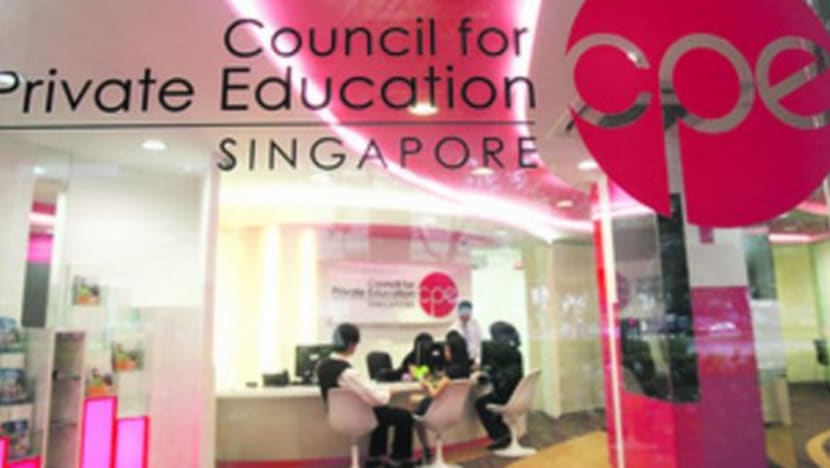


SINGAPORE — Students pursuing external degree programmes with private schools will get more financial protection and a clearer picture of employment prospects, after more stringent measures were rolled out for the sector on Friday (Oct 21).
The guidelines issued by the Committee for Private Education (CPE) include requiring private degree schools to set minimum entry requirements for students and having a minimum paid-up capital.
The CPE and Ministry of Education had earlier signalled that they were planning to roll out tougher rules to improve the quality of private education as well as employment outcomes, in the light of a survey which showed that private university graduates were unable to find jobs as quickly as those from autonomous universities. Only 58 per cent of the fresh graduates found full-time jobs within six months of completing their studies.
Another 21 per cent managed to find only part-time or contract work. This is well below the 83 per cent full-time job rate for the graduates from the National University of Singapore, Nanyang Technological University and Singapore Management University.





Tighter rules previously introduced for the sector have seen the number of private schools whittled down to just 291, compared to about 1,000 six years ago, but reports of sudden closures have continued, such as M2 Academy, which closed down last October after a year of operations, forcing students to seek last-minute placements at other schools.
Under the new guidelines, all private degree schools will have to participate in CPE’s annual graduate employment survey. The results will be published on CPE’s website.
Private schools offering degree programmes or programmes that lead on to an external degree will also have to set appropriate minimum academic entry requirements for fresh school leavers. With such benchmarks “explicitly” set, prospective students would be clearer about the pre-requisites for such courses, CPE said.
While the schools will have the flexibility to admit mature students who fail to meet the academic requirements but have relevant work experience, they will have to seek CPE’s approval for their criteria.
To ensure that these schools have the financial capability to operate, all new institutions must have a minimum of paid-up capital of S$100,000 with immediate effect. Existing schools have till June 1 next year to meet the minimum credit rating.
The EduTrust certification, currently a voluntary quality assurance scheme, will also be made mandatory for all private schools offering degrees. Currently, 110 private schools are on the scheme, but this will be enhanced by January next year.
Stressing that existing private school students would not be affected by the changes, CPE said it would “continue to review its safeguard in the interests of students”.
Mr Brandon Lee, director-general (private education) of SkillsFuture Singapore, said that institutions need to have sound foundations to operate and deliver quality training.
He added: “We also wish to remind students of the need to exercise due diligence by researching and assessing the suitability of the various education pathways available. We also hope that the enhanced information transparency will be useful in helping students make more informed decisions.”
Management Development Institute of Singapore (MDIS) secretary-general R Theyvendran said its latest graduate survey showed that an average of 75.4 per cent of the school’s graduates found employment within six months of graduation, up from 68 per cent last year. On the whole, the measures will “raise the bar” for the sector, he said. For students, this means “better informed choices”, protection of their course fees, and an assurance that “their choice will provide them with a recognised qualification and a strong foundation for success in the workplace”, he added.
A spokesman for SIM Global Education said the school — which was among nine private education institutions which participated in CPE’s pilot graduate employment survey — has been conducting its own graduate employment survey since 2012.
He added that the school “welcomes the CPE’s measures which will weed out sub-standard private education institutions and further enhance the standard and image of private education”. “These will ultimately help students make better choices and reap better outcomes from their education,” the spokesman said.