New study to gauge university outcomes proposed
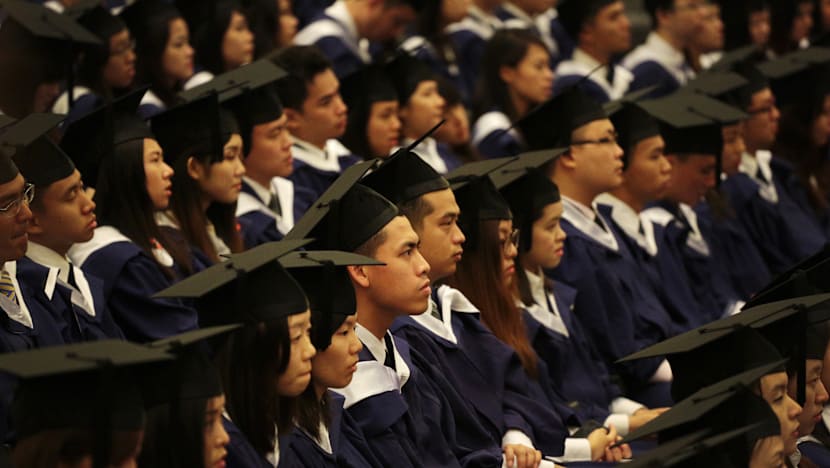
NUS Business School graduates at their commencement ceremony. TODAY file photo
SINGAPORE — Amid growing concern on how to choose the right university and an education landscape awash in a plethora of university rankings, the Organisation for Economic Cooperation and Development (OECD) wants to embark on a project to get universities across the world to take part in a new benchmarking study.
Revealing this today (Oct 14) at a conference on higher education co-organised by the OECD and the Ministry of Education (MOE), OECD deputy secretary-general Stefan Kapferer noted that more parents are questioning the prospects and employability of their children after university.
“At the moment, we have a situation that is very hard for parents to understand which universities, which learning outcomes may be the right decision for the young student … We have to establish a system (on) how we can deliver more comparable results of learning outcomes of institutions of higher education all over the world,” said Mr Kapferer.
Existing global rankings such as the Times Higher Education World University Rankings or QS World University Rankings are based on factors such as papers published in research journals, for example, which may not be the most important aspects for young students, especially since only a few would go on to a career in research, he said.





The OECD plans to measure indicators such as employability of graduates, in an exercise similar to OECD’s well-regarded Programme for International Student Assessment (PISA) that ranks countries on numeracy and literacy skills of 15-year-olds.
The OECD had tried to embark on a similar exercise in 2010 to look at university’s outcomes, but there were too few participating countries. Mr Kapferer anticipated some resistance with this latest project as it is costly. Only five or six countries have indicated interest so far, but the OECD would need a broad base of results to make “evidence-based” policy recommendations to improve universities’ learning outcomes. The project will be discussed further with the OECD’s education policy committee in November.
In response to queries, the MOE said it is open to learning more about the objectives, scope and methodology of OECD’s benchmarking study.
Professor Cheong Hee Kiat, president of SIM University, among the local universities contacted, said the institute would be keen to join the study. Other indicators the study could consider are graduates’ continuous learning or contributions to society as citizens, he suggested.
Professor Tan Eng Chye, deputy president (academic affairs) and provost at the National University of Singapore (NUS), said the university welcomed the study and looked forward to gathering insights from it.
Professor Thomas Magnanti, president of Singapore University of Technology and Design (SUTD), said being a fairly new university, SUTD would need time to build up data required for the exercise.
Speaking at a separate session at the conference, Professor Frans van Vught, high-level policy adviser to the European Commission, echoed Mr Kapferer’s concerns about existing university rankings. Prof Van Vught, who is part of a team behind a ranking tool called U-Multirank, described other rankings as biased towards research-intensive and comprehensive universities, particularly in the sciences and medical fields.
Higher education systems also have what he called an “information gap”, where students can only choose where to enrol based on information provided by higher education institutions or proximate indicators such as reputations. ADDITIONAL REPORTING BY NG JING YNG