NKF’s jobs programme helps kidney patient find ‘sense of purpose’
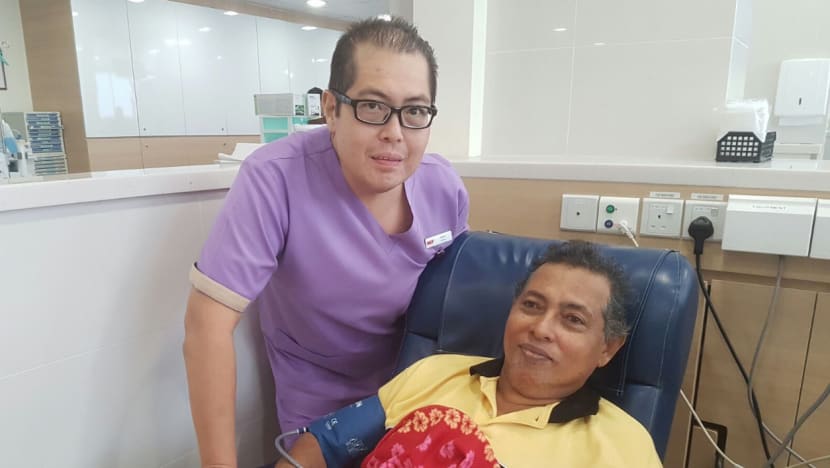
Mr Shahrin Sa'ban (left), 39, one of the 61 dialysis patients employed by NKF under the Patient Rehabilitation Programme, works as an NKF patients relations officer three times a week. Photo: Iliyas Juanda/TODAY
SINGAPORE — Suffering from a genetic disease which caused his kidneys to fail when he was 23, it was difficult for Mr Shahrin Sa’ban to hold down a full-time job, due to the dialysis treatments that he has three times a week.
The feeling of lethargy and nausea after treatment further impeded his ability to work. Without a job to give him a sense of purpose, he felt “half-dead”.
Then in March, the 39-year-old began working as a patient relations officer three times a week at one of the National Kidney Foundation (NKF) Dialysis Centre at Jurong West, as part of NKF’s Patient Employment Rehabilitation Programme.
Launched last November, the programme aims to help patients find suitable employment within NKF or with other employers to integrate back into society.





Currently, 61 patients are employed by the NKF under the programme in positions such as patient relations officers, exercise assistants and administration assistants.
The foundation is also working with other companies, such as small- and medium-sized enterprises in the security and cleaning sector, to place them in jobs there.
As a patient relations officer, Mr Shahrin helps out in the centre by interacting with the patients and tending to their needs, such as getting drinks, adjusting the temperature or chatting with them during their scheduled dialysis treatments.
Mr Shahrin works eight-hour shifts three times a week, earning about S$7 an hour. Being a patient himself, it is easier for the patients to open up to him regarding their problems, be it physical or social, he said.
Without a job, Mr Shahrin said he was easily agitated, something other patients felt as well, and working made him feel “more alive”. “Because when you are stuck at home (with no job), it’s like you’re almost half dead. You need to mix around with people or your soul will not be there. It’s a therapy, it gives us more life, and more hope of living,” he added.
Indeed, when he was diagnosed with the disease 16 years ago, he felt it was a “death sentence”.
“I was a pessimistic person thinking I could die anytime,” he said. He continued to work as an auditor for eight years before resigning as he needed more flexible hours for his dialysis treatments.
His next job as a taxi driver led him to cross paths with a passenger who was a dialysis patient himself. The man, who was in his sixties and had gone through dialysis for more than 30 years, advised him to take good care of himself, and to not give up if he wanted to live normally.
This cheered him up, but staying employed remained a challenge for the bachelor, who lives with his semi-retired parents.
“A common thing among employers is that when they find out you have (to go for) dialysis, their attitude towards you will be not as receptive. I understand why they think so but we can still do something,” he said.
With NKF leading the programme, Mr Shahrin hopes it will pave the way for companies and employers to follow suit and be more receptive to hiring dialysis patients.
An NKF spokesperson said: “It’s not just about getting money but also a sense of being able to integrate into society and having interaction with people, which is helpful for their emotions.”